
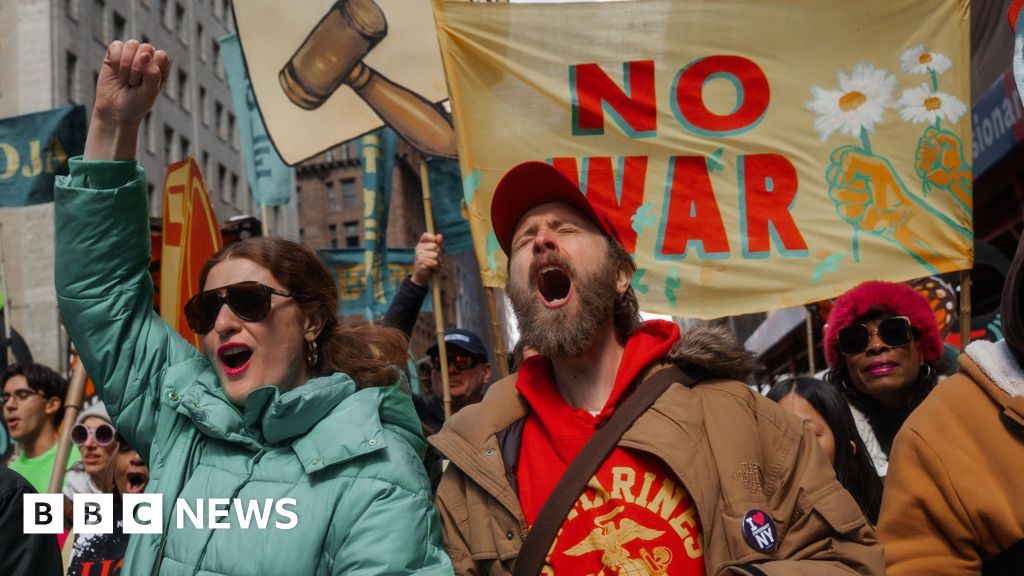
On Saturday, large-scale protests erupted in cities across the United States, marking the third wave of the No Kings rallies, a series of demonstrations opposing policies enacted under President Donald Trump's administration. Organizers estimated that more than eight million people participated nationwide, making it the largest iteration of the protests to date. Demonstrators rallied against a variety of issues, including the potential for war with Iran, aggressive immigration enforcement, and the escalating cost of living.
The No Kings movement, which derives its name from opposition to perceived authoritarian efforts by the Trump administration, emphasizes that the American people hold power-not a "wannabe king" or his wealthy allies. "Trump wants to rule over us as a tyrant. But this is America, and power belongs to the people-not to wannabe kings or their billionaire cronies," the event organizers declared. However, the White House dismissed the demonstrations as "Trump Derangement Therapy Sessions," claiming that only reporters paid to cover the protests cared about them. The BBC could not independently verify the organizers' attendance figures, which have previously been reported in the millions for prior No Kings protests.
On Saturday, protests were held in nearly every major U.S. city, with crowds also gathering in smaller towns and even abroad in cities such as Paris and London. In Washington, D.C., protesters took over the streets of downtown, marching through the nation's capital throughout the afternoon. Large groups lined the steps of the Lincoln Memorial and packed the National Mall. Echoing previous No Kings events, demonstrators carried effigies of President Trump, Vice President JD Vance, and other administration officials, calling for their removal and arrest.
One of the most prominent protests took place in Minnesota, a state still grappling with the aftermath of a tragic incident earlier in the year. In January, two American citizens, Renee Nicole Good and Alex Pretti, were killed by federal immigration agents, sparking outrage and nationwide demonstrations against the administration's immigration policies. Thousands gathered in St. Paul, the state capital, holding signs and listening to speeches from high-profile Democrats. Among them was Bruce Springsteen, who performed his song "Streets of Minneapolis," which critiques immigration enforcement practices.
New York City also saw a massive turnout, with thousands crowding Times Square and marching through Midtown Manhattan. Police had to close off several busy streets to accommodate the protestors. Actor and director Robert De Niro, who attended the New York protest, spoke to the BBC's Tom Brook about the importance of standing up against the president. De Niro expressed his concern that President Trump's actions were escalating tensions dangerously: "I think more people are starting to see that with this guy, it gets worse and worse and worse every day," he said. "Now we're in a war. The next thing is, what he'll do is put troops on the ground. He's crazy." He urged peaceful but firm resistance, emphasizing the need to fight back against what he described as an authoritarian regime.
The animosity between Trump and De Niro has been public and intense. Just the previous month, Trump had labeled the actor "a sick and demented person" with "an extremely Low IQ," accusing him of saying things that were "seriously CRIMINAL" on the social media platform Truth Social.
The No Kings protests have drawn large numbers in the past as well. In October, the New York Police Department reported that over 100,000 people had gathered across the city's five boroughs for the rallies. While most protests have been peaceful, some incidents occurred during Saturday's demonstrations. In Los Angeles, two individuals were arrested for assaulting federal law enforcement officers, according to the Department of Homeland Security (DHS). The DHS reported that a group of approximately 1,000 protesters surrounded the Roybal Federal Building, throwing objects including cement blocks at agents, injuring two officers who were receiving medical care.
Elsewhere in Los Angeles, the local police department made multiple arrests after protesters refused to disperse near a federal prison. Authorities used "non-lethal measures" to clear the area following warnings against attempts to tear down gates or throw items. Similar disturbances occurred in Dallas, where scuffles broke out after counter-protesters blocked streets and disrupted the No Kings march, leading to additional arrests.
American expatriates also joined the movement abroad, holding protests in cities such as Paris, London, and Lisbon. The scale of Saturday's protests, with an estimated total crowd of over eight million, surpassed the previous No Kings rally in October, which drew nearly seven million participants according to estimates.
In response to the protests, several U.S. states activated the National Guard to maintain order, though organizers insisted that the events remained peaceful overall.
Since returning to the White House in January 2025, President Trump has expanded the reach of executive power. He has issued numerous executive orders aimed at dismantling components of the federal government and has deployed National Guard troops to various U.S. cities despite objections from state governors. Additionally, Trump has urged top law enforcement officials within his administration to prosecute individuals he considers political adversaries.
The president defends these actions as necessary steps to restore a country he believes is in crisis. He has repeatedly dismissed accusations that he is behaving like a dictator as exaggerated or hysterical. In an October interview with Fox News, Trump stated, "They're referring to me as a king. I'm not a king."
However, critics warn that some of Trump's moves may be unconstitutional and pose a serious threat to American democracy. They argue that his aggressive use of executive power, military deployments within the country, and targeting of political opponents undermine the principles of checks and balances that are foundational to the U.S. system of government.
The No Kings protests reflect widespread concern among many Americans about the direction of the country under Trump's leadership. The massive turnout across the nation and abroad demonstrates a broad and growing resistance to his policies and approach to governance. As the Trump administration continues to push forward with its agenda, the conflict between the president and his detractors shows little sign of abating, highlighting a deeply polarized political climate in the United States.