
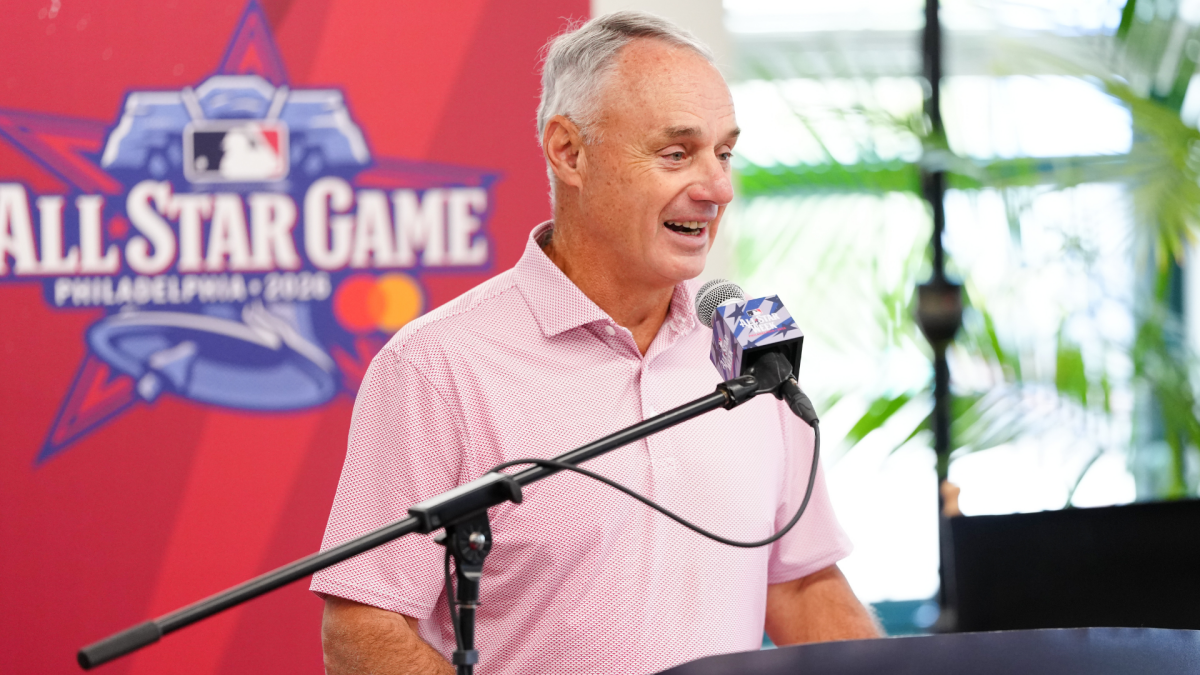
Major League Baseball (MLB) commissioner Rob Manfred addressed the media on Tuesday before the All-Star Game, discussing a range of topics including the ongoing and complex negotiations with the players' union over a new collective bargaining agreement (CBA). At the heart of these negotiations lies a contentious issue: the owners' push to implement a salary cap for the league.
Currently, MLB is unique among North America's major professional sports leagues as it has no salary cap. The owners are advocating for a cap, which they argue would improve competitive balance across teams. Publicly, the league frames the salary cap as a tool to level the playing field, ensuring that smaller-market teams can better compete with wealthier franchises. However, critics suggest that the true motivation behind the owners' push is financial: a salary cap could suppress player salaries while simultaneously increasing franchise values.
Manfred reiterated the call for a salary cap during his press conference, emphasizing the league's stance that it would benefit the sport's competitive landscape. This advocacy comes at an interesting time for baseball, as the league is currently experiencing a resurgence in popularity. Attendance figures are on track to reach their highest levels since 2017, television ratings remain robust, and the recent Home Run Derby captivated fans with its excitement. Additionally, league revenues are expected to rise again this year, buoyed by the anticipation of a new and more lucrative set of national broadcast contracts slated for 2028.
Moreover, many of Manfred's recent on-field changes, such as the introduction of a pitch clock and the new Automated Ball-Strike (ABS) challenge system, have been well-received and have achieved their intended goals of speeding up the game and enhancing the fan experience. Given these positive indicators, the push for a salary cap appears somewhat contradictory, as it requires the league to spotlight issues-such as competitive imbalance-that may not be as severe or widespread as suggested.
This approach can be likened to the "anti-marketing" campaigns from the early 1990s under former commissioner Bud Selig. Back then, the league often highlighted its own shortcomings, focusing on problems within the sport as a way to rally support for changes. Similarly, Manfred and the owners are underscoring competitive balance concerns, although many analysts argue that such issues would be better addressed through adjustments to the local revenue-sharing system rather than through a salary cap. It is worth noting that revenue sharing is also a topic currently under negotiation with the players' union.
Speaking to reporters, Manfred acknowledged the positive momentum in baseball, stating, "Momentum in the game is a great thing. We got that momentum by listening to fans.... The best way to lose momentum is to stand still." This remark underscores the league's desire to continue evolving and responding to fan feedback.
Regarding fan sentiment, Manfred and league officials have repeatedly suggested that fans themselves want a salary cap on team payrolls. This assertion is based on data from a November 2025 Morning Consult poll involving 2,202 respondents. The poll showed that 28% of all respondents strongly supported a cap, while 31% somewhat supported it. Among those who identified as avid MLB fans, support was even stronger, with 50% strongly supporting and 29% somewhat supporting a salary cap in baseball.
Despite this apparent fan backing, the real challenge lies in convincing the players' union to accept such a significant and unprecedented concession. Before pushing the salary cap as the centerpiece of negotiations, Manfred had to build consensus among the owners, a group historically divided along market-size lines. Larger-market teams such as the Los Angeles Dodgers, New York Yankees, and New York Mets stand to lose substantial revenue under proposals to equalize local revenue sharing. Yet, Manfred claims that he has successfully united the ownership group behind the idea of more equal revenue sharing, a unification that he says hinges on securing a salary cap.
"I think that I have an ownership group that is more united than any group in my entire time of baseball," Manfred said on Tuesday. "They are a group that believes in what I am arguing for." Observers note, however, that owners, who ultimately direct Manfred's agenda, have a vested interest in promoting the salary cap plan.
On the players' side, MLB Players Association (MLBPA) interim head Bruce Meyer also spoke to the press prior to the All-Star Game. Meyer sharply criticized the owners' position and messaging, stating, "The supposed stewards of the game have spent an inordinate amount of time trying to convince those same fans that they don't have hope or they shouldn't have hope or that the product that they're paying to consume in record numbers is somehow broken." Meyer's comments highlight the deep tensions and adversarial nature of the current CBA talks. He called the owners' approach "perverse," reflecting the union's frustration with the league's narrative.
Public statements from both sides remain firmly entrenched, with little indication of compromise. While public remarks are often strategic and may not fully reveal the state of behind-the-scenes discussions, the prevailing consensus is that the two sides remain far apart on key issues, including the salary cap and revenue sharing.
This impasse has raised widespread expectations that the owners, led by Manfred, will impose a lockout once the current CBA expires on December 1. A lockout would halt all player activities and could lead to a labor stoppage, putting the 2027 MLB season at serious risk.
The history of recent labor disputes adds gravity to this threat. During the negotiations for the 2022-26 CBA, owners locked out players for 99 days. This lockout delayed and shortened spring training, compressed the regular season schedule, and brought the league close to losing games. Though MLB has not lost games to labor strife since the devastating 1994-95 strike, that earlier stoppage, which also involved a push for a salary cap, resulted in the cancellation of the World Series and left a lasting scar on the sport.
As such, there is a real possibility that games could be lost again if a lockout occurs in 2027. Beyond the immediate impact on the season, there is also a reputational risk for Manfred, who is currently serving what is expected to be his final term as commissioner. Manfred is slated to step down in January 2029, and presiding over a shortened or canceled season could tarnish his legacy. Despite the progress made under his leadership with innovations and changes to improve the game on the field, a labor dispute would overshadow much of that work.
For now, baseball will continue to celebrate its annual Midsummer Classic, with Tuesday night's All-Star Game serving as a highlight of the season. The second half of the year will follow, featuring the trade deadline, the stretch run to the playoffs, and ultimately the postseason and the crowning of a champion.
However, once the season concludes, the focus will shift to the off-season, which promises to be the most fraught and potentially damaging period for MLB in decades. The negotiations will intensify, and all stakeholders will be watching closely. Among them, commissioner Rob Manfred stands to gain or lose the most, as the future of baseball and his own legacy hang in the balance.