
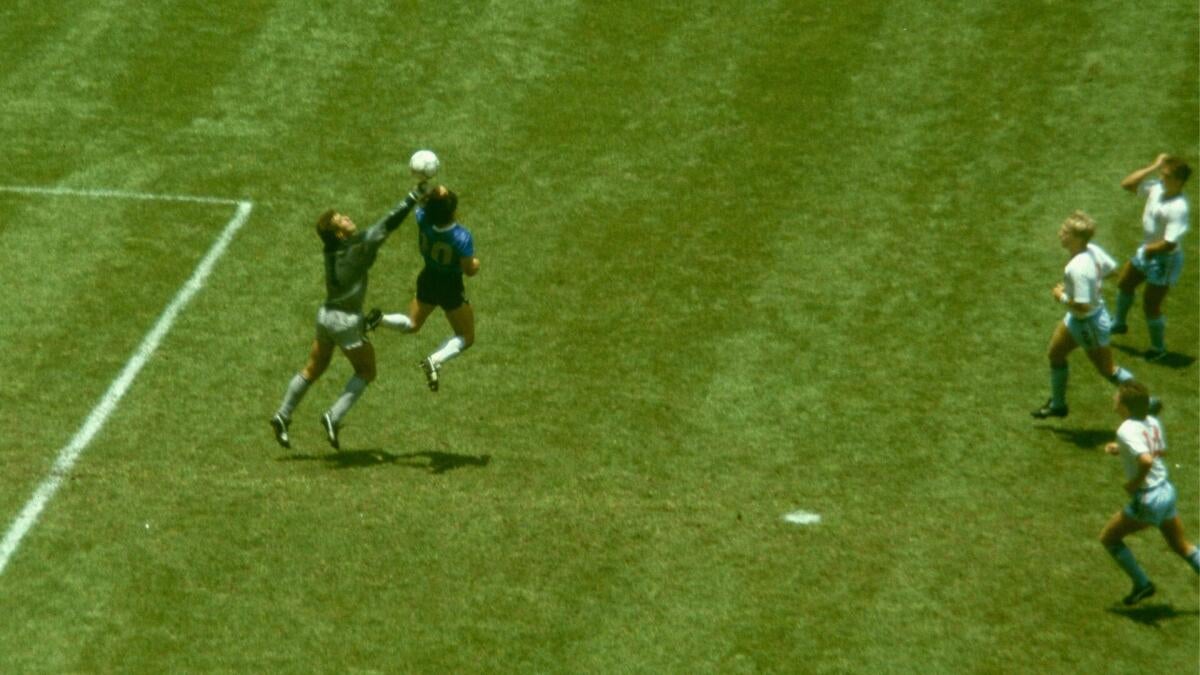
The 2026 World Cup semifinal between England and Argentina is more than just a high-stakes soccer match; it is the latest chapter in a deeply emotional and historically charged rivalry. This rivalry has produced some of the sport's most memorable moments, none more iconic than the 1986 World Cup quarterfinal in Mexico City. That match gave the world the unforgettable "Hand of God" goal and the "Goal of the Century," both scored by Diego Armando Maradona, arguably the greatest player in soccer history. Yet, the story between these two nations extends far beyond the football pitch, rooted in a complex and painful history that continues to influence their encounters today.
Diego Maradona himself encapsulated the intense emotions tied to this rivalry and the broader historical context when he refused to meet Prince Charles during a visit, as documented in Emir Kusturica's 2008 film *Maradona by Kusturica*. Maradona's words were blunt and revealing: "One day they wanted to introduce me to Prince Charles. I said no. I would never shake a hand with so much blood in it. Never." This statement highlights how deeply history shapes the way Argentinians like Maradona view their relationship with England, a view that cannot be separated from the political and military conflicts between the two countries.
To understand why the England-Argentina matches carry such emotional weight, it is necessary to look back over a century, particularly at events surrounding the Falkland Islands, known in Argentina as the Islas Malvinas. These islands lie about 300 miles off Argentina's Atlantic coast and have been a point of contention since colonial times. In the 17th and 18th centuries, control of the islands passed among France, Spain, and Britain.
Britain established a settlement there in 1765 and maintained control for years, but Argentina, which declared independence from Spain in 1816, also claimed the islands. The situation escalated in 1833 when British naval forces expelled Argentine authorities from the islands, and Britain has controlled the Falklands ever since. Argentina has always considered this takeover illegal, and the dispute simmered largely as a diplomatic issue for much of the following century.
However, tensions exploded into armed conflict in 1982. That year, Argentina's military dictatorship, struggling with internal problems and seeking to rally nationalistic support, invaded the Falkland Islands. The British government, led by Prime Minister Margaret Thatcher, responded by sending a naval task force to reclaim the territory. This brief but intense war lasted 74 days and involved combat on land, sea, and air. It ended with the surrender of Argentine forces on June 14, 1982. The human cost was significant, with approximately 649 Argentine and 255 British military personnel losing their lives.
The defeat in the Falklands War had profound consequences for Argentina. The military junta, which had ruled since 1976 and was responsible for the notorious "Dirty War"-a campaign of state terrorism involving the disappearance, torture, and murder of thousands of suspected dissidents-collapsed soon after the conflict. The regime's brutal actions, including the deaths and disappearances of thousands known as *Los Desaparecidos*, left a lasting scar on Argentine society. The military relinquished power in 1983, and Argentina returned to democracy. Yet, the Falklands/Malvinas issue remained unresolved and continued to fuel national sentiment.
Even decades later, the sovereignty of the islands remains a sensitive topic. Just days before the 2026 World Cup semifinal, Argentina reiterated its claim over the Falklands despite a 2013 referendum where the islanders voted overwhelmingly to remain a British overseas territory. Argentina rejects the legitimacy of that referendum, maintaining that the islands are rightfully theirs. This political backdrop amplifies the significance of any sporting encounter between the two nations.
The 1986 World Cup quarterfinal match between Argentina and England, played at Mexico City's Azteca Stadium, remains one of the most famous and emotionally charged games in soccer history. Maradona was the central figure in a match that many consider among the best ever played. In a span of four minutes, he changed the course of the game and etched his name into football lore. His first goal was the infamous "Hand of God": Maradona punched the ball into the net with his left hand, an illegal move unnoticed by the referee. After the match, he famously said, "How did I score? A little with the head of Maradona and a little with the hand of God." For many Argentinians, that goal symbolized a form of sporting revenge for the humiliation suffered in the Falklands War.
Shortly after, Maradona scored again, this time with a remarkable solo effort now known as the "Goal of the Century." He dribbled 60 meters past multiple English defenders before scoring. The goal was so extraordinary that the Uruguayan commentator Victor Hugo Morales's emotional call remains one of the most celebrated commentaries in World Cup history: "Cosmic kite, what planet did you come from, to leave so many Englishmen behind, for the country to be a clenched fist crying for Argentina? Argentina 2, England 0! Diegoal, Diegoal, Diego Armando Maradona! Thank you, God, for football, for Maradona, for these tears." Argentina went on to win the match 2-1 and eventually secured their second World Cup title, largely thanks to Maradona's brilliance.
The cultural impact of that match has endured. Argentine singer Rodrigo Bueno wrote the song "La Mano de Dios," widely regarded as the greatest tribute to a football player, inspired by Maradona's legendary goal. Maradona himself sang the song in Kusturica's documentary during a poignant scene, underscoring how deeply the sporting moment was intertwined with Argentine identity and pride.
Interestingly, the England-Argentina rivalry has influenced the sport in other ways as well. The introduction of yellow and red cards in soccer was partly prompted by a controversial incident involving Argentina and England in the 1966 World Cup quarterfinals. Argentine captain Antonio Rattin was sent off by German referee Rudolf Kreitlein for a second offense, but at that time, no cards were shown-only verbal warnings were issued. Rattin, who spoke neither English nor German, did not understand the decision and refused to leave the pitch for nearly ten minutes. This confusing situation led FIFA's referee committee leader Ken Aston to introduce the card system to make disciplinary decisions clearer, starting with the 1970 World Cup.
The rivalry has also featured moments involving more recent players. In the 1998 World Cup round of 16, England's David Beckham was sent off after fouling Argentina's Diego Simeone, leaving England with ten men and helping Argentina win the match on penalties. Beckham faced heavy criticism in England for the incident. However, four years later at the 2002 World Cup, Beckham redeemed himself by scoring the only goal in England's 1-0 group stage victory over Argentina, helping England advance and transforming his reputation in the national team.
Despite the passion and history behind the England-Argentina rivalry, Argentina's current head coach Lionel Scaloni has sought to downplay the political and historical tensions ahead of the 2026 semifinal. Speaking to the media, Scaloni described the upcoming match as "just a football match," emphasizing respect for England's team and coach. Nonetheless, the sentiment among Argentine fans remains deeply connected to history. During the World Cup, fans sang a chant that referenced both the Malvinas and Maradona, ending with the words: "For the Malvinas, for Diego, for Leo's last World Cup. Argentina, I want to see you win it again."
This chant reveals the enduring connections between sport, national identity, and history. The England-Argentina soccer rivalry cannot be separated from the political and emotional backdrop of their shared past. It is about more than just the game on the field; it is a reflection of national pride, historical grievances, and the complex relationship between two countries whose histories are intertwined through conflict, culture, and football. The 2026 World Cup semifinal promises to be another unforgettable chapter in this storied rivalry, where the stakes transcend the beautiful game itself.