
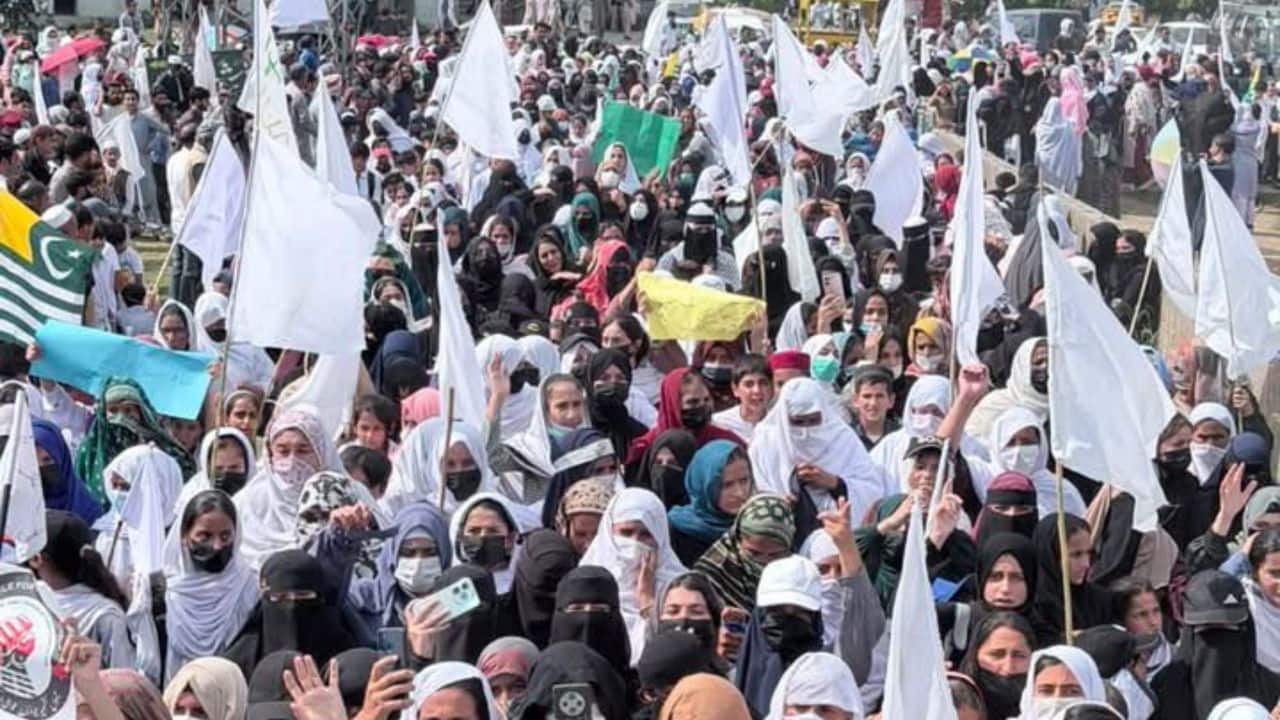
Protests in Pakistan-occupied Kashmir (PoK) have intensified in recent weeks, with a broad cross-section of society-including students, teachers, and families-joining rallies despite stern warnings from Pakistani authorities. These demonstrations are fueled by widespread frustration over rising prices, cuts to subsidies, heightened security restrictions, and longstanding political grievances. The unrest has reached a critical juncture as the banned Joint Awami Action Committee (JAAC), a coalition of political and social groups, has announced plans for a Long March to Muzaffarabad, the regional capital, scheduled for July 15.
On Tuesday, hundreds of schoolchildren gathered alongside their teachers and parents at Rawalakot's Eidgah Ground, a prominent public space in PoK. The protesters carried white flags and held banners demanding international media coverage of their plight. Their slogans included "Yeh jo deshatgardi hai, iske peeche wardi hai!" which translates to "Behind this terrorism is the uniform," a direct accusation against the Pakistani military's role in the region. The demonstration underscored the growing discontent with the military's actions and the broader political situation.
The protest occurred despite a clear warning from Pakistani authorities issued the day before. Officials cautioned that the banned Joint Awami Action Committee would face legal consequences if students participated in protests or if any untoward incidents took place. Nevertheless, students and other protesters turned out in large numbers, signaling their determination to voice their grievances regardless of official threats.
The current wave of protests is part of a broader movement that has been building over several months. It reflects widespread anger not only over economic hardships such as inflation and subsidy removals but also over political demands and security measures imposed by Pakistani forces. Local groups and activists have accused the Pakistani military and security forces of using excessive force against civilians, leading to deaths and injuries. Reports from the ground indicate that several civilians have been killed or wounded during clashes with security personnel.
Tensions escalated further after the Pakistani government banned the Joint Awami Action Committee on June 5. In response, JAAC called for a mass Long March to Muzaffarabad on July 15, urging people from across the region to participate in what is expected to be a significant show of public dissent. The government's crackdown has included restrictions on communication, with limits placed on mobile services, road movements, and public gatherings in several areas. These measures have been criticized by protest groups as attempts to suppress dissent and isolate the region.
The unrest has also attracted attention from overseas groups concerned with the human rights situation in PoK. The United Kashmir People's National Party (UKPNP), a diaspora organization, convened an emergency meeting involving community leaders, journalists, and civil society members. Participants discussed the ongoing human rights abuses, the siege imposed by security forces, and the brutal crackdown on peaceful civilians. The UKPNP issued several demands, including an end to enforced disappearances and arbitrary arrests, the return of bodies of civilians killed since June 5, and the lifting of the ban on the JAAC.
Additionally, the UKPNP called for the restoration of essential services disrupted by the crackdown, such as mobile internet access, food supplies, and medical aid. They also demanded the removal of security personnel from hospitals to ensure injured civilians could receive treatment without fear of intimidation or arrest.
Despite these pressures, the JAAC remains resolute, urging residents of Pakistan-occupied Kashmir to join the Long March to Muzaffarabad. The call comes amid ongoing curfews, roadblocks, and heightened security presence in many areas. The authorities continue to impose restrictions aimed at curbing the scale and impact of the protests.
The situation grew even more volatile following reports of two additional young men killed in recent firing by security forces. Protest organizers condemned the killings, holding Pakistani authorities accountable for failing to protect civilians. In a statement posted on the social media platform X (formerly Twitter), the JAAC accused the regional government of complicity, stating: "Every ruler sitting in the Muzaffarabad Assembly is responsible for this massacre. People will remember that the killers of these young men are the Pakistani forces. On one side, we are lifting the bodies of our young brothers... and on the other, the rulers are turning this massacre into an election celebration by ignoring it. We will take revenge for the blood of the deceased."
Despite security measures, people continue to mobilize toward Muzaffarabad, signaling the depth of public anger and frustration. The ongoing protests and the government's response have created a tense atmosphere, with the potential for further escalation. The size and impact of the upcoming Long March could prove pivotal in determining the next phase of the unrest.
International observers and human rights groups are closely monitoring the situation, which could bring increased global attention to the political and human rights challenges facing Pakistan-occupied Kashmir. The developments in PoK highlight the complex interplay of economic hardship, political repression, and security concerns that have fueled the current wave of protests.
This unrest comes at a sensitive time, as Pakistan continues to face internal challenges and regional tensions. The outcome of the Long March and the government's handling of dissent in PoK will likely have implications beyond the immediate region, influencing broader geopolitical dynamics in South Asia.
For ongoing updates and comprehensive coverage of these developments, Zee Media Bureau continues to provide timely and accurate reporting on the situation in Pakistan-occupied Kashmir and related issues. The bureau's team of experienced journalists and correspondents follows a collaborative newsroom model to ensure editorial consistency and adherence to journalistic standards, particularly for breaking news and evolving stories.
As the Long March approaches, all eyes remain on Muzaffarabad and the unfolding political landscape in Pakistan-occupied Kashmir, where the aspirations and grievances of the people continue to drive a significant movement for change.