
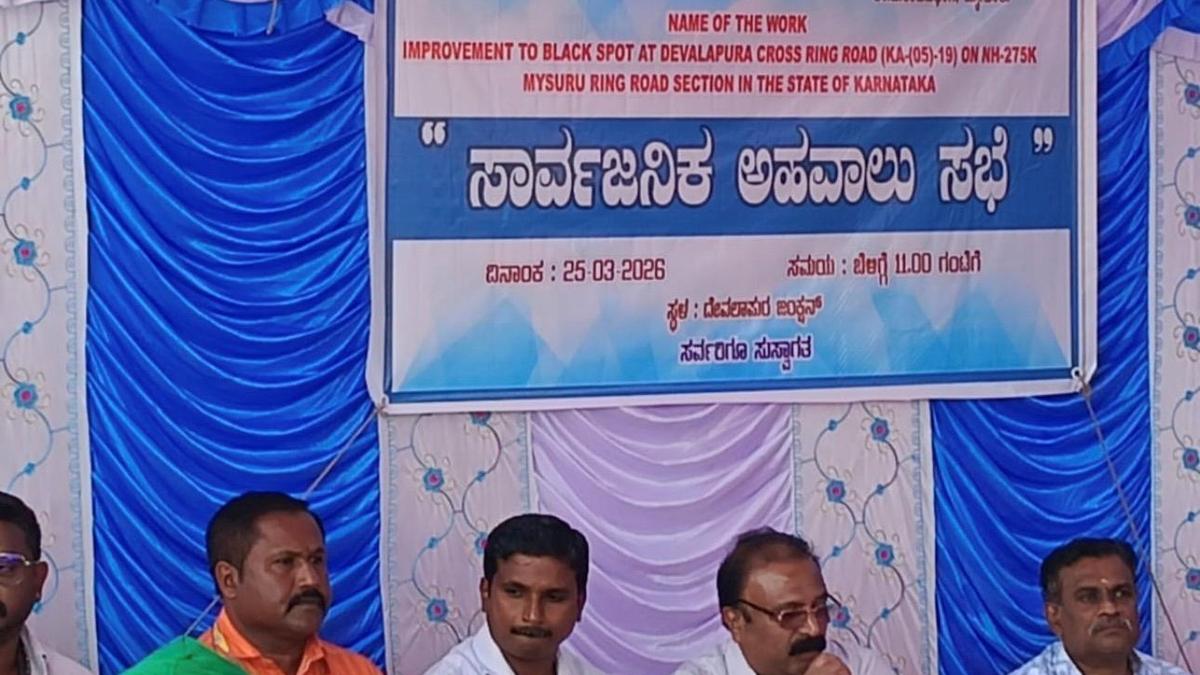
On March 25, 2026, a significant public grievance meeting was held in Hosahundi village, located in Kasaba hobli of Mysuru taluk, addressing the contentious issue of a proposed flyover construction at Devalapura Cross on National Highway 275-K (Outer Ring Road). This meeting, organized jointly by the Forest Department and the National Highways Authority of India (NHAI), Mysuru, was convened to discuss road safety concerns in the area, which has been identified as a traffic ‘black spot’ due to a history of accidents. However, the residents of Hosahundi vehemently opposed the flyover project, urging authorities to explore alternative safety measures rather than proceeding with the construction.
The opposition from the villagers, which included local leaders, women, youth, and traders, was rooted in a series of concerns ranging from the potential disruption to their livelihoods to environmental impacts. They submitted a formal representation to the Executive Engineer of NHAI Mysuru, recalling that their objections had first been raised during a similar public grievance meeting held on January 13, 2026. At that earlier forum, residents and environmental activists had voiced the opinion that a flyover was unnecessary at Devalapura Cross and recommended the implementation of other accident prevention strategies instead. They were assured that their concerns would be conveyed to higher authorities. Despite these assurances, the locals alleged that construction work had recently begun abruptly without adequate consultation, which sparked protests and eventually forced a halt to the works.
The designation of the Devalapura Cross stretch as a ‘black spot’ by NHAI is based on accident data that recorded seven fatal and 15 non-fatal incidents over the three years leading up to 2024. This troubling statistic has been cited as justification for the flyover, intended to improve road safety by streamlining traffic flow and reducing collision risks. However, the villagers argue that the root causes of these accidents are not infrastructure-related alone but are primarily due to behavioral factors such as overspeeding, negligent driving, and drunk driving. They maintain that erecting a flyover will not address these underlying issues effectively.
Instead, the community advocates for immediate traffic management interventions including the installation of traffic signals, speed breakers, and proper road signage. They also call for stringent enforcement of traffic laws and the removal of liquor outlets in close proximity to the junction, which they believe contribute to reckless driving. The villagers pointed out that similar measures are successfully implemented at other junctions along NH-275, such as between Manipal Hospital junction and T. Narasipura Road junction, but have been overlooked at Devalapura Cross. This selective application of safety protocols, they argue, undermines the overall efficacy of road safety efforts.
Beyond traffic concerns, the residents of Hosahundi highlighted socio-economic impacts that the flyover project could trigger. The village has already experienced significant loss of fertile agricultural land over the years due to major developmental projects, namely the Varuna canal initiative, airport expansion, and the construction of the Ring Road itself. These land acquisitions have compelled many villagers to shift from traditional farming to small business ventures such as shops and hotels to sustain their livelihoods. The proposed flyover threatens to exacerbate this disruption, potentially harming local businesses by altering traffic patterns and accessibility. Community representatives expressed apprehension that the flyover could also degrade the aesthetic character of the village, which they cherish.
Environmental concerns formed another critical dimension of the opposition. The project necessitates the felling of 48 mature trees, a move the villagers strongly contest amid growing awareness about climate change and rising temperatures in Mysuru. They argue that cutting down these trees would negatively impact local microclimates and contribute to environmental degradation. Additionally, the villagers referenced expert opinions cautioning against the transplantation of neem trees, stating that such efforts have a low survival rate, thereby making tree removal more damaging and irreversible. This environmental dimension resonates with broader concerns about sustainable development and balancing infrastructure growth with ecological preservation.
Given these multifaceted concerns, the residents of Hosahundi have called for the flyover plan to be scrapped entirely. They urge the authorities to redirect infrastructure investments towards areas within Mysuru city that face severe traffic congestion and where flyovers and other large-scale projects are more urgently needed. Their plea underscores the need for a more context-sensitive approach to urban planning and road safety interventions that genuinely reflect the needs and voices of local communities.
This episode in Mysuru exemplifies the complex challenges involved in infrastructure development in rapidly urban