
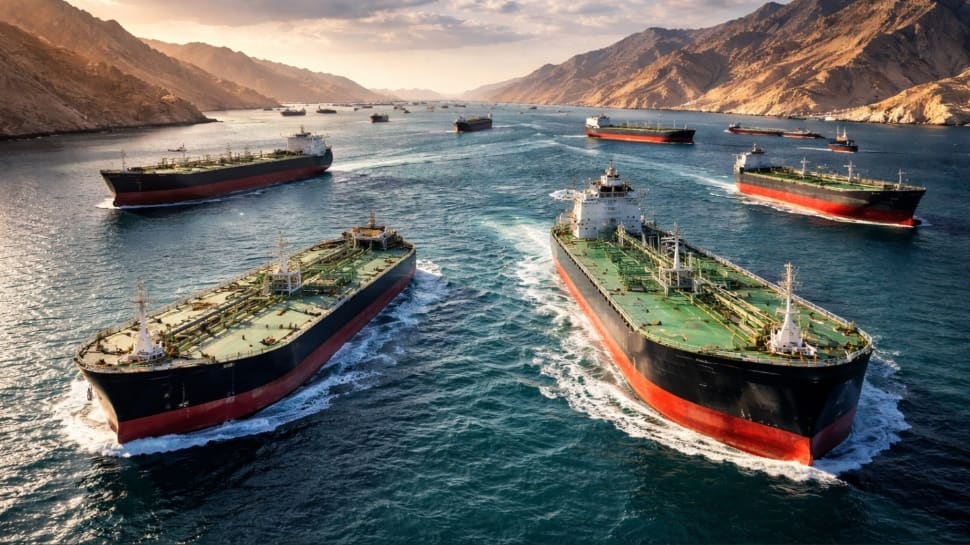
The Strait of Hormuz, a narrow 39-kilometer-wide waterway, stands as one of the most critical and vulnerable points in the global economic system. Named after the ancient Persian deity Ahura Mazda, the god of wisdom and cosmic order, the strait's significance extends far beyond its historical and spiritual naming. It is a geographical chokepoint that controls not only energy supplies but also essential commodities that sustain modern life, making it a linchpin in global trade and industry.
While the Strait of Hormuz is commonly described as a vital energy corridor-through which approximately one-fifth of the world's seaborne oil and liquefied natural gas passes-this characterization only scratches the surface of its true importance. Each year, some 30,000 vessels navigate this 167-kilometer-long channel, carrying not just hydrocarbons but also a vast array of critical raw materials. These include over 30% of global ammonia trade, nearly half of the world's urea, and a fifth of diammonium phosphate-all essential for fertilizer production. Additionally, the strait handles 50% of the world's sulphur, a key element in metal processing, one-third of global helium supplies used in cooling semiconductors, nearly 10% of the world's aluminum, and significant quantities of Gulf-produced plastics.
The strait functions like the aortic valve of globalized production: when it is blocked, the entire system risks collapse. Unlike oil, many of these commodities, such as fertilizers, have no alternative pipelines or routes and cannot be easily rerouted. The nitrogen supply chain, crucial for synthetic fertilizers that feed roughly 48% of the global population, is particularly vulnerable. Disruptions in March threaten agricultural yields by September due to the tight timing of fertilizer application in the Northern Hemisphere. Beyond agriculture, the closure of the strait disrupts aluminum production, which involves complex, time-consuming restarts after shutdowns, with costly procedures required to prevent metal solidification.
The Gulf region itself is heavily dependent on this narrow maritime passage for survival. Countries like Saudi Arabia and Qatar import over 80% and 85% of their food, respectively. Despite their wealth, these nations face structural vulnerabilities as their food security hinges on uninterrupted access through the Strait of Hormuz.
Historically, control of Hormuz has been synonymous with power and economic dominance for over nine centuries. In the 11th century, an Arab merchant-prince named Muhammad Diramku, known as Dirhem Kub ("Dirham minter"), established the Kingdom of Hormuz on the Iranian coast to control this vital trade route. By the 15th century, Hormuz had evolved into a bustling emporium attracting merchants from across the medieval world, including Egypt, China, Java, Bengal, Zanzibar, and Yemen. Famous travelers like Marco Polo and Chinese admiral Zheng He recognized its importance, with Zheng He making it the final destination of his treasure fleet.
The strategic value of the strait drew the attention of the Portuguese, who seized the port in 1507 under Admiral Afonso de Albuquerque, understanding that whoever controlled Hormuz controlled the trade corridor between India and the Mediterranean. Subsequently, in 1622, Persia's Shah Abbas I recaptured the port with English naval assistance. The British later imposed a naval blockade on the strait in 1951 to pressure Iranian Prime Minister Mohammad Mosaddegh to reverse oil nationalization, a blockade that lasted over two years and contributed to Mosaddegh's overthrow in 1953.
During the Iran-Iraq war from 1980 to 1988, the strait endured intense attacks on commercial vessels, resulting in hundreds of casualties. Despite this, oil shipments continued, albeit at higher insurance costs. This turbulent history may have led belligerents in the 2026 conflict to underestimate the impact of a partial closure. However, significant changes since the 1980s have transformed the nature of disruption.
The critical difference today lies in the global marine insurance system. Within 48 hours of the recent conflict's outbreak on February 28, major marine insurance providers canceled war risk coverage for the Gulf. By early March, commercial insurance protections essential for shipping had effectively vanished. This resulted in a "phantom blockade," where legal and financial barriers, rather than physical obstructions, prevent vessel movement. Even if the strait remained physically open, no commercial ship could risk transiting without insurance, and banks refused letters of credit for cargoes dependent on Hormuz. Commodity traders scrambled to secure emergency credit lines worth $7 billion to avoid forced liquidations.
This financial paralysis was not merely a supply disruption but a cardiac arrest of global commerce. Alternative ports outside the strait became the only viable options, but these too faced threats. Iranian drone attacks targeted Omani ports at Salalah and Duqm, forcing their suspension and undermining efforts to establish new routes. Consequently, even attempts to bypass Hormuz met with active hostility, exacerbating the crisis.
The current conflict represents a historic first: the effective closure of the Strait of Hormuz. Adding to the urgency is the potential for Bab al-Mandeb-the narrow Red Sea passage dubbed the "Gate of Tears"-to follow suit if Houthi forces, allied with Iran, intensify their pressure on global trade routes. Two of the world's three most critical maritime chokepoints closing simultaneously would create an unprecedented crisis far beyond previous disruptions such as the 2021 Suez Canal blockage, the COVID-19 pandemic's demand shocks, or the war in Ukraine's supply corridor interruptions.
This confluence of crises exposes a dangerous collective strategic blindness. The global community has long treated Hormuz as a regional energy issue, overlooking its broader role as a vital global infrastructure hub. The concentration of key supply chains-whether for fertilizers, metals, or semiconductors-in a single narrow passage represents a systemic risk masked as cost optimization.
To prevent future crises, the international community must recognize the Strait of Hormuz as global critical infrastructure deserving multilateral security guarantees extending beyond energy supplies. There is also a pressing need to establish strategic reserves not only for petroleum but also for fertilizers and metals vital to food production and industrial processes. Furthermore, a concerted effort is required to diversify and disperse critical supply chains to reduce dependence on any single chokepoint.
The world has now witnessed the consequences when Hormuz fails. The next closure will not be a surprise. The fundamental question is whether global systems will learn from this failure and implement the necessary changes to safeguard the arteries of global commerce or remain vulnerable to the next inevitable crisis.
In summary, the Strait of Hormuz is far more than an energy corridor; it is the lifeline of modern global production and trade. Its closure impacts not only oil but also fertilizers that sustain nearly half the world's population, helium critical for semiconductor cooling, aluminum essential for manufacturing, and many other vital materials. Historical struggles for control of Hormuz have shaped the geopolitics of the region for centuries, but today's challenges are compounded by financial and insurance mechanisms that can paralyze trade without a single shot fired.
The international community faces a clear imperative to rethink security, supply chain resilience, and strategic reserves with a comprehensive understanding of Hormuz's global significance. Only through such measures can the stability of the global economy and food security be protected against the vulnerabilities of a 39-kilometer stretch of water named after the god of order.