
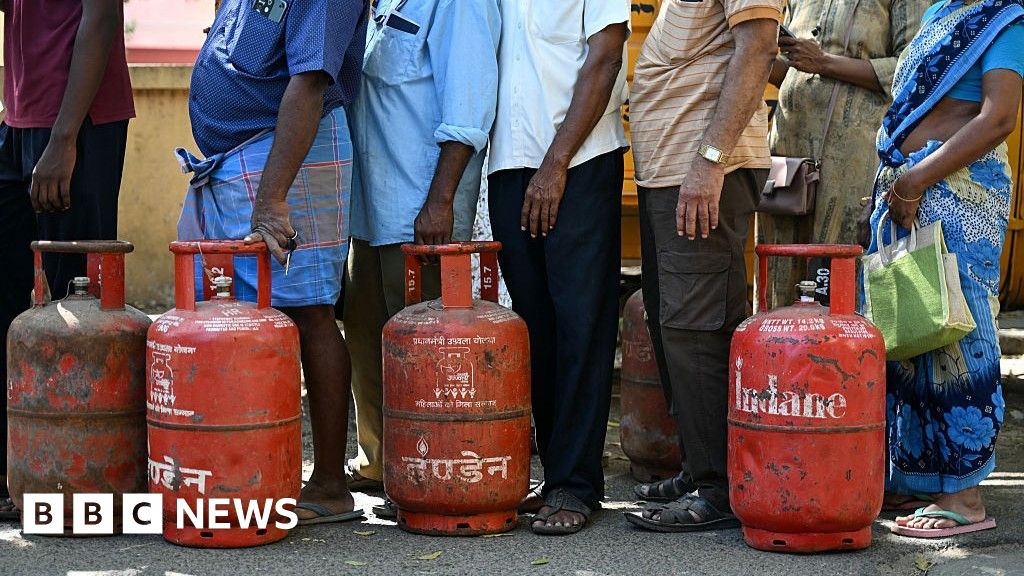
The ongoing conflict involving the US and Israel’s strikes on Iran has led to significant disruptions in energy shipments through the Strait of Hormuz, a crucial maritime chokepoint for global oil and gas trade. Though the conflict is occurring nearly 3,000 kilometers away from India, its repercussions are now being felt keenly within the country’s kitchens, particularly in the supply of liquefied petroleum gas (LPG). This disruption is causing widespread shortages, forcing restaurants across India to cut down their menus, reduce operating hours, and in some cases, shut down entirely.
Reports and social media posts from various Indian cities depict long queues outside cooking gas dealers, as consumers and businesses alike worry about dwindling fuel supplies. Among those most affected are commercial LPG users, especially restaurants that rely heavily on LPG cylinders or piped gas for cooking. Manpreet Singh, representing the National Restaurant Association of India—an organization that includes around 500,000 restaurants—describes the situation as “dire,” emphasizing that cooking gas is simply unavailable in many areas. According to Singh, the shortages are not confined to a few cities but are being felt nationwide, with a noticeable impact in metropolitan hubs like Delhi, Mumbai, Bengaluru, and Chennai.
In Mumbai, media reports suggest that up to 20% of hotels and restaurants have either partially or fully shut down due to the tightening commercial LPG supply. Meanwhile, in the southern cities of Bengaluru and Chennai, some eateries report that their gas reserves have nearly run out, leaving them with few alternatives. Haroon Sait, owner of an artisan bakery and restaurant chain in Bengaluru, laments the situation, saying, “We can only make coffee and nothing else—it is nothing less than pathetic. Businesses are going to suffer.” In response to the constraints, many restaurant operators are trying to adapt by scaling back their menus, limiting meal services to only lunch or dinner, or closing temporarily when supplies are exhausted. Singh notes that the situation remains fluid, with some restaurants reopening after brief closures as supplies fluctuate.
This LPG shortage has also triggered a surge in sales of electric cookers, with retailers reporting they are running low on stock. Despite the visible strain on commercial users, the Indian government maintains that there is no overall shortage of LPG. India boasts more than 300 million domestic LPG users, and officials assert that supplies are being prioritized for households amid the global energy market turbulence caused by the Gulf conflict.
India’s LPG consumption is heavily dependent on imports, with approximately 60% of the country’s LPG coming from abroad. Notably, around 90% of these imports transit through the Strait of Hormuz, which has effectively been closed or severely disrupted due to the ongoing war. In response, the Indian oil ministry ordered refineries on March 8 to maximize LPG production focused on household consumption, increasing domestic output by roughly 25%. Non-domestic supplies are being rationed for essential services such as hospitals and educational institutions. The ministry has also pledged to ensure distribution remains “fair and transparent,” aiming to curb panic buying and hoarding. Sujata Sharma, a senior official in the petroleum ministry, explained that some of the demand spikes have been triggered by misinformation, and the normal delivery cycle for domestic LPG remains about two-and-a-half days.
However, the anxiety is not restricted to cooking gas. Videos circulating on social media from cities like Chennai reveal long queues at petrol stations, indicating growing public concern about fuel availability in general. Despite these fears, data from Kpler, a maritime intelligence firm, suggests that concerns over India’s broader fuel supplies may be somewhat exaggerated.
India imports about 90% of its oil needs, with roughly half of its crude oil imports—approximately 2.5 to 2.7 million barrels per day—passing through the Strait of Hormuz. These imports primarily come from Middle Eastern countries such as Iraq, Saudi Arabia, the United Arab Emirates, and Kuwait. Even if supplies through the strait are disrupted, India has the capacity to partially offset the shortfall by increasing imports of discounted Russian crude oil. Sumit Ritolia, an analyst specializing in refineries and oil markets at Kpler, notes that incremental Russian crude imports in March could reach between one and 1.2 million barrels per day, reducing India’s effective shortfall from the Strait of Hormuz disruption to around 1.6 million barrels daily.
This Russian crude oil is currently stored in large quantities on ships in the Indian Ocean—estimated at 25 to 30