
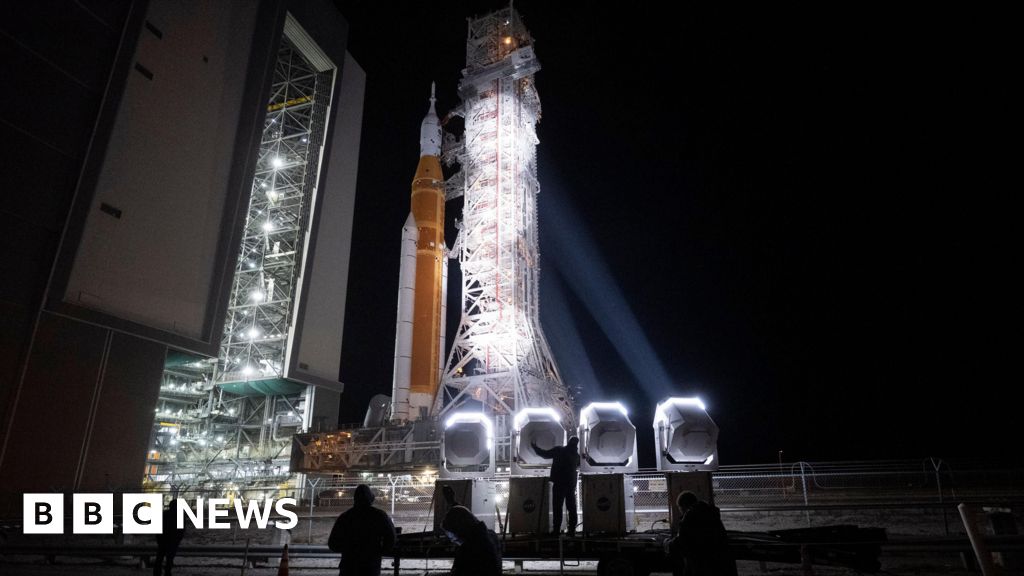
NASA’s monumental Space Launch System (SLS) rocket, poised to carry astronauts around the Moon, has made a significant return to its launch pad at Kennedy Space Center in Florida. This marks the second time the 98-meter-tall rocket and its Orion spacecraft have been transported from the assembly building to Pad 39B, ahead of a mission that will mark the first crewed lunar journey in over five decades.
The SLS and Orion spacecraft embarked on a slow, deliberate journey of approximately four miles from the Vehicle Assembly Building (VAB) to the launch pad. This journey was carried out by NASA’s Crawler-Transporter-2, a massive tracked vehicle originally built in 1965 to move the iconic Saturn V rockets used during the Apollo Moon missions. The crawler moves at a painstaking pace of about one mile per hour and even more slowly on bends or inclines, making the entire trip last up to 12 hours. This careful pace is intended to minimize mechanical stress on the rocket, which, combined with its launch platform, weighs roughly 5,000 tonnes and stands taller than London’s Big Ben clock tower.
The recent return to the pad follows a setback in March when NASA detected a problem with the rocket’s helium system during a fueling test. The helium system plays a critical role in pressurizing the propellant tanks of the upper stage of the rocket, which is vital for engine performance and the safe management of fuel. When the anomaly was discovered, NASA made the cautious decision to abort the planned launch and roll the rocket back into the VAB for thorough inspection and repairs, rather than attempting troubleshooting while the rocket was on the pad.
Inside the VAB, engineers and specialists worked meticulously to address the helium system issue. They installed work platforms around the upper stage to access valves and plumbing in the helium circuit, replaced suspect components, and swapped out batteries in several critical systems. Following these repairs, extensive tests were conducted to ensure the problem had been fully resolved. After reviewing the repair outcomes and test data, NASA managers authorized the rocket’s second rollout to the launch pad to begin the final pre-launch preparations.
Now positioned at Pad 39B, the rocket will undergo several days of rigorous testing. Engineers will reconnect the launch tower to the vehicle and conduct pressure tests on the helium system to confirm the repairs remain intact after the move. In addition to hardware checks, mission controllers will perform countdown rehearsals using the actual computers and communication networks that will be employed on launch day. These simulations will not involve fueling the rocket but will help ensure that all systems and procedures function smoothly under realistic conditions.
NASA’s mission management team is slated to convene a few days before the earliest launch opportunity, which currently opens on April 1, to review the results of these final tests and decide whether to proceed with the launch. If all goes well, the Artemis II mission will mark the first crewed flight of NASA’s Artemis program.
The Artemis II crew consists of four astronauts: Reid Wiseman, Victor Glover, Christina Koch, and Jeremy Hansen. They have already entered pre-flight quarantine to minimize health risks and will travel to Florida closer to launch to participate in final rehearsals. These activities include suit fittings and simulated trips to the launch pad, allowing the crew to practice and prepare for the mission ahead.
NASA is targeting the first launch window for Artemis II on April 1 at 18:24 Eastern Daylight Time (23:24 British Summer Time). If the launch must be postponed, additional windows are available on April 2, 3, 4, 5, and 6. Should all these opportunities be missed, the final chance for launch in April would be on the 30th.
The Artemis II mission is scheduled to last approximately ten days and will send astronauts on a journey looping around the far side of the Moon before safely returning them to Earth. This mission is a critical step in NASA’s broader goal of returning humans to the lunar surface and establishing a sustainable presence on the Moon.
Looking beyond Artemis II, NASA has ambitious plans to continue human exploration of the Moon. The next mission, Artemis III, is planned for 2027 and will be a crewed test flight in Earth orbit. Following that, Artemis IV, targeted for 2028, aims to land astronauts on the lunar surface once again, marking the first Moon landing since the Apollo program ended.
The successful launch and completion of Artemis II will pave the way for these future endeavors, laying