
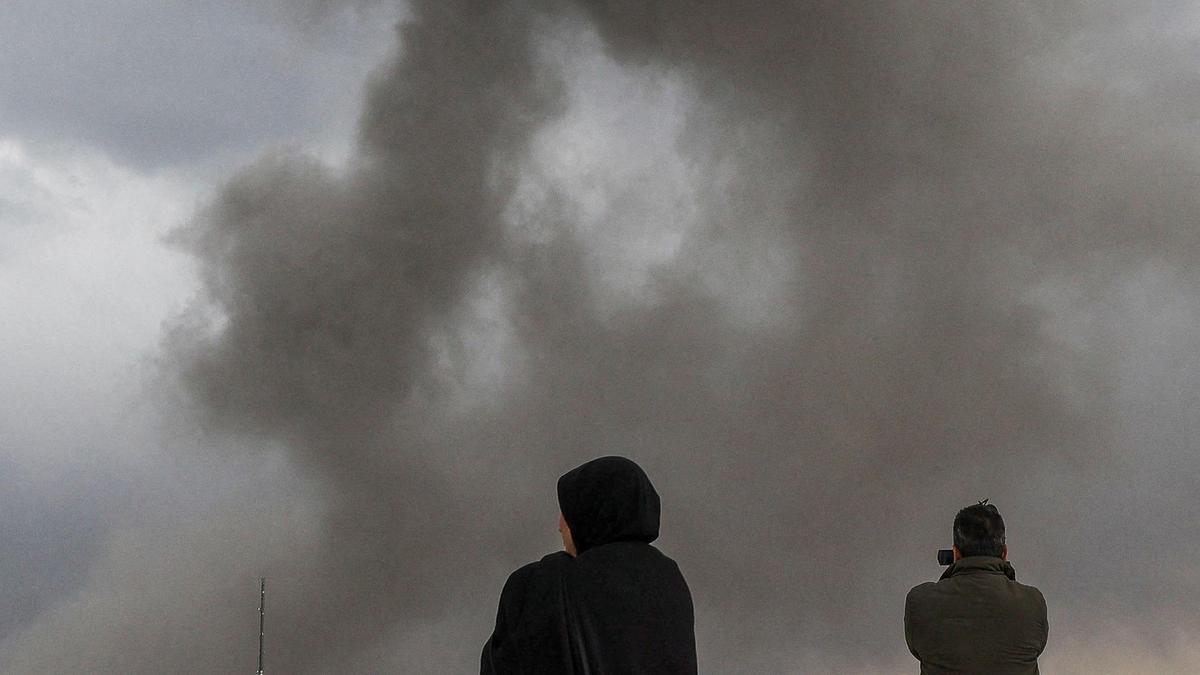
As tensions escalate in West Asia following coordinated air and missile strikes by the United States and Israel on Iranian cities, concerns have grown significantly among Indian families whose children are studying in Iran. The deteriorating security situation has sparked fears of a prolonged regional conflict, directly impacting thousands of Indian students, particularly medical students, currently residing in various Iranian cities.
One poignant example is that of Kunwar Shakeel Ahmed, a resident of the Turkman Gate area in Old Delhi. His 19-year-old daughter, who had been pursuing medical studies at the Islamic Azad University in Tehran for the past three years, now finds herself living amid constant danger. Encouraged by her strong academic record and passion for medicine, Ahmed had sent her to Iran with hopes for a bright future. However, recent weeks have brought a terrifying new reality. Ahmed recounts the distressing conditions his daughter faces daily: the deafening blasts, thick black smoke billowing in the sky, and even the physical damage to the dormitories where she and other students reside. “The plaster was falling off the roof of the dormitories,” he said, describing the chaos and fear engulfing the students. “No father wants to see his child in such a state of fear and uncertainty.”
The situation worsened after the coordinated strikes on February 28, which targeted multiple Iranian cities and heightened fears of a broader conflict engulfing the region. On March 3, reports emerged from Urmia, a city approximately 750 kilometers from Tehran, where airstrikes near student dormitories caused panic among the residents. This incident underscored the widespread nature of the threat and the vulnerability of foreign students caught in the crossfire.
In response to these developments, Indian student organizations have been actively working to support students stuck in Iran. The All India Medical Students’ Association (AIMSA) and the Jammu & Kashmir Students’ Association have taken the lead in connecting students in Tehran, Urmia, and other cities with their anxious families back home. These groups have also engaged with the Indian Embassy in Tehran and the Ministry of External Affairs (MEA) in Delhi to communicate the students’ plight and explore possible relocation strategies. According to Mohammad Momin Khan, the president of AIMSA (J&K), about 3,000 Indian medical students are currently enrolled in Iranian universities, with nearly 2,000 hailing from Kashmir alone. By early March, approximately 1,000 students had already returned to India, but between 900 and 1,200 remain in Iran, many of whom are experiencing severe distress.
One of the key challenges has been finding safe routes for evacuation amid the ongoing conflict. On March 5, 107 students from Urmia University formally wrote to the Indian Embassy requesting evacuation assistance, suggesting land routes through neighboring countries such as Armenia or Azerbaijan as viable options. The Embassy responded by seeking a detailed list of students to verify numbers before facilitating their movement. The plan involves moving students to Armenia, from where they could arrange and finance their journey back to India. However, this process presents substantial difficulties. Ticket prices from Armenia to India currently exceed ₹1.2 lakh (approximately 120,000 Indian Rupees), placing a significant financial burden on many students. Additionally, essential services like internet connectivity have been disrupted in Iran, complicating communication efforts. International direct dialing (ISD) calls are reportedly not going through, leaving students isolated and without assistance.
The financial and logistical challenges faced by stranded students have also been highlighted by Nasir Khuehami, national convener of the J&K Students’ Association. He emphasized the dire conditions many students are enduring, including lack of funds for basic necessities like food. The disruption of communication channels has further compounded their vulnerability, rendering them unable to seek timely help. Social media has become a crucial platform for students to voice their pleas. For instance, two students stranded in Arak, a city in Iran, posted appeals on March 3 urging the Indian government to facilitate their rescue. One of them, Ifra Ahmed, a third-year medical student, remains stranded despite her repeated efforts to seek help. Her father, Shameed Ahmed, shared that although he was able to contact her on March 6, the Embassy had not yet responded positively to their evacuation requests.
Dr. Khan of AIMSA stressed the possibility of replicating evacuation efforts that had been successfully carried out in the past. In June 2025, around 100 Indian students were evacuated through the Armenian border under