
In the lead-up to the Tamil Nadu Assembly elections of 2026, the political landscape of the state is witnessing an unusual development with the emergence of Tamilaga Vettri Kazhagam (TVK), a party founded and led by popular actor Vijay. Unlike the typically loud and vibrant election campaigns that Tamil Nadu is known for, the TVK's campaign strategy appears markedly different-quiet, subtle, and, in some ways, taking place within the intimate confines of households rather than public rallies or mass gatherings.
Supporters of Vijay and the TVK have adopted a unique approach to political persuasion, which has caught the attention of many observers. A notable feature of this campaign is how young family members who are not yet eligible to vote-children and teenagers-are actively encouraging their parents to cast their ballots in favor of Vijay. The phenomenon has sparked talk and some concern, as the push from these younger voices sometimes borders on emotional pressure or even coercion, influencing adults' voting decisions through familial interaction.
This dynamic recalls a celebrated piece of Tamil literature, the short story "Marumagal Vaaku" (Daughter-in-law's Vote) by the late renowned Tamil writer Krishnan Nambi. The story, regarded as one of the greatest short stories worldwide by the late writer Sujatha Rangarajan, offers a poignant exploration of political influence and family dynamics during elections. It provides a fitting cultural lens through which to view the current electoral behavior in Tamil Nadu, where personal relationships and subtle social pressures intertwine with political choice.
"Marumagal Vaaku" is set in a village in the Kanniyakumari district, an area close to where Krishnan Nambi lived. The narrative centers on a local body election contest between two candidates, Veerabahu Konar and Mariyadu Perumal Pillai, who represent opposing political factions symbolized by a parrot and a cat, respectively. The story paints a vivid picture of political rivalry and community allegiances, noting how even in neighborhoods considered strongholds of one faction, practical dependencies-such as the milk supply-can blur strict political boundaries.
The human drama unfolds around three main characters: Meenakshi Ammal, a widow; her son Ramalingam, a government employee who secured his position through compassionate grounds following his father's death; and Ramalingam's wife Rukmani. Within this family, political loyalties and personal relationships become deeply intertwined. Rukmani, the daughter-in-law, is portrayed as a seemingly powerless woman under the dominance of her mother-in-law, Meenakshi Ammal, and is expected to follow the latter's political preferences.
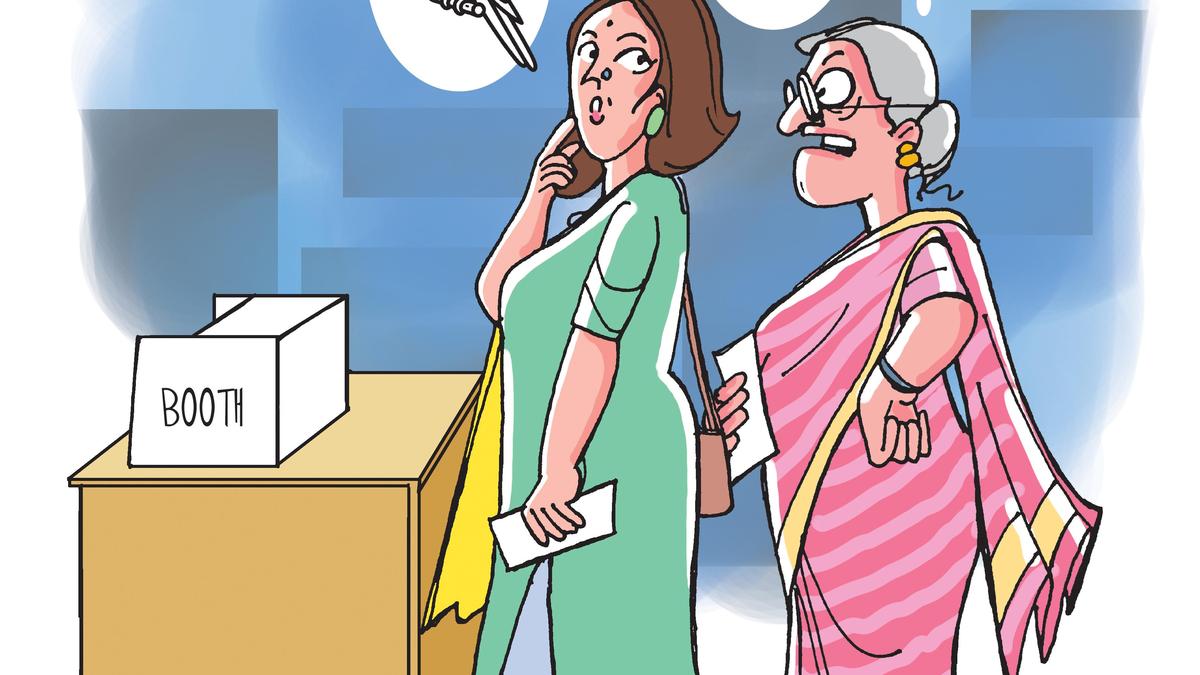
Despite Meenakshi Ammal's clear support for the cat candidate, the story highlights the social pressures and subtle manipulations that influence Rukmani's voting decision. On election day, as both women head to the polling station-located at their local school-Rukmani is momentarily uplifted by memories of her childhood, sparked by the sight of an anise tree and a parrot perched on its branches. This nostalgic moment symbolizes her internal conflict and desire to vote according to her own feelings, which lean toward the parrot candidate favored by her late memories and perhaps her own convictions.
However, as Rukmani stands before the ballot box, her resolve falters. The story's climactic moment reveals that an unseen force-interpreted as the influence of Meenakshi Ammal-intervenes, guiding Rukmani's hand away from the parrot and toward the cat. Overwhelmed by this coercion, Rukmani marks her vote for the cat candidate, despite her initial inclination. She leaves the voting booth with a bowed head, carrying the weight of her inner turmoil and the pain of suppressed choice. This poignant scene captures the complexity of personal agency within family and political structures.
This literary backdrop offers a compelling parallel to the current elections in Tamil Nadu, where the political campaign of Tamilaga Vettri Kazhagam is unfolding in ways that resonate with the themes of "Marumagal Vaaku." The involvement of children nudging their parents' votes and the quiet, household-level campaigning reflect how political influence can permeate private spaces and family relationships, sometimes blurring the lines between persuasion and pressure.
The emergence of TVK and Vijay's entry into electoral politics mark a significant moment in Tamil Nadu's political history. Traditionally, Tamil Nadu's elections have been characterized by intense competition between well-established parties and fiery public campaigns that mobilize large crowds. The TVK's low-key, emotionally charged approach contrasts sharply with this norm and has introduced a new dimension to the state's political discourse.
While the TVK's campaign is relatively understated in the public sphere, its impact is felt deeply within homes, where political discussions and decisions may be influenced by the younger generation's enthusiastic support for their idol. This dynamic raises questions about the nature of political engagement and the role of family dynamics in shaping electoral outcomes.
As the Tamil Nadu Assembly elections approach, observers and voters alike will be watching closely to see how this novel campaign strategy plays out in the democratic process. The intertwining of popular culture, familial influence, and political choice reflects the evolving nature of electoral politics in the state and underscores the enduring relevance of cultural works like "Marumagal Vaaku" in understanding these developments.
In conclusion, Tamil Nadu's 2026 elections are not only a political contest but also a cultural moment that reveals the complex interplay between personal relationships and political allegiances. The quiet, emotionally charged campaign of Tamilaga Vettri Kazhagam under Vijay's leadership challenges traditional modes of electioneering and highlights how influence operates beyond public rallies-often within the intimate spaces of home and family. The resonance with Krishnan Nambi's classic short story enriches the understanding of these phenomena, reminding us that the politics of voting is as much about human emotions and social bonds as it is about ideology and public policy.