
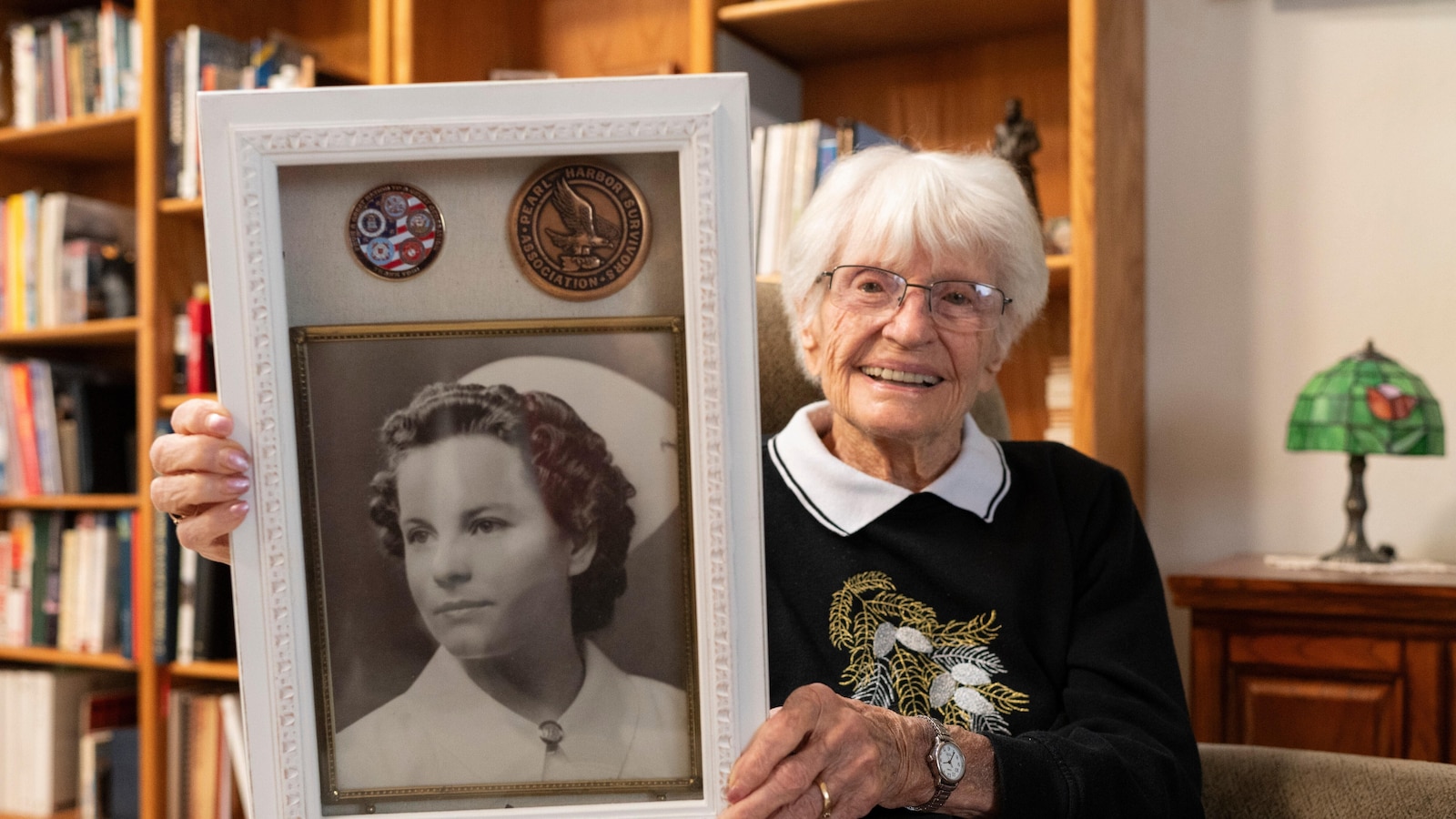
At 106 years old, Alice Darrow vividly remembers her days as a World War II nurse, a member of a courageous group who braved frontline dangers to care for wounded soldiers. Stationed at a hospital on California’s Mare Island, Darrow and her fellow nurses often faced life-threatening situations, treating burn victims and soldiers with gunshot wounds under the constant threat of enemy fire. Some nurses lost their lives in combat zones, while others endured years as prisoners of war. Yet, despite their sacrifices, many returned home to quiet, unheralded lives, their vital contributions largely overlooked by history.
Darrow recalls sitting with patients long after her shifts ended, offering comfort as well as medical care. One patient, a young soldier who arrived with a bullet lodged in his heart, was not expected to survive surgery. But against the odds, he pulled through — and profoundly changed Darrow’s life. “To them, you’re everything because you’re taking care of them,” she reflects from her home in Danville, California, near San Francisco.
Now, nearly eighty years after World War II ended, a coalition of retired military nurses and supporters is campaigning to award the Congressional Gold Medal, one of the United States’ highest civilian honors, to every nurse who served during the war. While other groups such as the Women Airforce Service Pilots and the iconic Rosie the Riveters have already received this recognition, the nurses who worked tirelessly on battlefields and hospital wards remain largely unrecognized.
“The general public doesn’t often recognize, I think, the contribution that the nurses have made in pretty much every war,” says Patricia Upah, a retired Army colonel and nurse who served abroad, and whose own mother was an Army nurse in the South Pacific during World War II. Upah is part of the coalition advocating for this honor, which aims to shine a long-overdue spotlight on the bravery and dedication of these women.
Only a handful of World War II nurses are still alive today. The coalition knows of just five remaining veterans, including Elsie Chin Yuen Seetoo, who at 107 is the oldest living Chinese American nurse to have served in the Army Nurse Corps during the war. With so few survivors remaining, the urgency to honor these trailblazing women is mounting.
“It’s high time we honor the nurses who stepped up and did their part to defend our freedom,” said U.S. Senator Tammy Baldwin of Wisconsin, a Democrat who, along with Republican Representative Elise Stefanik of New York, has sponsored legislation to award the medal. However, the bill faces significant challenges in Congress. To pass, it requires two-thirds majorities in both chambers—67 cosponsors in the Senate and 290 in the House. Currently, it has only eight and six cosponsors respectively.
The scale of the nurses’ contribution to the war effort was immense. Before World War II, the U.S. Army had fewer than 600 nurses, and the Navy about 1,700. By war’s end, those numbers had soared to 59,000 and 14,000 respectively. These nurses served in a variety of dangerous and demanding roles, often close to the front lines.
The Congressional bills highlight numerous acts of valor. Some nurses served aboard Navy hospital ships, providing care while under enemy attack. On November 8, 1942, sixty nurses landed amid sniper fire during the invasion of North Africa. Without weapons to defend themselves, they established field hospitals in abandoned civilian buildings, treating wounded troops in perilous conditions.
These nurses played a crucial role in saving lives. According to the legislation, fewer than 4% of U.S. soldiers who received medical care in the field or evacuation died from wounds or disease—a testament to the skill and dedication of the medical personnel. Edward Yackel, a retired Army colonel and president of the Army Nurse Corps Association, explains that World War II nurses handled an array of medical challenges including infections and chemical injuries, all while lacking modern disposable supplies, requiring meticulous sterilization of equipment.
“Without them,” Yackel emphasizes, “we would not have the knowledge base we need now to fight the wars of today.”
The dangers these nurses faced extended beyond the battlefield. In 1942, nearly 80 military nurses were captured when the United States surrendered the Philippines to Japanese forces. These women endured three years as prisoners of war, suffering starvation and disease, yet continued their nursing duties under horrific conditions until their eventual liberation.
N