
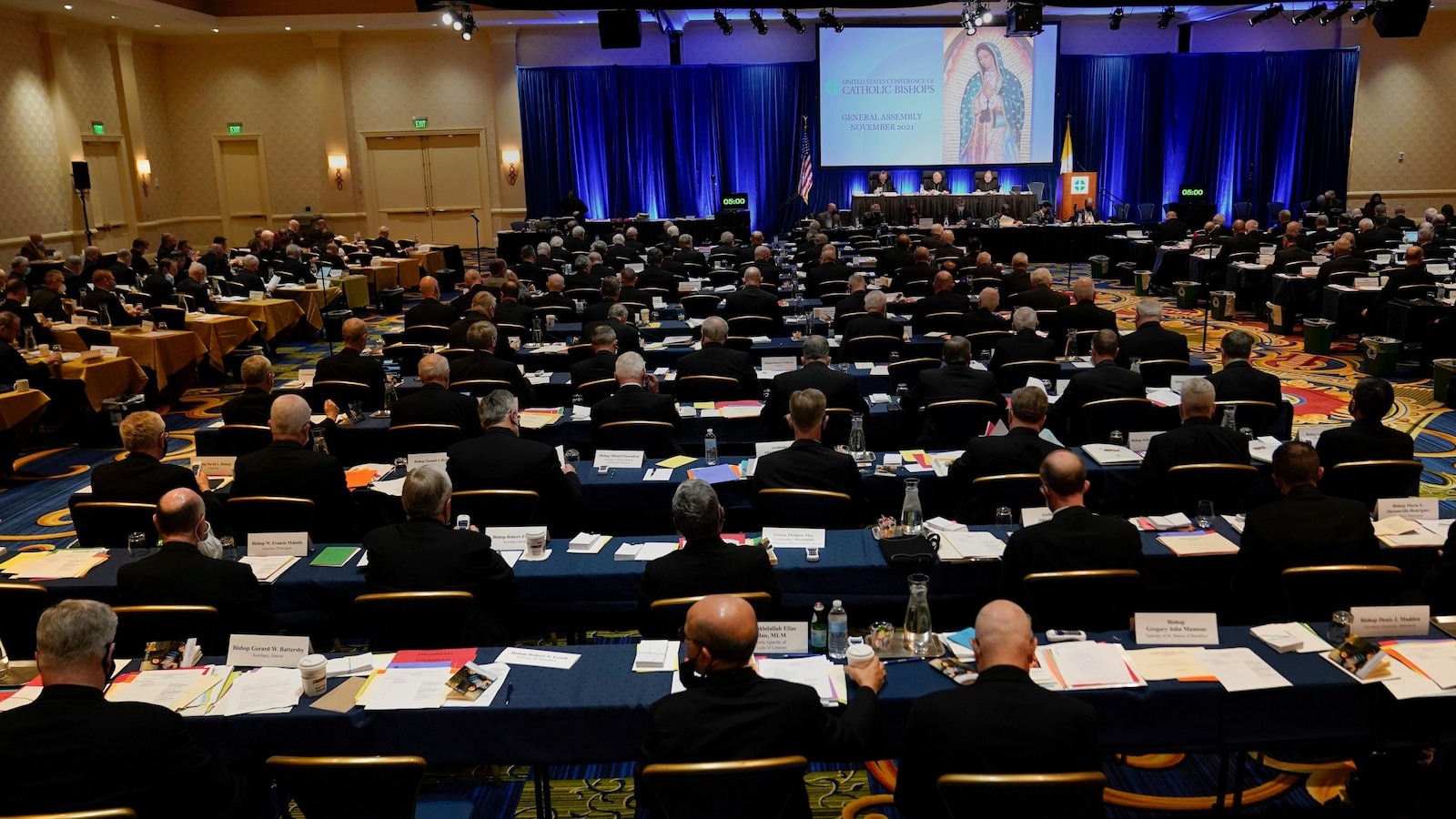
The United States Conference of Catholic Bishops (USCCB) is preparing to elect its next president and vice president in a pivotal vote scheduled for Tuesday in Baltimore. This leadership election is more than a routine administrative decision; it serves as a significant indicator of the priorities and direction of the American Catholic hierarchy in the years to come. The election’s outcome could reveal whether the bishops lean toward a more outspoken, conservative culture warrior approach or a leadership style that emphasizes unity and pastoral care in line with recent papal priorities.
The USCCB has often found itself at odds with the approach of Pope Francis, who has emphasized a pastoral focus on marginalized communities, poverty alleviation, and the care of the environment. This approach has been continued under Pope Leo XIV, the current pontiff, who maintains a similar emphasis on these social issues. Within this broader context, the bishops’ election is reflective of ongoing tensions between more conservative factions, who prioritize opposing abortion and LGBTQ+ rights, and those who advocate for a broader pastoral mission in line with the Pope’s concerns.
Out of the 10 candidates on the ballot to lead the USCCB, half represent the conservative wing of the conference. However, the differences among candidates often hinge more on style and emphasis rather than fundamental doctrinal disagreement. The majority of U.S. bishops share conservative views on social issues, but some adopt a more combative stance, particularly in opposing abortion and LGBTQ+ rights, while others focus on pastoral outreach and dialogue.
David Gibson, director of Fordham University’s Center on Religion and Culture, notes that the candidate slate “perfectly reflects the dynamics of the American hierarchy” with a clear split that mirrors the broader ideological divisions within the Church in the United States. Despite this division, there is no clear front-runner in the race. The candidates were nominated by their fellow bishops, and the winner will replace the outgoing leader, Military Services Archbishop Timothy Broglio, who is concluding his three-year term. The current vice president, Archbishop William Lori of Baltimore, is ineligible to ascend to the presidency due to his proximity to the mandatory retirement age of 75.
Among the conservative candidates, Archbishop Paul Coakley of Oklahoma City is viewed as a strong contender. Coakley has already been elected as secretary of the conference in 2022, making him the third-ranking official in the USCCB hierarchy. His connections to conservative Catholic networks are well known; he serves as an adviser to the Napa Institute, which is a gathering point for conservative Catholic leaders. In 2018, Coakley publicly supported Italian Archbishop Carlo Maria Viganò, a vocal critic of Pope Francis who was later excommunicated for schism. This association underscores Coakley’s alignment with the more conservative and sometimes confrontational wing of the US Church.
Another prominent figure on the ballot is Bishop Robert Barron of the Winona-Rochester diocese in Minnesota. Barron is a well-known media personality within the Catholic world, having built a large following through his Word on Fire ministry, which combines online media and evangelization efforts. He also serves on President Donald Trump’s Religious Liberty Commission alongside Bishop Kevin Rhoades of Fort Wayne-South Bend, Indiana, another candidate in the race. Their involvement with the Trump administration’s religious liberty efforts signals a continued alignment with conservative political and social causes within parts of the USCCB leadership.
In contrast to the conservative candidates, some bishops are viewed as potential unifiers who might improve relations with the Vatican and promote a more pastoral approach. Archbishop Charles Thompson of Indianapolis and Bishop Daniel Flores of Brownsville, Texas, are among those seen as candidates who could help bridge divides within the USCCB. Both bring different strengths to the table, with Flores particularly notable for his leadership in the Vatican’s synod process aimed at modernizing aspects of the Church.
Flores and another candidate, Archbishop Nelson Perez of Philadelphia, are both Latinos, reflecting the growing demographic significance of Hispanic Catholics in the U.S. Church. Their presence on the ballot highlights the increasing recognition of Latino Catholics’ influence within the American Catholic community. Bishop Flores’s diocese along the U.S.-Mexico border positions him uniquely as a leader who combines traditional Catholic teachings on sexual ethics with a passionate advocacy for migrant rights and social justice.
Steven Millies, a professor of public theology at the Catholic Theological Union in Chicago, points out that the two most discussed candidates are Bishop Flores and Archbishop Coakley. Millies describes