
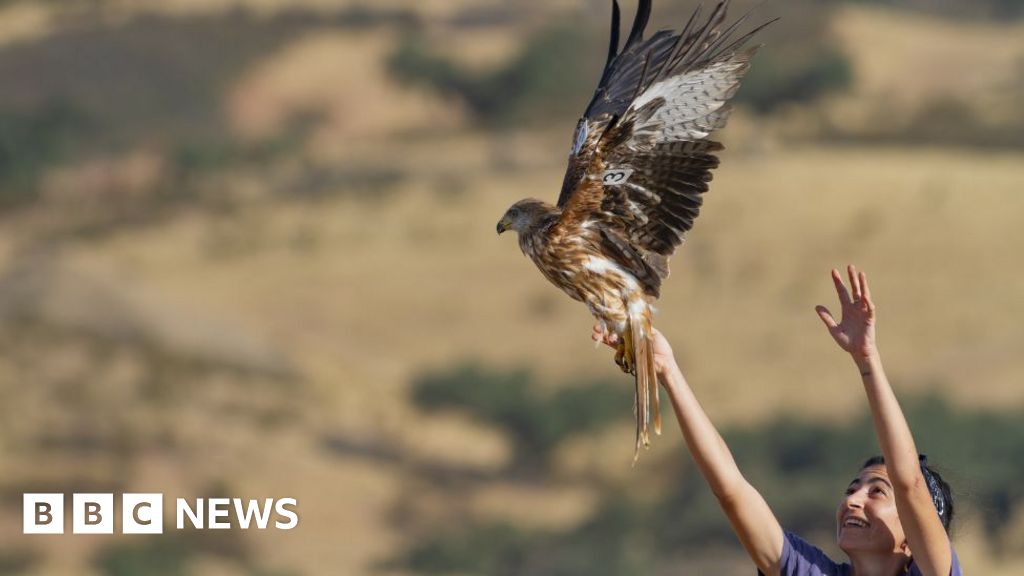
A British red kite, a striking bird of prey, recently took its first flight into the wild hills of western Spain, marking a significant moment in a remarkable conservation journey that has spanned nearly four decades and crossed international borders. This six-month-old bird, just released from an aviary, soared silently over the rugged scrubland before vanishing into a distant wooded valley. Its flight symbolizes not only newfound freedom for the individual bird but also the success of a broader effort to restore the red kite population to areas where it once faced extinction.
The red kite’s story in the UK is one of conservation triumph. By the late 20th century, these magnificent raptors had disappeared from England and Scotland, surviving only in small numbers in Wales. The species was on the brink of extinction within the UK, but a determined reintroduction program began in the late 1980s and early 1990s. Conservationists brought red kite chicks from Spain and Sweden and released them in the Chiltern Hills, along the Oxfordshire-Buckinghamshire border. The initiative proved so successful that today, red kites thrive across the UK, with an estimated 6,000 breeding pairs—roughly 15% of the global population.
Dr. Ian Evans of Natural England, one of the pioneers of the UK reintroduction program, recalls the early days as filled with uncertainty. “There were a lot of unknowns. The first lot we released, we thought they might just die or they might just move away,” he said. However, by 1991, the first breeding pairs were recorded, an encouraging sign that the project could succeed. This breakthrough paved the way for further releases across England and Scotland, helping secure the species’ future in Britain.
Now, the conservation story has come full circle. British-born red kite chicks are being sent back to Spain to help revive dwindling populations there. In the southwestern region of Extremadura, Spain, fewer than 50 mating pairs remain, threatened by natural predators like eagle owls as well as human dangers such as illegal poisoning and electrocution from power lines. To combat this, a four-year international project began in 2022, with conservationists obtaining special licenses from Natural England to collect red kite chicks from Northamptonshire and other areas in the UK and transport them to Spain.
Since the project’s inception, over 120 chicks have been relocated, with around 30 exported each year. The journey begins with the birds being flown to Madrid before traveling another 240 miles to a wildlife hospital in Villafranca de los Barros, run by the Spanish conservation group Accion por el Mundo Salvaje (AMUS). At this facility, ornithologist and project manager Alfonso Godino and his team carefully weigh, measure, and tag each chick. The birds are fitted with GPS backpacks, which allow researchers to track their movements and monitor their adaptation to the wild.
The tagging process, while apparently uncomfortable to the birds, is only a minor inconvenience, akin to having one’s ears pierced, according to Godino. The juvenile red kites quickly adapt to the devices, which are crucial for observing their survival and behavior after release. After tagging, the chicks spend two weeks in holding aviaries near the Portuguese border, acclimatizing to their new environment before being set free.
The release site itself is remote and quiet, purposely chosen to minimize human disturbance. Conservationists use a sheep carcass to lure the birds and encourage feeding, leaving a faint but persistent smell of rotting flesh in the air. The moment of release is suspenseful; the birds do not immediately rush out. Instead, it takes hours before one by one they gather the courage to leave the safety of the aviary and take to the skies. Godino explains that this critical phase allows the birds to begin learning essential survival skills such as hunting, avoiding predators, and interacting with other species, all while being closely monitored via their GPS tags.
However, this period is also fraught with risk. Sofia Marrero, a field technician with AMUS, candidly describes the emotional toll, noting that mortality rates for raptors during their first years are high. Only about a quarter of the released red kites survive to adulthood. Predation is a significant threat, with eagle owls responsible for killing half of the project’s newly released chicks in 2023 alone. In response, the team has adjusted their release strategies to improve survival chances. Furthermore, efforts have been made