
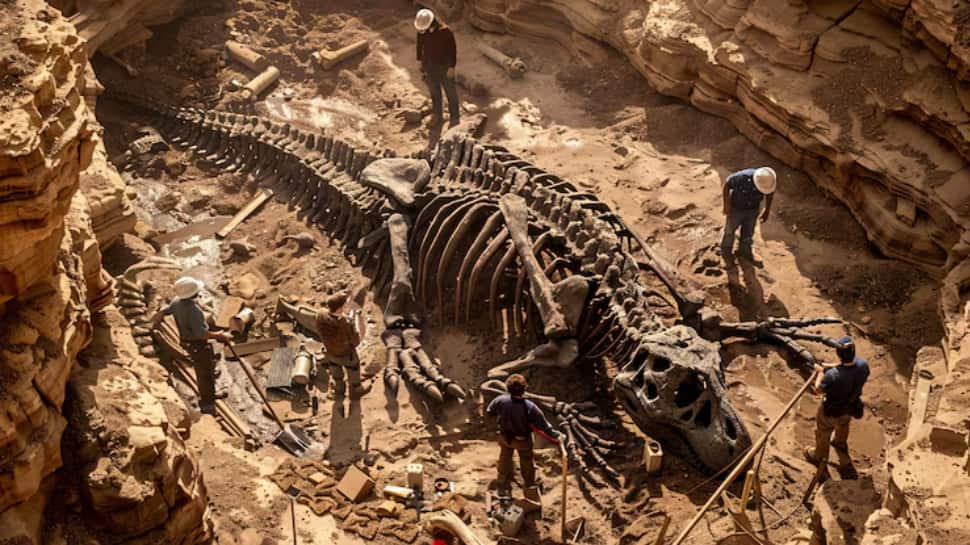
In the remote and windswept region of Patagonia, Argentina, a groundbreaking paleontological discovery has sent ripples through the scientific community. The unearthed fossil of a colossal dinosaur, named *Chucarosaurus diripienda*, has not only amazed researchers with its immense size but also challenged long-standing assumptions about how the largest land animals evolved and moved. This “untamable giant,” as its name suggests, is rewriting the story of dinosaur gigantism, locomotion, and evolutionary diversity.
### Discovery and Naming: The Untamable Giant Emerges
*Chucarosaurus diripienda* was discovered in the Río Negro Province of Patagonia, a region renowned for its rich fossil beds. The dinosaur’s name reflects the nature of both its discovery and physical state. “Chucaro” is a local Argentine Spanish term meaning “untamable,” while “diripienda” derives from Latin, meaning “torn apart.” These names capture the dinosaur’s wild, fragmented fossil remains and the immense power it must have embodied in life.
When paleontologists carefully extracted and encased the massive bones in plaster for transport to Buenos Aires, the sheer weight of the specimen—estimated to be several tons—literally cracked a paved road. Although the damage was minor, the incident became a symbolic metaphor for the fossil’s seismic impact on paleontology. This “road-breaking” fossil has since become a centerpiece of scientific study, housed at the Museo Argentino de Ciencias Naturales Bernardino Rivadavia, where it joins a prestigious collection that continues to deepen our understanding of South American dinosaurs.
### Anatomy That Defies Expectations
What makes *Chucarosaurus* truly revolutionary is not just its size, but its unique anatomy. Unlike other titanosaurs—massive, long-necked sauropods known for their thick, pillar-like legs designed to support enormous weight—*Chucarosaurus* possessed surprisingly slender limb bones. The fossilized remains include parts of the pelvis, femur, tibia, and ischium, and these bones reveal a fascinating combination of strength and delicacy.
Deep muscle scars on the bones indicate robust tendon attachments, suggesting powerful musculature, yet the bones’ narrow shafts point to a lighter, more flexible skeletal structure. This unusual blend of robustness and slenderness hints at a distinct evolutionary approach to gigantism. Rather than relying solely on brute mass and bulk, *Chucarosaurus* appears to have evolved a lighter, more agile form, challenging the conventional idea that gigantic sauropods were necessarily slow and lumbering.
### Size and Scale: A Giant Among Giants
Despite incomplete remains, scientists estimate that *Chucarosaurus* weighed around 69 metric tons, placing it among the heaviest animals ever to roam the Earth. To put this in perspective, its mass is roughly equivalent to ₹570 crore worth of gold if converted by weight. Its femur alone measures an impressive 1.9 meters (6.2 feet) long, yet remains remarkably slim compared to those of its titanic relatives.
These proportions suggest that, in sauropods, size and mass did not always correlate directly. Some species, like *Chucarosaurus*, may have evolved to be large but relatively lighter and more mobile. This challenges the long-held belief that the largest dinosaurs were necessarily slow-moving giants, indicating instead that some could have been surprisingly dynamic despite their enormous size.
### Redefining the Titanosaurs: The Colossosauria Clade
The discovery of *Chucarosaurus* has important taxonomic implications. A research team led by Fernando E. Novas of Argentina’s Museo Argentino de Ciencias Naturales formally described the dinosaur in 2023, classifying it within the Colossosauria clade. This subgroup of titanosaurs is distinct from the traditionally recognized, stockier Saltasaurinae giants.
A detailed study published in the *Annals of the Brazilian Academy of Sciences* highlights that limb structure diversity among South American titanosaurs has been vastly underestimated. Some of these dinosaurs evolved legs supported primarily by ligaments, allowing for greater flexibility and endurance rather than rigid, pillar-like support. This suggests that there wasn’t a singular “blueprint” for giant dinosaurs; rather, multiple evolutionary pathways led to gigantism, each with distinct biomechanical adaptations.
### New Insights Into Dinosaur Locomotion
Traditionally, paleontologists classified sauropods based on vertebrae and overall body volume. However