
In a groundbreaking archaeological discovery, researchers have uncovered a monumental ancient Maya site in southern Mexico that sheds new light on early Maya civilization and their cosmological understanding. The site, known as Aguada Fénix, dates back to between 1000 and 800 B.C.E., predating the emergence of established Maya social hierarchies and rulers. This discovery challenges long-held assumptions about the development of Maya society and the origins of their architectural achievements.
The Aguada Fénix site, first located in 2017 by archaeologist Takeshi Inomata and his team from the University of Arizona, is remarkable not only for its vast size but also for its unique features. Covering nearly nine by 7.5 kilometers, it ranks among the largest ancient constructions in Mesoamerica. Unlike previously known Maya sites dominated by pyramids and ceremonial centers attributed to powerful rulers, Aguada Fénix reveals a different form of monumental architecture rooted in collective ritual rather than hierarchical authority.
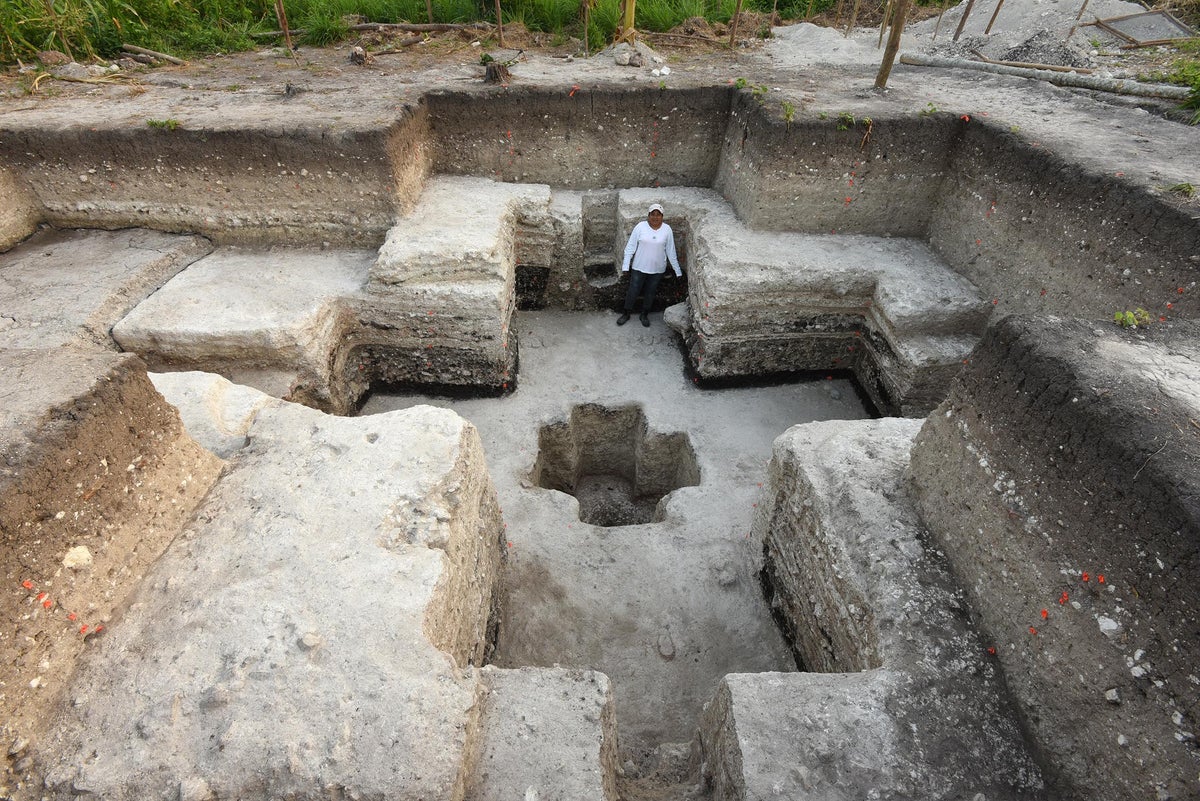
One of the most striking aspects of the site is a massive, cross-shaped pit discovered beneath a rectangular plateau and plaza area, excavated between 2020 and 2024. The pit is oriented along the four cardinal directions and contains vibrant pigments of blue azurite to the north, green malachite to the east, yellow ochre to the south, and marine shells along with axe-shaped clay offerings to the west. Radiocarbon dating places the ritual deposit in the pit at around 900 B.C.E. This pit aligns with an extensive network of raised causeways, carved corridors, and canals forming nested crosses oriented north-south and east-west, collectively creating a cosmogram—a symbolic map of the universe etched into the landscape.
Cosmograms were significant in Mesoamerican civilizations as representations of their spiritual and cultural understanding of the cosmos. The Aguada Fénix cosmogram is particularly noteworthy because it predates the rise of Maya rulers and suggests that early Maya communities organized large-scale construction projects centered on shared religious and ritual activities rather than centralized political power. The canals and causeways, some extending from the main plateau toward a nearby lake and including a dam, appear to have had no practical hydraulic function, leading researchers to conclude that they were likely built for ceremonial purposes.
This discovery stands in contrast to conventional archaeological theories that link monumental Maya architecture to the emergence of social hierarchies and elite classes around 350 B.C.E. Traditionally, Maya society was understood as a stratified system with slaves and commoners at the bottom and priests and nobility at the top, with monumental architecture serving as the domain of the ruling elite. However, the absence of palaces, royal tombs, or elite residences at Aguada Fénix suggests a different social structure—one where dispersed communities may have gathered seasonally for communal rituals, ceremonies, and feasts. Inomata emphasizes that religion played a pivotal role in motivating people to collaborate on such an extraordinary construction, highlighting the capacity of collective ritual to unite communities without centralized authority.
The significance of this find has been recognized by other experts in the field. Archaeologist Oswaldo Chinchilla of Yale University, who was not involved in the study, acknowledges the robust evidence supporting the identification of the site as a cosmogram. While some archaeologists caution against the overuse of the term cosmogram in interpreting ancient sites with limited evidence, Aguada Fénix presents clear markers such as the use of pigments, alignment with cardinal directions, and ceremonial architectural layouts that strongly tie it to Maya religious and cosmological traditions. These traditions continue to resonate among contemporary Maya communities in Mexico and Central America.
David Stuart, an archaeologist at the University of Texas at Austin and another expert unaffiliated with the study, adds that the cross-shaped pit likely anchored the site cosmologically, establishing it as a sacred space for the community. He interprets the underground offerings—colored pigments and symbolic artifacts—as metaphorical plantings designed to activate the space ritually, creating a cosmic stage for communal gatherings and performances. These elements underscore the deep intertwining of Maya cosmology, religion, and social life from an early period in their history.
The Aguada Fénix discovery invites a reevaluation of how ancient societies organized and expressed their worldviews through architecture and ritual. It challenges the notion that complex social hierarchies are prerequisites for monumental construction, instead highlighting the power of collective religious motivation to achieve large-scale projects. Inomata reflects on this as a