
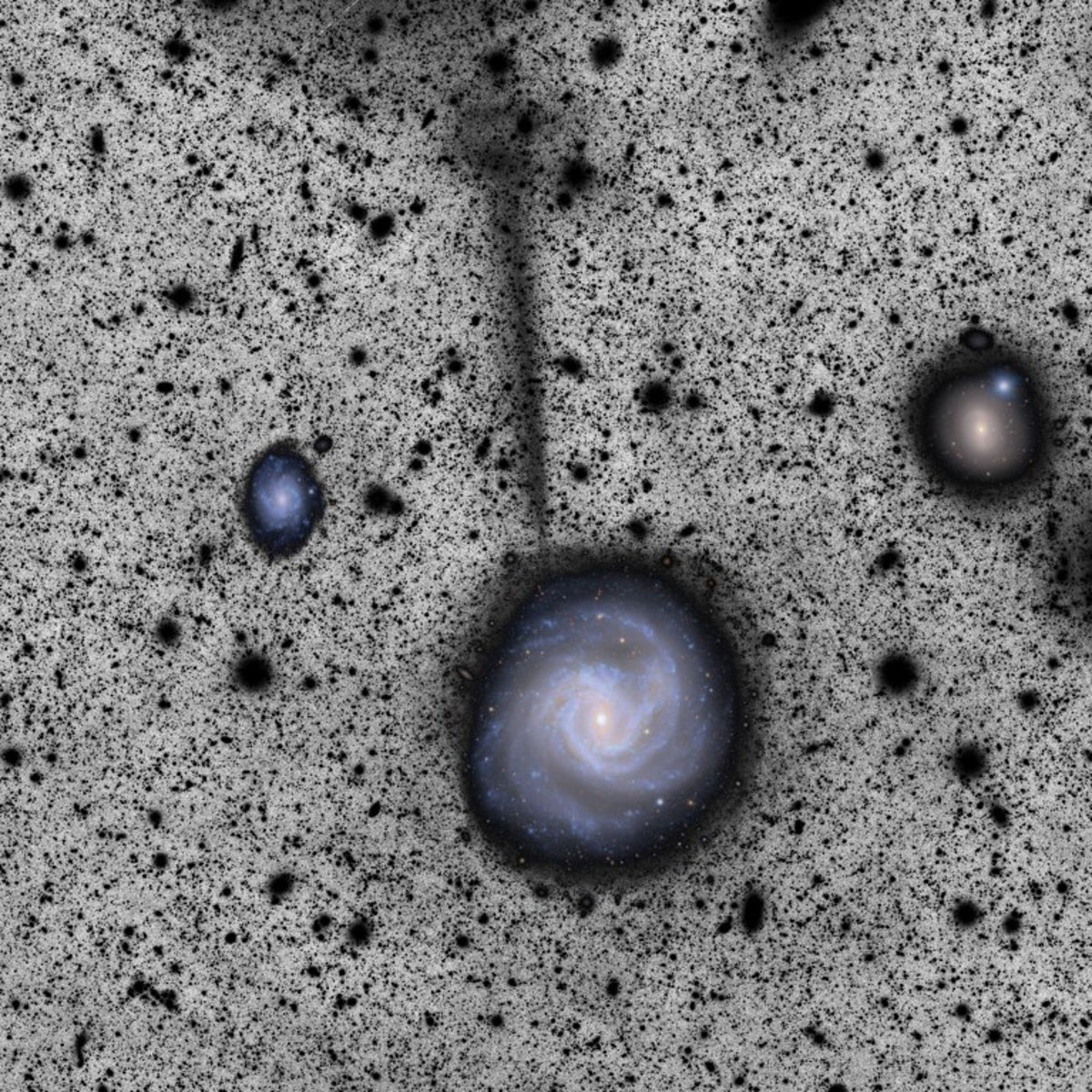
On November 8, 2025, a remarkable discovery was made by the Vera C. Rubin Observatory that promises to deepen our understanding of galaxy formation and evolution. Though the observatory has yet to begin its official scientific survey, its first test image has already revealed a surprising new feature of a well-known galaxy, Messier 61 (M61). This discovery, a previously undetected stellar stream extending from M61, offers fresh insights into the galaxy’s mysterious properties and potentially explains some of its unusual characteristics.
Located in the Virgo Cluster, M61 has long been a subject of fascination for astronomers since its initial observation in 1779. It is classified as a starburst galaxy, a type known for intense star formation activity. Over the years, M61 has hosted numerous supernovae and continues to produce new stars at a surprisingly high rate. Despite extensive studies using some of the world’s most advanced telescopes, including the James Webb Space Telescope and the Hubble Space Telescope, this newly discovered stellar stream had remained hidden—until now.
The Vera C. Rubin Observatory, perched atop a mountain in Chile, is equipped with the world’s largest digital camera, designed to capture vast swaths of the night sky with unprecedented detail. Even in this initial test image, the observatory’s capability to detect faint celestial features has become evident. By carefully filtering out excess light from the image, astronomers identified a long trail of stars—known as a stellar stream—stretching about 55 kiloparsecs, or roughly 180,000 light years, from M61. This makes it one of the longest stellar streams ever discovered.
Stellar streams are remnants of smaller galaxies or star clusters that have been gravitationally torn apart by larger galaxies. In this case, the stream likely originated from a dwarf galaxy that was shredded by M61’s gravitational pull. Such galactic interactions are fundamental to the way galaxies grow and evolve, often triggering waves of new star formation. The authors of the study suggest that this event might have significantly contributed to the starburst activity observed in M61, providing a compelling explanation for some of the galaxy’s previously puzzling features.
Sarah Pearson, an astrophysicist at the University of Copenhagen, emphasized the significance of this discovery as the first stellar stream detected by the Rubin Observatory. She views it as just the beginning, anticipating that many more such features will be uncovered as the observatory begins its full scientific mission. Aaron Romanowsky, an astronomer at San Jose State University and co-author of the study, expressed similar enthusiasm, noting that despite decades of intense observation of M61, this stellar stream had gone unnoticed until now. This underscores the enhanced sensitivity and power of the Rubin Observatory’s imaging technology.
The Rubin Observatory’s first image is a treasure trove, capturing light from an astonishing ten million galaxies. This glimpse into the cosmos is merely a prelude to what lies ahead. Over the next decade, the observatory is expected to observe approximately 20 billion galaxies—more than any other observatory in history. Such comprehensive coverage will allow astronomers to study galaxy formation and evolution on an unprecedented scale.
Romanowsky highlighted that stellar streams are expected to be a universal feature around galaxies, as they are a fundamental aspect of how galaxies assemble over time. However, detecting them requires observing extremely faint light that has eluded previous surveys. The Rubin Observatory’s advanced technology aims to reveal these faint structures, potentially transforming our understanding of cosmic history.
This discovery not only showcases the capabilities of the Vera C. Rubin Observatory but also opens new avenues for exploring the dynamic processes that shape galaxies. By detecting faint stellar streams, astronomers can reconstruct the interactions between galaxies and their smaller companions, gaining insights into how galaxies grow, evolve, and trigger bursts of star formation.
The findings were published in the Research Notes of the American Astronomical Society, marking a significant milestone for the Rubin Observatory and the broader astronomical community. As the observatory ramps up its operations, the scientific community eagerly anticipates further discoveries that will illuminate the hidden structures of the universe.
The Vera C. Rubin Observatory represents a new era in astronomy, combining cutting-edge technology with a vast, systematic survey of the night sky. Its unprecedented depth and breadth of observation promise to answer longstanding questions about galaxy formation and the large-scale structure of the cosmos. The detection of the stellar stream around M61 is a vivid demonstration of the observatory’s potential to reveal the universe’s subtle and intricate features.