
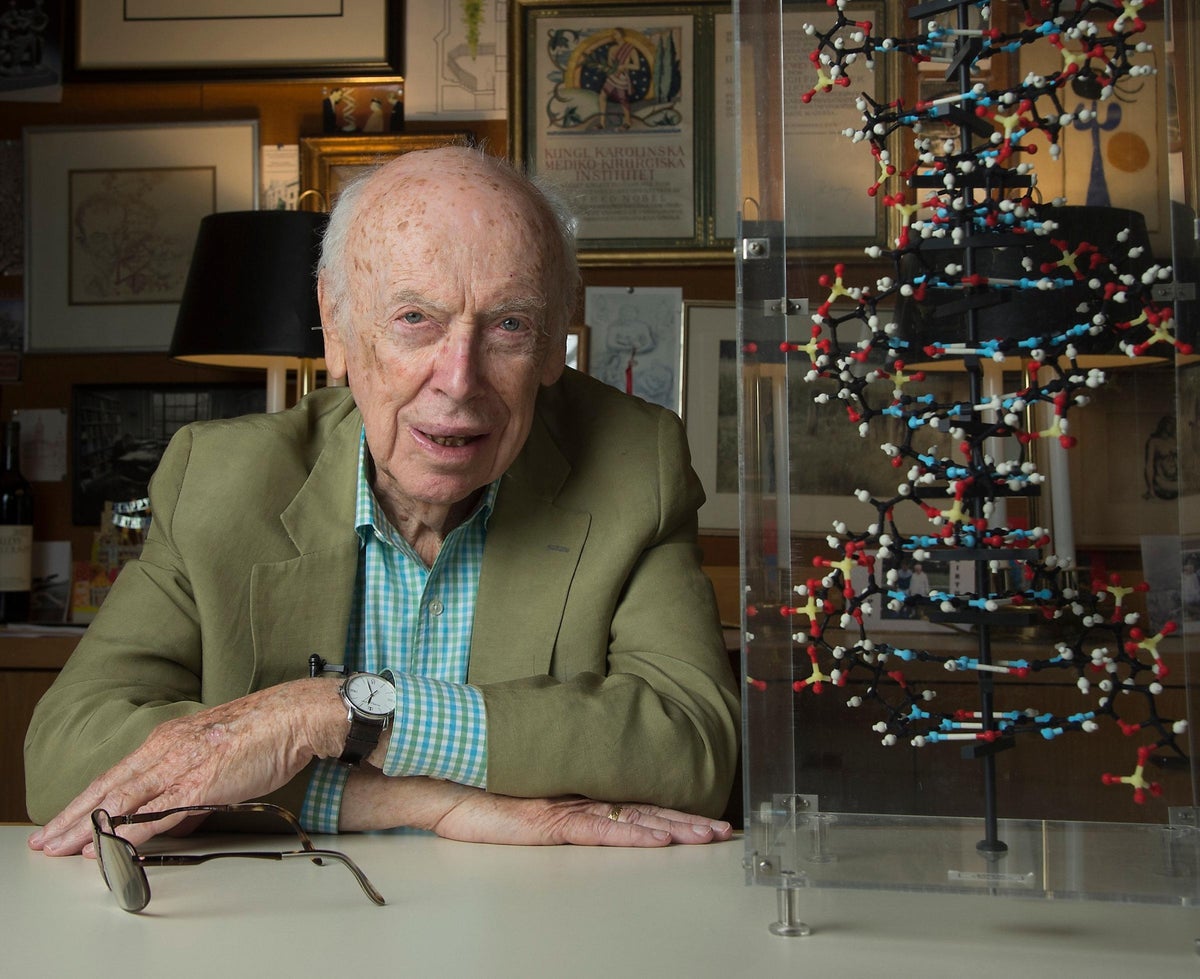
James Dewey Watson, a pioneering molecular biologist renowned for his critical role in uncovering the double-helix structure of DNA, passed away on November 6, 2025, at the age of 97. Watson’s groundbreaking work, which fundamentally transformed our understanding of genetics and biology, marked the beginning of a new era in molecular genetics and biotechnology. His contributions have left an indelible mark on science, shaping the trajectory of genetic research and its applications in medicine, agriculture, and beyond.
Born on April 6, 1928, in Chicago, Watson exhibited prodigious talent from an early age. Demonstrating a keen interest in science, he entered the University of Chicago at just 15 years old, where he pursued a degree in zoology. After completing his undergraduate studies, he continued to build on his scientific foundation by earning a Ph.D. from Indiana University in 1950. His academic journey set the stage for one of the most remarkable scientific collaborations of the 20th century.
In 1951, Watson joined the Cavendish Laboratory at the University of Cambridge in England. It was here that he met Francis Crick, another molecular biologist with whom he would forge a close partnership. Together, they embarked on a mission to decipher the molecular structure of DNA, the molecule responsible for storing genetic information in living organisms. Their collaboration combined Watson’s biological insight with Crick’s expertise in physics, enabling them to interpret complex experimental data and construct a model that would revolutionize biology.
A key element in their discovery was the use of X-ray diffraction images produced by chemist Rosalind Franklin and biophysicist Maurice Wilkins at King’s College London. Franklin’s meticulous work provided critical clues about the shape and dimensions of the DNA molecule, although she was not fully credited at the time. Drawing on this data and building upon existing knowledge, Watson and Crick proposed the double-helix model of DNA in 1953, a structure that explained how genetic information is stored, replicated, and transmitted from one generation to the next.
The discovery of the double helix was published in the scientific journal Nature, sparking a revolution in molecular biology. It illuminated the physical basis of heredity and paved the way for vast advancements in genetics, including the understanding of gene expression, mutation, and genetic diseases. For their groundbreaking work, Watson, Crick, and Wilkins were awarded the Nobel Prize in Physiology or Medicine in 1962. Unfortunately, Franklin had passed away by then, and the Nobel Committee’s rules do not allow posthumous awards, meaning her crucial contributions were recognized only much later by the scientific community.
Following this monumental achievement, Watson continued to advance molecular biology through his research and leadership. He joined the biology faculty at Harvard University, where his work shifted towards understanding messenger RNA (mRNA), a key molecule involved in translating genetic information into proteins. His research helped unravel the complexities of gene expression and regulation, further broadening the scope of molecular genetics.
In 1968, Watson was appointed director of Cold Spring Harbor Laboratory in New York, a position he held for several decades. Under his guidance, the laboratory evolved into a premier center for genetic research, fostering innovation and training generations of scientists. His leadership helped propel Cold Spring Harbor to the forefront of studies on genetics, molecular biology, and cancer research, solidifying its reputation as a leading institution in the life sciences.
Beyond his scientific research and administrative work, Watson was also an accomplished author. His books, including the candid and influential memoir *The Double Helix* and the comprehensive textbook *Molecular Biology of the Gene*, have educated and inspired countless students and researchers. *The Double Helix* offered an inside look at the race to discover DNA’s structure, blending scientific insight with personal narrative, while *Molecular Biology of the Gene* became a foundational text in molecular biology education.
Despite his scientific achievements, Watson’s legacy is complex and, at times, controversial. Over the years, he made repeated public statements linking race and intelligence in ways that were widely criticized as racist and scientifically unfounded. These remarks sparked significant backlash from the scientific community and the public alike. In 2007, facing mounting pressure, Watson resigned from his position at Cold Spring Harbor Laboratory. These controversies have cast a shadow over his otherwise monumental contributions to science, prompting ongoing debates about the responsibilities of prominent scientists in public discourse.
James Watson’s passing marks the end of an era in