
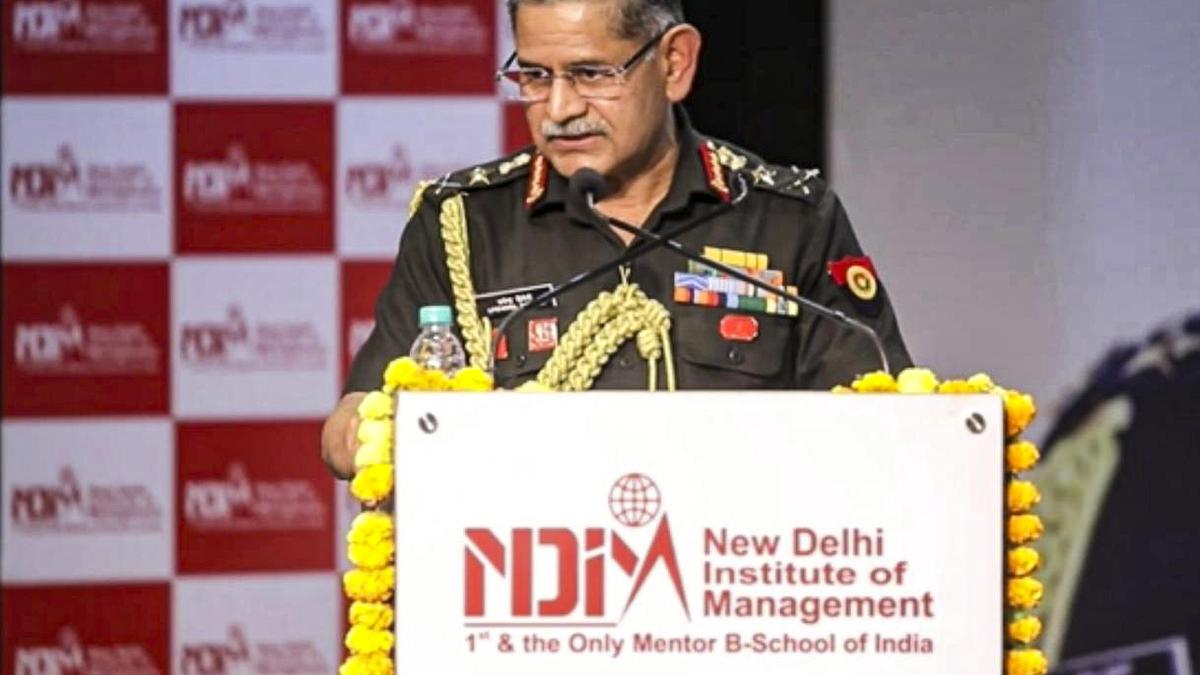
On November 22, 2025, General Upendra Dwivedi, Chief of the Army Staff (COAS) of India, delivered a compelling address at the convocation ceremony of the New Delhi Institute of Management (NDIM). His speech, themed “Navigating Change: The Real Constant,” offered a profound reflection on the evolving nature of global affairs, military strategy, technology, leadership, and adaptability. Central to his address was an insightful discussion on Operation Sindoor, India’s recent military operation against terrorist infrastructure in Pakistan and Pakistan-occupied Kashmir (PoK), which demonstrated the Indian armed forces’ precision, coordination, and strategic foresight.
General Dwivedi described Operation Sindoor as a “trusted orchestra” where every element of the armed forces played a simultaneous and synergistic role. This harmonious coordination allowed the Indian military to destroy nine terrorist targets within an astonishing 22 minutes. The operation, which began early on May 7, 2025, was not a spontaneous reaction but the result of years of anticipation and meticulous planning. “It was a response shaped not in the moment, but through years of imagining how intelligence, precision and technology could converge into action,” General Dwivedi explained. Over the span of nearly 88 hours, the conflict between India and Pakistan—including Pakistan’s offensives and India’s counter-offensives under Operation Sindoor—was brought to a halt after both sides reached an understanding on the evening of May 10.
The Army Chief highlighted that such swift and effective military action was only possible because of prior visualization, trust among the forces, and the ability to act decisively without hesitation. “There was no time for decision making, had we not visualized, and had we not trusted the entire team,” he noted. This emphasis on trust and preparedness underscored the broader theme of his speech: the importance of adapting to change and leading with wisdom and humility in a world that never stands still.
Addressing the graduating students, General Dwivedi urged them to embrace change as a constant and to cultivate courage, agility, and vision. “Markets will shift, technology will evolve, and your own ambitions will also change. Yet within that motion lies your greatest strength—the courage to learn, the agility to adapt, and the vision to lead with a purpose,” he advised. He stressed that change is not something that happens to us passively; rather, it is what individuals and organizations choose to become through their responses to change.
Expanding on the global context, General Dwivedi painted a picture of the 21st century as an era marked by increasing competition, contestation, and conflicts. He noted that more than 55 conflicts are currently raging worldwide, involving over 100 nations either directly or indirectly. This blurring of lines between peace and conflict, he suggested, is mirrored in the economic and geopolitical arena as well. The rise of nationalism, protectionism, and economic sanctions has ushered in the era of geoeconomics—a concept articulated by strategist Edward Luttwak that describes a logic of war expressed through commerce and economic interactions.
In this new paradigm, the traditional rules of engagement have been replaced by what General Dwivedi referred to as the “6Cs”: cooperation, collaboration, co-existence, competition, contestation, and conflict. These six dimensions govern both strategic military dealings and broader global interactions. “These are the 6Cs which we have to know together,” he emphasized, noting that students would encounter these dynamics in their future careers, whether in defense, business, or diplomacy.
Technology, according to General Dwivedi, is a critical driver of change and evolution, particularly in warfare. He traced the transformation of military technology from the days of “muddy trenches” and rifles to today’s intelligent networks, drones, and robotic systems. This technological revolution extends beyond the military, affecting businesses and everyday life alike—from simple consumer products to space exploration initiatives like the Gemini missions. The general stressed the significance of embracing these technological shifts proactively rather than reactively.
Reflecting on his own military career, General Dwivedi illustrated the notion of “velocity of relevance” — the speed at which one must adapt and remain significant in a rapidly changing environment. When he was commissioned, computers were not part of the Army's landscape. Today, however, the Indian Army employs data sciences and artificial intelligence in modern warfare, showcasing a dramatic transformation in operational capabilities. He highlighted ongoing efforts to restructure the Army for greater agility