
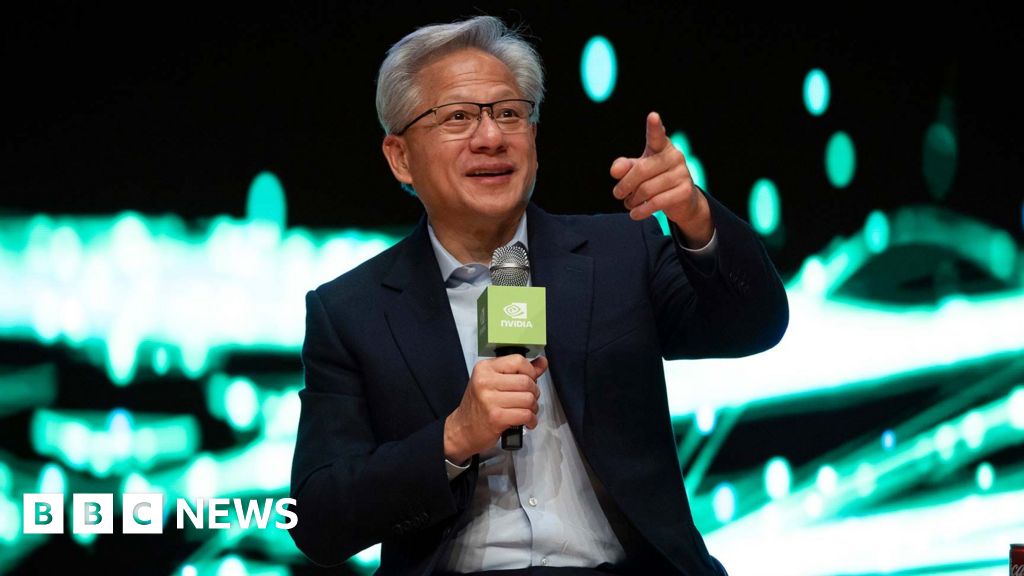
Nvidia, the leading semiconductor company at the forefront of the artificial intelligence (AI) revolution, recently reported significantly stronger-than-expected financial results, alleviating investor concerns about heavy AI-related spending that had unsettled the markets in recent weeks. The company’s performance highlights the robust demand for its AI chips, which power data centers critical to the rapidly growing AI sector.
For the quarter ending in October, Nvidia announced revenues of $57 billion, marking a remarkable 62% increase compared to the previous year. This surge was primarily driven by the sales of chips used in AI data centers, which alone contributed over $51 billion, representing a 66% rise. In addition to beating revenue expectations for the quarter, Nvidia forecasted fourth-quarter sales in the range of $65 billion, surpassing analyst estimates and sending the company’s shares up approximately 4% in after-hours trading. These results underscore Nvidia’s dominant position in the AI hardware market and its role as a bellwether for the broader AI boom.
Jensen Huang, Nvidia’s CEO, emphasized the extraordinary demand for the company’s AI products, dismissing fears of an AI bubble that some investors and analysts have raised. “There's been a lot of talk about an AI bubble. From our vantage point, we see something very different,” Huang said. He described sales of Nvidia’s AI Blackwell systems as “off the charts” and noted that the company’s cloud graphics processing units (GPUs) are currently sold out. “We excel at every phase of AI,” he added, highlighting the company’s technological leadership across the AI hardware ecosystem.
Nvidia’s role as the world’s most valuable company and its critical importance to AI infrastructure have made its quarterly reports exceptionally closely watched on Wall Street. The company’s success is a key indicator of the health and trajectory of the AI industry, especially amid growing concerns that some AI stocks may be overvalued. These worries had contributed to four consecutive daily declines in the S&P 500 index leading up to Nvidia’s earnings announcement, with the benchmark index falling nearly 3% in November alone. Investors have been grappling with uncertainty about the long-term returns on AI investments, particularly given the rapid price run-ups seen in many tech stocks.
The enthusiasm and caution surrounding AI today have drawn comparisons to the dotcom boom of the late 1990s. During that era, excitement about the internet’s potential drove the valuations of early online companies to unsustainable levels, ultimately leading to a market crash in the early 2000s. The bursting of the dotcom bubble devastated many companies and eroded the value of individual investors’ savings, including pension funds. Against this historical backdrop, Nvidia faced high expectations going into its earnings report.
Financial analysts widely anticipated that Nvidia would surpass revenue forecasts, but the key question was the magnitude of its outperformance. Adam Turnquist, chief technical strategist at LPL Financial, noted that the issue was “not whether the company would beat expectations, but by how much.” Similarly, Matt Britzman, senior equity analyst at Hargreaves Lansdown, praised Nvidia’s strong performance and distinguished it from other parts of the AI sector where valuations might be overheated. “While AI valuations are dominating the news feeds, Nvidia is going about its business in style,” Britzman said, emphasizing that Nvidia’s financial fundamentals remain sound.
Looking ahead, Nvidia has projected a staggering $500 billion in AI chip orders through the next year, reflecting the enormous scale of AI adoption and investment globally. Investors have been keen to understand when the company expects these revenues to materialize and how it plans to meet such unprecedented demand. Nvidia’s Chief Financial Officer, Colette Kress, indicated that the company would “probably” take on orders beyond the already announced $500 billion. However, Kress also expressed frustration with regulatory restrictions that limit Nvidia’s ability to export its chips to China, a major market for AI technology. She stressed the importance of gaining support from developers worldwide, including those in China, and highlighted Nvidia’s commitment to ongoing dialogue with both the American and Chinese governments.
In parallel with its financial announcements, Nvidia has been expanding its global footprint and partnerships in the AI space. At the US-Saudi Investment Forum in Washington, Nvidia’s CEO Jensen Huang joined Elon Musk to announce a massive new data center complex in Saudi Arabia. This facility will be equipped with hundreds of thousands of Nvidia chips and will count Musk’s AI company, xAI, as its first