
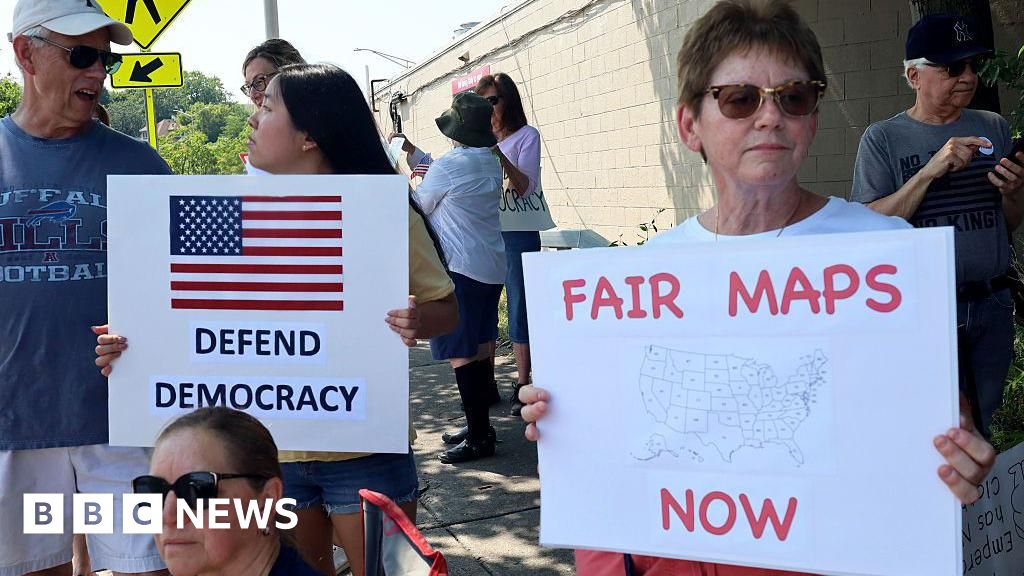
The ongoing battle over congressional redistricting in the United States has intensified, with Indiana emerging as the latest state to join a widening national tussle between Republicans and Democrats over the control of electoral maps. This struggle to redraw congressional district boundaries is a strategic effort by both parties to sway the balance of power in Washington ahead of the 2026 midterm elections. The redistricting conflict reflects deeper political tensions and has significant implications for the future composition of the U.S. House of Representatives.
At the heart of this dispute are large, populous states such as Texas and California, which have already taken bold steps to reshape their congressional districts in ways that favor their respective political parties. Texas, a Republican stronghold, made headlines this summer by approving a new map that creates five additional congressional seats likely to benefit Republicans. This move was part of a broader Republican strategy, encouraged by former President Donald Trump, to redraw districts mid-decade—a departure from the usual post-census redistricting schedule—aimed at securing a stronger hold on the House of Representatives.
In response, California, a Democratic bastion, swiftly countered by approving its own redrawn maps designed to increase Democratic representation by five seats. Unlike Texas, California’s new maps will be subject to voter approval before they can be implemented in the 2026 elections. To monitor this contentious process, Trump has directed federal poll watchers to California, underscoring the high stakes and national attention surrounding redistricting efforts.
Missouri followed suit with a Republican-led initiative to redraw its congressional districts, seeking to add an additional seat favorable to the GOP. Other states such as Ohio and North Carolina have announced plans to revisit their district boundaries, with Indiana now joining the fray by calling a special legislative session in December to discuss redistricting. These developments illustrate an emerging pattern where states controlled by either party use redistricting as a tool to influence the national political landscape.
Interestingly, not all redistricting maneuvers align neatly with party lines. For example, Utah, with a Republican governor, recently saw a judge order the adoption of new congressional maps that favor Democrats. This judicial intervention followed a ruling that the previous Republican-drawn map violated voter-approved rules against partisan gerrymandering and incumbency protection. Utah’s case highlights the legal complexities and checks that can shape redistricting outcomes, even in states dominated by one party.
The political tug-of-war over redistricting is set to intensify, with both Democrats and Republicans eager to leverage this process to gain an edge in the closely divided House of Representatives. Currently, Republicans hold a slim majority in the 435-member House, with Democrats needing to capture just three additional seats to flip control. Given that the president’s party historically loses seats in midterm elections, the stakes for redistricting are exceptionally high, as control of the House influences legislative priorities and oversight capabilities.
Redistricting is typically a decennial exercise following the U.S. Census, intended to reflect population shifts and ensure equal representation. However, the current mid-decade redistricting efforts, particularly in Texas, are unusual and have sparked significant controversy. Texas Democrats attempted to block the Republican redistricting plan by fleeing the state to deny the quorum needed for a vote, but returned after California announced its countermeasures. The Texas legislature ultimately passed the new map, which Governor Greg Abbott signed into law.
Critics, including Democrats and civil rights groups, argue that Texas’ new maps dilute the voting power of minority communities, potentially violating the federal Voting Rights Act. Lawsuits have been filed challenging the maps on these grounds. Gerrymandering—the practice of drawing electoral boundaries to benefit a political party—is legal unless it is found to be racially discriminatory. Both parties have engaged in gerrymandering, but the explicit political motivations behind recent efforts, openly supported by Trump, mark a notable shift in the transparency and intensity of the practice.
The controversy over redistricting is further complicated by the 2019 Supreme Court ruling that removed federal courts’ authority to block partisan gerrymandering. Chief Justice John Roberts stated that federal judges do not have the power to reallocate political power between parties, effectively leaving redistricting battles to be resolved through the political process and state courts.
The consequences of these battles extend beyond individual states. States led by Democrats, including Illinois, New York, New Jersey, New Hampshire, and Maryland, are exploring ways to counteract Republican gains in Texas. Meanwhile, Republican