
Comets are often seen as spectacular visitors in our solar system, with their glowing heads and long, bright tails that become visible as they near the Sun. These icy, dusty bodies, billions of kilometers away from the Sun, are frozen solid. However, as they approach the warmth of our star, the ice begins to vaporize, creating the iconic coma and tail that can sometimes be seen even with the naked eye. While a few comets become bright enough to be widely visible, most remain faint and only detectable with powerful telescopes, especially when they reside in the far reaches of the solar system beyond Neptune.
Given that planets are now understood to be common around other stars in our galaxy, it is natural to ask whether comets also exist beyond our solar system. Our Sun is surrounded by a vast collection of small cometary bodies, possibly numbering in the trillions, and astronomers have long suspected that similar populations may orbit other stars. However, detecting such “exocomets” presents an extraordinary challenge. The nearest star is tens of thousands of times farther away than Neptune, making any comet around it incredibly faint and difficult to observe. Despite these hurdles, astronomers have indeed identified dozens of stars hosting exocomet populations, with the first confirmed detections dating back nearly four decades.
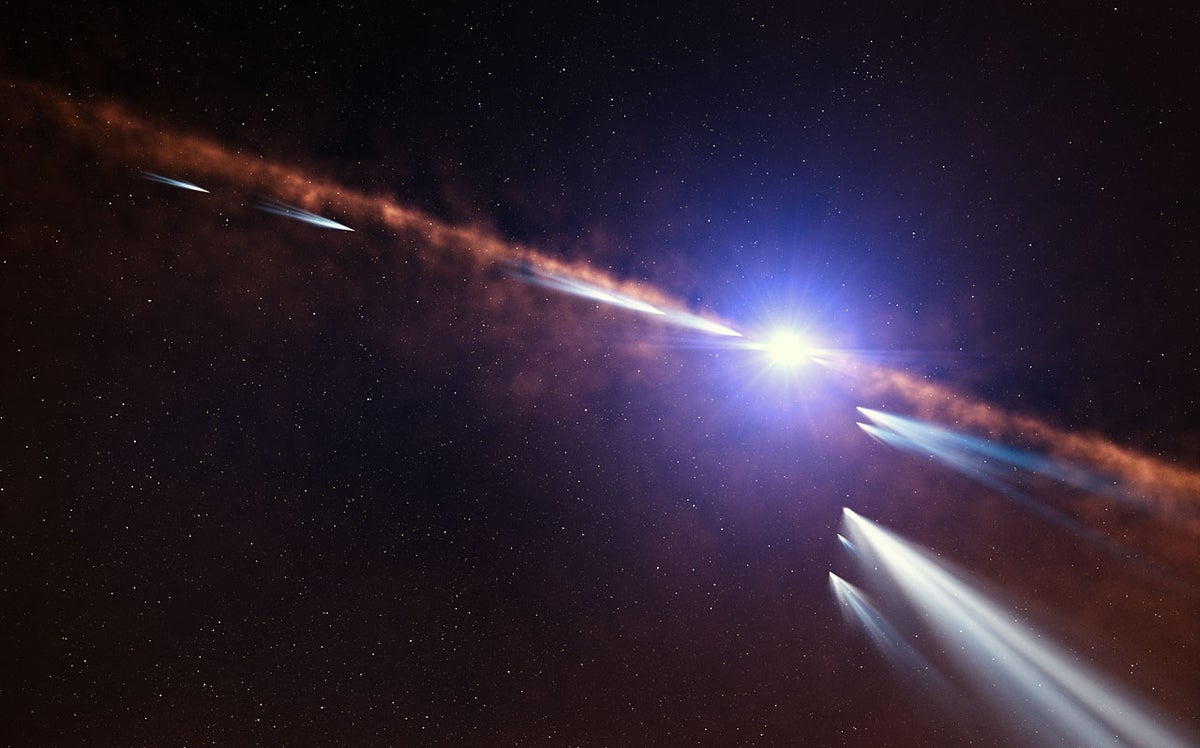
One of the most studied systems with exocomets is Beta Pictoris, a young star located about 60 light-years from Earth. In the early 1980s, infrared observations revealed a warm glow around Beta Pictoris, indicating a large debris disk left over from the star’s planet formation process. This disk was later confirmed to host at least two planets. However, in 1987, astronomers noticed strange, sporadic fluctuations in the star’s light spectrum. When analyzing the star’s light at different wavelengths, they observed rapid, irregular changes that were difficult to explain. After considering various possibilities, the presence of exocomets emerged as the most likely cause. These comets, falling inward from the debris disk, would occasionally pass in front of the star from Earth’s perspective, absorbing some of its light and creating the observed spectral variations.
Further studies over the years have confirmed the existence of these exocomets around Beta Pictoris. In fact, hundreds of exocomets have been detected, allowing scientists to categorize them into different groups much like the classifications used for comets within our solar system. Remarkably, these distant cometary bodies, orbiting a star trillions of kilometers away, exhibit characteristics strikingly similar to those of comets familiar to us at home.
Most discoveries of exocomet systems have relied on spectral analysis, but recent research has introduced new methods. A team led by undergraduate Adalyn Gibson at the University of Colorado Boulder reported the detection of a cometary cloud around RZ Piscium, a star about 600 light-years away, without relying on spectral data. RZ Piscium is a young star, slightly smaller and cooler than the Sun, surrounded by a warm debris disk as evidenced by excess infrared radiation. Instead of spectra, the researchers used brightness data gathered over several years by NASA’s Transiting Exoplanet Survey Satellite (TESS). This satellite typically detects planets by observing periodic dips in a star’s brightness as planets transit—or pass in front of—the star, causing a mini-eclipse.
However, the brightness fluctuations observed around RZ Piscium did not match the patterns expected from planets. Instead, the data showed about two dozen large dips in brightness, some reducing the star’s light by as much as 20 percent—much more than a planet would block. The team concluded that these significant dips were caused by clouds of gas expanding around exocomets orbiting the star, occasionally obscuring its light.
By analyzing the statistics of these events, the researchers estimated that the solid nuclei of these exocomets ranged from 1 to 7 kilometers in diameter. Interestingly, this size distribution closely resembles that of comets in our own solar system’s Kuiper Belt, a region filled with icy bodies beyond Neptune. This discovery is yet another reflection of how the distant cosmos can mirror familiar features of our own celestial neighborhood, offering a comforting sense of connection across the vast gulf of space.
While observing exocomets around distant stars is a remarkable achievement, astronomers have also detected exocomets that venture into our own solar system. Currently, an interstellar comet named 3I/ATLAS is passing through our neighborhood.