
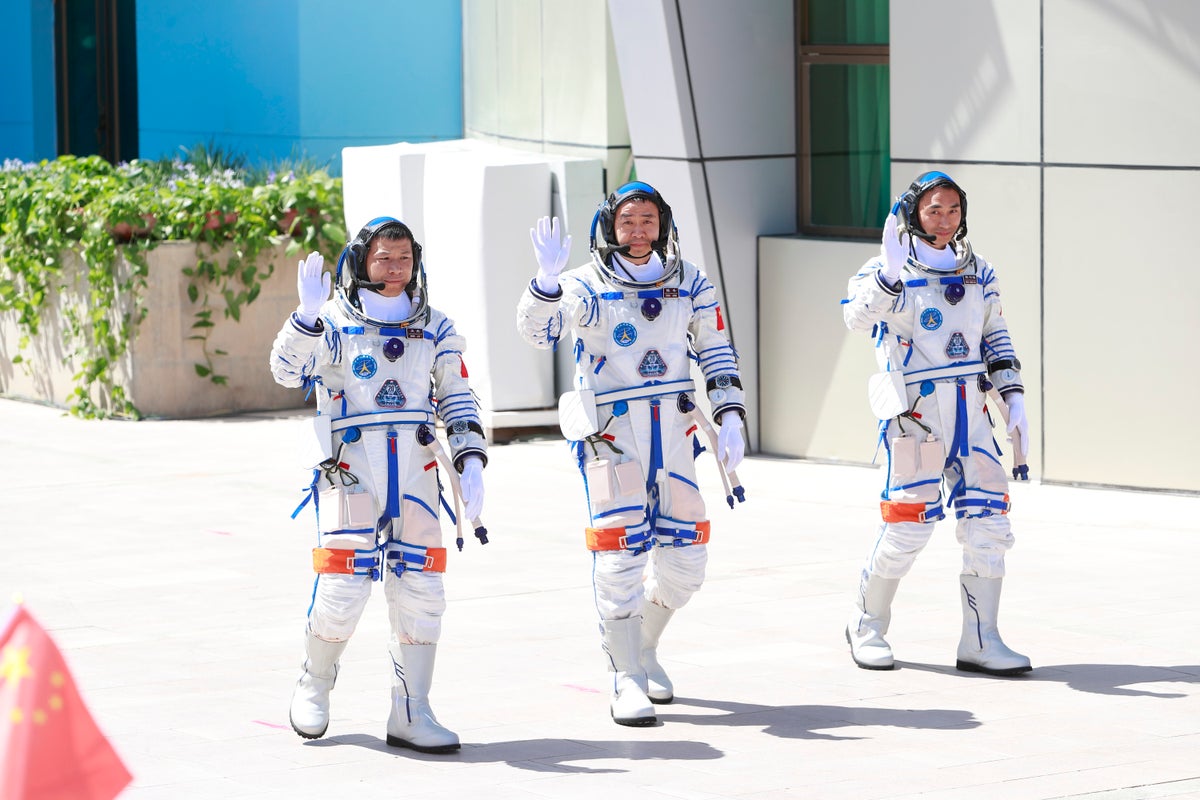
On November 7, 2025, the China Manned Space Agency (CMSA) announced a delay in the return to Earth of three astronauts aboard the Shenzhou 20 spacecraft, following a reported collision with a piece of space debris. The astronauts—Wang Jie, Chen Dong, and Chen Zhongrui—had been stationed on China’s Tiangong space station since their April 2025 launch. Although the extent of the damage to the spacecraft is still under investigation, the incident has raised serious concerns among space experts about the increasing dangers posed by space junk in Earth’s orbit.
This event marks the first known instance where orbital debris has directly impeded a crewed spacecraft’s return journey, underscoring a threat scientists have long predicted. “It was only a matter of time before this happened,” said Lauren Kahn, a research analyst at Georgetown University, who co-authored a recent comprehensive analysis on space debris. This analysis tracked 34,000 pieces of orbital debris larger than 10 centimeters cataloged since 1958, finding that the majority—73 percent—originated from just 20 major sources, primarily launches from China, the United States, and Russia.
Space junk, broadly defined, consists of all human-made objects in orbit that no longer serve a useful purpose. These include defunct satellites, spent rocket stages, fragments from explosions or collisions, and miscellaneous debris from past missions. As the volume of launches and space activities has surged in recent decades, so too has the population of debris, which can persist in orbit for decades before gradually descending due to atmospheric drag. This accumulation has created a hazardous environment for operational spacecraft, satellites, and space stations, all of which are vulnerable to high-speed impacts.
Currently, NASA estimates that over 45,000 human-made objects orbit Earth, ranging from large defunct satellites to tiny fragments. While objects larger than 10 centimeters can generally be tracked and monitored, the real peril lies in smaller debris pieces—sometimes as small as a bullet—that travel at speeds exceeding 27,000 kilometers per hour. According to Jonathan McDowell, an astronomer at the Center for Astrophysics | Harvard & Smithsonian, these small fragments are “time bombs in orbit” because even a tiny object can cause catastrophic damage if it strikes critical components of a spacecraft.
Although the CMSA has not disclosed specific details about the object that may have struck Shenzhou 20, McDowell emphasized that even a small impact could pose significant risks. Fortunately, the astronauts are expected to remain safe because China has another spacecraft docked to the Tiangong station, ready to serve as a backup rescue vehicle if the Shenzhou 20 is deemed unfit for reentry. This contingency highlights the importance of redundancy in crewed space missions, especially given the growing hazards in orbit.
The broader threat posed by escalating space debris is the potential for a chain reaction of collisions known as the Kessler syndrome. In this scenario, one collision generates more debris, which in turn causes further collisions, exponentially increasing the amount of hazardous material in orbit. Such a cascade could render certain orbital regions unusable and jeopardize the viability of many space operations.
Much of the concern centers on low-Earth orbit (LEO), where most human spaceflight and many satellite missions occur. According to Kahn’s analysis, over 83 percent of tracked debris resides in LEO, alongside about 13,000 active satellites—a tenfold increase from a decade ago. This crowded environment forces satellites to perform avoidance maneuvers tens of thousands of times annually to prevent collisions with debris or other spacecraft. McDowell warns that if the number of satellites continues to multiply, the frequency of these maneuvers could grow disproportionately, complicating traffic management and increasing the risk of accidents.
Despite these risks, plans are underway to launch mega constellations of small satellites, similar to SpaceX’s Starlink system, and to develop orbital data centers such as Nvidia’s Starcloud. McDowell notes that there is currently no limitation on how many satellites can be launched, which exacerbates the potential for congestion and collisions in orbit.
Victoria Samson, chief director of space security and stability at the nonprofit Secure World Foundation, highlights two particularly worrisome issues: the absence of effective methods to clean up existing space debris and a lack of international coordination to prevent collisions that generate new debris. This is especially problematic given the geopolitical complexities between major spacefaring nations like the