
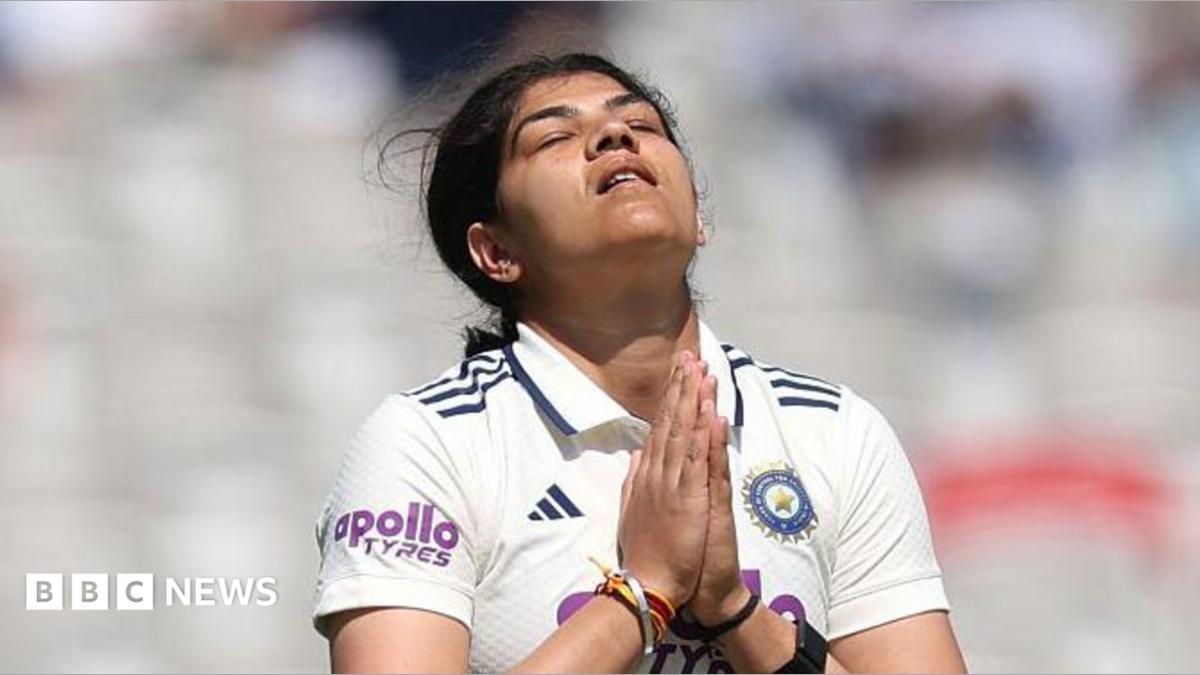
On a historic Monday afternoon at London's iconic Lord's cricket ground, the Indian women's cricket team achieved a landmark victory that marked a significant milestone in the half-century journey of women's cricket in India. The moment came when off-spinner Sneh Rana, a bandana-wearing bowler from a small town in northern India, delivered a crucial ball that bowled England's Sophie Ecclestone, sealing a 270-run win for India. This victory was not only emphatic-the largest by any visiting team against England in women's Test cricket and the fourth largest overall-but also symbolic, celebrating decades of progress and perseverance.
The match itself was historic for multiple reasons. It was the first women's Test ever played at Lord's, often called the Home of Cricket, occurring 142 years after the venue hosted its first men's Test. For the Indian team, captained by Harmanpreet Kaur, the win was the first-ever women's Test victory at Lord's and extended their unbeaten Test record in England to ten matches, comprising three wins and seven draws. The triumph came 40 years after India's maiden women's Test tour of England in 1986, underscoring a long journey of growth and achievement.
Harmanpreet Kaur, now India's most successful Test captain with four wins in the format, expressed her pride and gratitude in the aftermath. Speaking to the host broadcaster, she emphasized the special nature of playing at Lord's and thanked those who advocated for staging a women's Test at the prestigious ground. "These kinds of matches bring a lot of happiness and excitement," she said, adding hope for more Test matches and continued strong performances from the team.
The occasion was especially poignant for Harmanpreet, who at 37 was playing only the eighth Test of her 17-year international career-a reflection of the limited opportunities women cricketers of her generation have historically had in the longest format of the game. At a pre-match press conference, she acknowledged the significance of still being part of this historic day, saying, "Maybe it's late but not too late. Still I'm playing and still getting this opportunity."
History was made in other ways as well. For the first time, Indian women cricketers earned places on the fabled Lord's Honours Boards, which record outstanding performances in Test matches. On Saturday, 22-year-old seam bowler Kranti Gaud became the first woman to feature on the bowling board after taking five wickets for 37 runs in England's first innings. Gaud's story is compelling; she hails from Ghuwara, a small town in central India, where her mother once pawned jewellery to buy her a cricket kit, highlighting the sacrifices behind her rise.
The following day, Yastika Bhatia, a left-handed batter from Vadodara in western India, secured a place on the batting board with a confident 113 runs-her first international century and the first-ever women's Test hundred at Lord's. In her post-match remarks, Bhatia paid homage to the pioneers of Indian women's cricket, acknowledging their invaluable contributions. "Their contribution has inspired us to take up cricket and to perform the way we are doing today," she said, lamenting that these trailblazers had not received the recognition they truly deserved. Bhatia called for a moment of gratitude towards those early players who laid the foundation for the current generation's success.
The victory was a team effort, with different players stepping up at various stages. Vice-captain Smriti Mandhana set the tone with an aggressive tally of 153 runs, the highest individual score of the match. Alongside her, Harmanpreet Kaur, Deepti Sharma, and Richa Ghosh all contributed half-centuries. On the bowling front, seamer Sayali Satghare impressed with her pace, while the spin trio of Sneh Rana, Deepti Sharma, and debutant N Sree Charani provided crucial control and breakthroughs. This balanced team performance reflected the depth and talent that had been nurtured over years.
The significance of the Test victory extended beyond the immediate triumph. It arrived just eight months after India's landmark win in the senior Women's ODI World Cup held in Navi Mumbai, and only two weeks after a disappointing T20 World Cup campaign ended in a group-stage exit at Lord's. Thus, the Test win represented not only a historical achievement but also a reaffirmation of India's growing stature in women's cricket.
The roots of organized women's cricket in India trace back to 1973, when Mahendra Kumar Sharma, the founding secretary of the Women's Cricket Association of India (WCAI), spearheaded efforts to formalize the sport for women. The WCAI, driven largely by volunteers and operating with limited resources, nurtured the first generations of Indian women cricketers with immense dedication.
In 1976, India played their first officially recognized international series under the captaincy of Shantha Rangaswamy from Bengaluru. This was a six-Test series against the West Indies, starting in Bengaluru and culminating in India's maiden international victory in the fourth Test held in Patna. A decade later, the Indian women toured England for the first time, playing three Tests and three ODIs. Notable leaders from that era included Shubhangi Kulkarni, who captained the opening Test at Wetherby, and Diana Edulji, who led the remaining Tests at Blackpool and Worcester.
Four decades after that initial tour, Harmanpreet Kaur and her "trailblazing band of sisters" maintained India's unbeaten Test record in England. Their performances connected past and present generations: Smriti Mandhana became only the second Indian woman after Sandhya Agarwal to score 70 or more runs in both innings of a Test, while Sneh Rana's fourth haul of four or more wickets in her 10 Test innings placed her alongside Neetu David and behind only Shubhangi Kulkarni and Jhulan Goswami in terms of bowling achievements.
Before the match, Harmanpreet had acknowledged the debt owed to prior generations. "Our seniors have always supported us immensely," she said. "No matter how difficult the phases in our lives have been, they have always stood by us. It is because of their support that we have been able to grow so much over the years." These sentiments resonated deeply as celebrations unfolded in front of unprecedented crowds.
The match attracted a cumulative attendance of 37,846 spectators over four days, setting a record for women's Test cricket. Among the notable attendees on the final day was Indian batting legend Sachin Tendulkar, who was at Lord's exactly 24 years after playing a key role in India's NatWest Series final victory under Sourav Ganguly's captaincy. ICC chairman Jay Shah and several Board of Control for Cricket in India (BCCI) officials were also present to witness the historic occasion.
Despite the presence of many prominent figures, none of India's original pioneers were at Lord's to see the victory firsthand. Yet through the voices and performances of players like Harmanpreet Kaur and Yastika Bhatia, the legacy of those early trailblazers remained central to the story.
Fifty years after Indian women's cricket entered the international arena, a journey that began on modest grounds across the country reached a defining and proud moment with a historic Test win at the Home of Cricket. The match was not just a sporting achievement but a tribute to decades of dedication, struggle, and progress-a moment for the past and the present to unite in celebration.
This historic victory at Lord's signals a new chapter for women's cricket in India, promising more opportunities and inspiring generations to come. The journey that started in 1973 with volunteer-driven efforts and modest beginnings has culminated in a landmark triumph on one of cricket's most revered stages, affirming the growth and global stature of Indian women's cricket.
*Annesha Ghosh is a freelance sports journalist, broadcaster, and documentary producer.*