
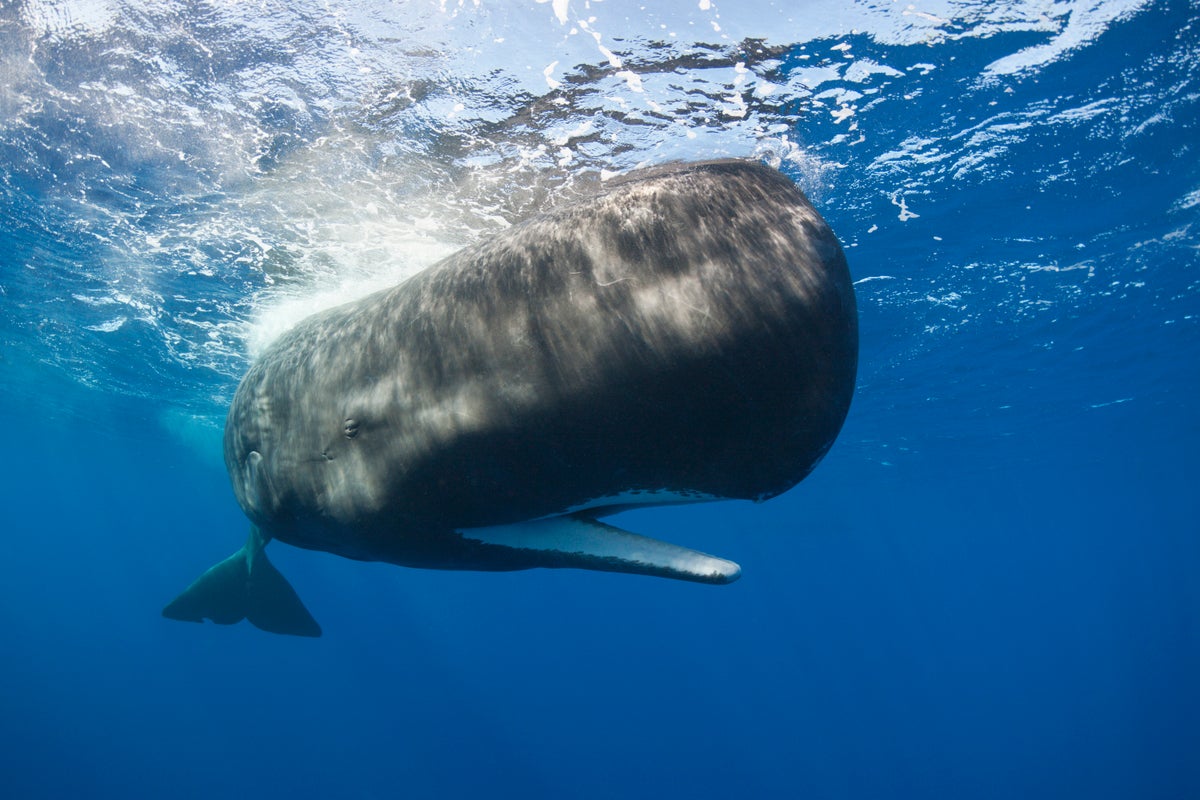
A recent study published in the journal Proceedings of the Royal Society B: Biological Sciences has revealed intriguing new insights into the communication system of sperm whales, suggesting that these marine mammals may produce vowel-like sounds in their clicking calls, akin to human speech. This discovery sheds light on the complexity of sperm whale vocalizations and hints at deeper parallels between human language and whale communication than previously understood.
Sperm whales are known for their distinctive clicking sounds, which they use to communicate with one another across vast ocean distances. These clicks are produced by rapidly flapping specialized structures in their noses called "phonic lips," somewhat analogous to human vocal cords. The whales combine individual clicks into rhythmic sequences known as codas, which vary notably between different whale clans. Historically, scientific analysis of sperm whale communication has primarily focused on the rhythm and timing of these clicks, interpreting them in a manner similar to Morse code.
However, scientists from Project CETI-a nonprofit organization dedicated to decoding sperm whale language-have uncovered a new dimension to these vocalizations. Their research, led by University of California, Berkeley linguist Gašper Beguš, indicates that sperm whales produce two distinct types of clicks that differ based on frequency relationships within the sound, a characteristic known as a "formant." In human speech, formants shape the unique sounds of vowels, allowing us to distinguish between "a," "e," "i," "o," and "u." The Project CETI team found that sperm whales similarly manipulate their vocal apparatus to create different vowel-like sounds within their clicks.
These subtle vowel distinctions are difficult for the human ear to detect in real time, but become evident when the recordings are sped up or analyzed using spectrograms-visual representations of the sound frequencies present in a vocalization. Spectrograms are widely used in linguistics to distinguish vowel sounds in human speech by showing which frequency bands are resonating within the vocal tract. The researchers propose that sperm whales achieve variation in their clicks' formants by altering the shape of a structure called the distal air sac located in their nose, in a way comparable to how humans change mouth and throat shape to produce different vowels.
For ease of study, the scientists labeled the two click types the "a-coda" and "i-coda," drawing an analogy to human vowels. The key question was whether these different click types were used randomly or followed systematic patterns that might suggest intentional communication. The study found that sperm whales do use these vowel-like clicks in specific, repeated patterns.
For example, one rhythmic sequence resembling a "click... click... click-click-click" pattern contained an almost equal mix of a-codas and i-codas, while other codas predominantly featured a-codas and rarely included i-codas.
Additionally, a-codas tended to be shorter in duration compared to i-codas, which appeared in both short and long forms. Such distinctions in sound length and patterning are reminiscent of human languages where vowel length can change word meaning, as seen in languages like Arabic.
These findings imply that sperm whales actively control which type of click to produce within their communication system, following structured rules rather than random vocalizations. However, the exact significance of these different vowel-like clicks remains unknown. Beguš emphasizes that although researchers do not yet understand whether these sounds carry specific meanings, the complexity and systematic use of these vocal patterns likely evolved for some communicative purpose.
Experts outside the study have praised the research for expanding our understanding of sperm whale communication. Mason Youngblood, a scientist who studies vocal communication in songbirds and whales at Stony Brook University, noted that the ability to distinguish different vowel-like sounds means sperm whales can convey more information than previously thought. This recognition of nuanced acoustic variation marks a significant advance in appreciating the sophistication of whale communication systems.
The discovery that sperm whales employ distinct vowel-like clicks, controlled with precision and arranged in meaningful patterns, challenges earlier assumptions that their communication was solely rhythmic or mechanical in nature. Instead, it opens the door to exploring how these intelligent marine mammals may use complex vocalizations to share information, coordinate social behaviors, or even express ideas in ways comparable to human language.
While much remains to be learned about the meanings behind sperm whale codas and their vowel-like components, this study represents a critical step toward decoding the rich and intricate language of one of the ocean's most iconic species. The work also highlights the broader importance of interdisciplinary research-combining linguistics, biology, and acoustic science-to unravel the mysteries of animal communication and deepen our understanding of intelligence and language evolution across species.
Allison Parshall, associate editor for mind and brain at Scientific American and a contributor to various science media, authored the article summarizing these discoveries. She underscores the vital role that scientific inquiry and public support for research play in advancing knowledge about the natural world, particularly at a time when science faces unprecedented challenges and scrutiny.
In sum, the recent findings from Project CETI suggest sperm whales do not merely produce clicks as simple signals but manipulate vowel-like sounds in their calls similarly to how humans use vowels in speech. This revelation enriches our comprehension of whale communication, inviting further study into the parallels between human and animal languages and the cognitive capacities of these remarkable creatures.