
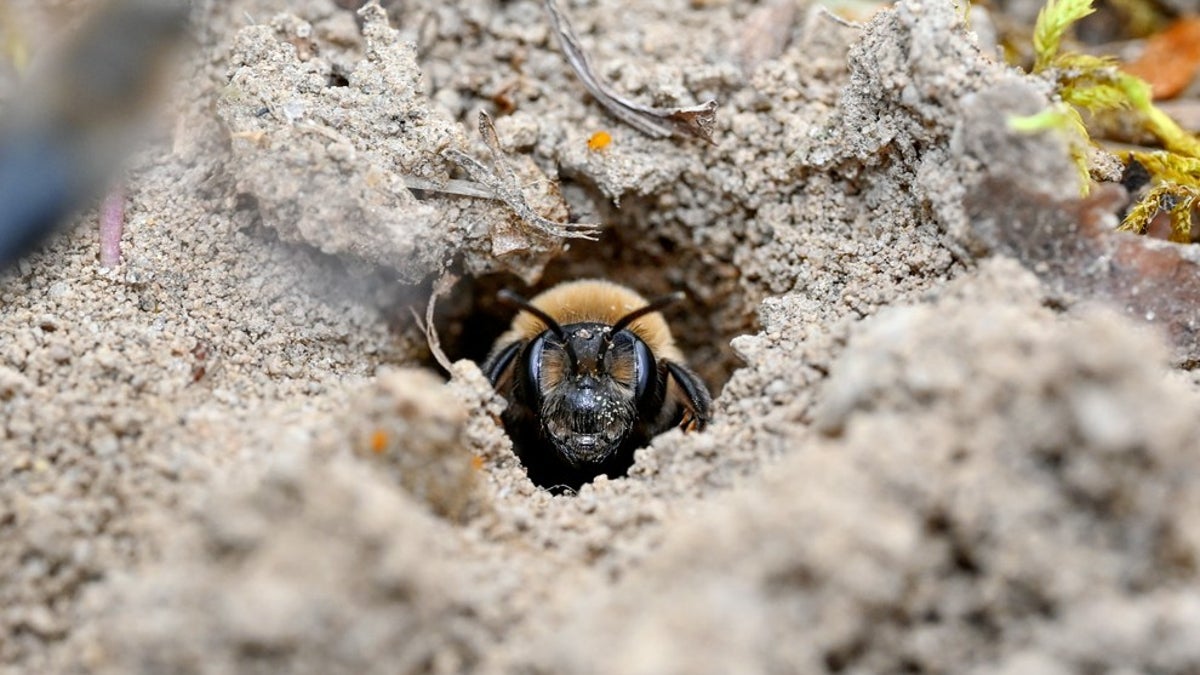
A recent study has unveiled a remarkable and massive bee aggregation beneath a cemetery in New York State, revealing an estimated population of nearly 5.6 million ground-nesting bees. This discovery not only highlights one of the largest bee colonies ever recorded but also suggests that this aggregation is among the oldest known, shedding new light on the often-overlooked solitary bees that play a crucial role in pollination.
The study focused on the East Lawn Cemetery in Ithaca, New York, a site with historical roots dating back to 1878. Scientists have known for decades that the regular mining bee, scientifically known as Andrena regularis, has been present at this location since at least 1935. However, the true scale of their population remained a mystery until now. Researchers from Cornell University undertook a detailed investigation during the spring of 2023, collecting data over approximately six weeks to estimate the number of these bees nesting underground.
Their findings, published in the journal Apidologie, revealed an extraordinary abundance of bees emerging from the soil. The researchers estimated that around 5.56 million individual A. regularis bees took flight during the spring season across an area of roughly 6,500 square meters. To put this in perspective, the typical honeybee colony numbers around 30,000 members, and on apple farms-where Cornell entomology professor Bryan Danforth, the study's senior author, has conducted extensive research-there are usually only two to three honeybee colonies per hectare (roughly the size of two football fields). The sheer scale of the mining bee aggregation in the cemetery thus far exceeds expectations.
Professor Danforth expressed his astonishment at the results, noting that while previous studies have documented bee aggregations in the hundreds of thousands, the figure of over five million was unprecedented in his experience. Other studies cited in their research provide a comparative context: a site in Arizona was estimated to have about 1.6 million Centris caesalpiniae bees over a smaller area, while a suburban lawn in upstate New York hosted around 650,000 Melissodes bimaculatus bees. In Brazil, an aggregation of approximately 13,500 Epicharis picta bees was recorded in an even smaller patch of land. The East Lawn Cemetery's bee population far surpasses these numbers, emphasizing its exceptional scale.
This discovery offers important ecological insights, especially regarding the role of cemeteries and similar habitats in supporting pollinator populations. Unlike the commonly recognized honeybees that live in hives, about 70 percent of bee species in the United States are ground-nesting and solitary. These solitary bees do not form large colonies but instead nest individually in burrows underground. Despite their solitary nature, these bees are vital pollinators, contributing significantly to the health of natural ecosystems and agriculture.
Professor Danforth highlighted that solitary bees remain largely underappreciated, even though they perform essential pollination services. Their hidden lifestyles, often underground or in less conspicuous habitats, mean they frequently go unnoticed by the general public and even some scientists. The new findings underscore the importance of recognizing and protecting these solitary bee species, particularly in urban and semi-urban areas where natural habitats are increasingly fragmented.
The study also sheds light on the potential conservation value of cemeteries, which may serve as refuges for pollinators amid expanding human development. These spaces often feature grassy areas with limited pesticide use, making them suitable habitats for ground-nesting bees. The East Lawn Cemetery, with its long history and relatively undisturbed environment, has evidently provided a stable home for A. regularis for nearly a century.
The research involved systematic sampling and careful calculation to estimate the bee population. By tracking the bees' emergence during their active season, the scientists could infer the size of the underground nesting population. Such large-scale aggregations are rare to document, partly because solitary bees do not form visible hives and their underground nests can be difficult to detect.
This study adds to a growing body of knowledge emphasizing the diversity and ecological significance of solitary bees. While honeybees often dominate conversations about pollination, solitary ground-nesting bees like Andrena regularis contribute substantially to the pollination of wild plants and crops alike. Their health and abundance are critical to maintaining biodiversity and agricultural productivity.
In addition to ecological importance, the findings carry broader implications for environmental stewardship and urban planning. Recognizing cemeteries and other green spaces as valuable pollinator habitats could influence how these areas are managed, encouraging practices that support bee populations, such as reducing pesticide use and preserving native vegetation. Protecting solitary bees is increasingly urgent given global concerns over pollinator declines caused by habitat loss, pesticides, disease, and climate change.
The research team's work at East Lawn Cemetery not only reveals an extraordinary natural phenomenon but also invites greater appreciation and awareness of the hidden lives of solitary bees. Their study underscores the need to broaden conservation efforts beyond the more familiar honeybee to encompass the diverse range of pollinators essential to ecosystem health.
Jackie Flynn Mogensen, the reporter who covered this study, is a science journalist with experience in environmental communication and earth sciences. Her reporting helps bring attention to pivotal scientific discoveries and the importance of supporting science and research in today's world.
In summary, the discovery of nearly 5.6 million ground-nesting bees beneath a New York State cemetery represents a landmark finding in entomology and ecology. This massive aggregation of Andrena regularis bees highlights the critical role of solitary bees in pollination and the potential of urban green spaces like cemeteries to serve as important pollinator habitats. The study calls for increased recognition and protection of these often-overlooked insects, which are vital to sustaining the health of both natural and agricultural ecosystems.