
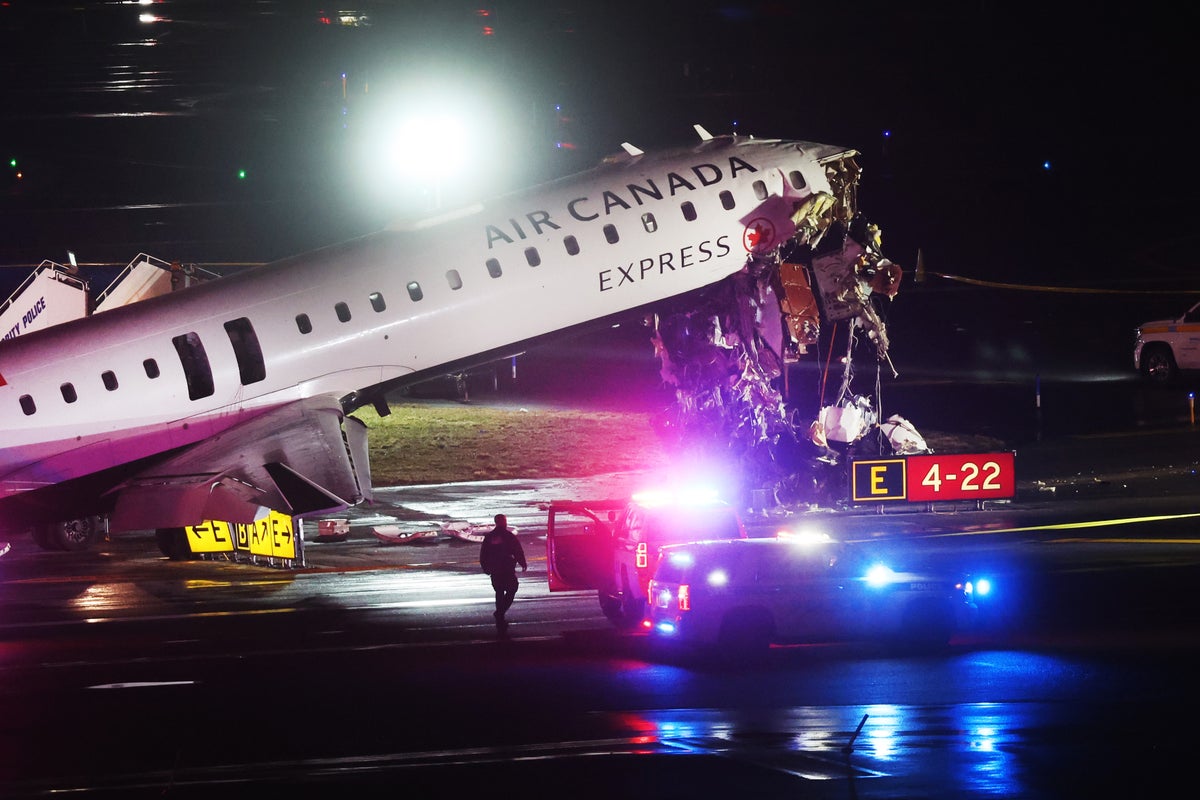
On the evening of Sunday, March 22, 2026, a tragic accident unfolded at New York’s LaGuardia Airport involving an Air Canada aircraft and a fire truck on the runway. The collision resulted in at least two fatalities and numerous injuries, leaving many to question how such a deadly incident could occur at one of the busiest airports in the United States. Aviation experts have since weighed in to explain why the crash was so destructive, shedding light on both the circumstances of the accident and the fundamental design limitations of commercial airplanes when it comes to collisions with ground vehicles.
The Air Canada plane had just landed at LaGuardia after a flight from Montreal, carrying approximately 72 passengers and four crew members. According to preliminary reports, the aircraft was traveling at speeds exceeding 90 miles per hour when it collided with a fire truck that was responding to a separate incident on the runway. The force of the impact sheared off the plane’s nose cone—a section of the aircraft that houses critical radar equipment but is made of relatively fragile plastic rather than metal. Tragically, both pilots aboard the plane lost their lives in the crash. In addition, 41 passengers and two firefighters were hospitalized, with 32 people released by the following afternoon. The severity of the remaining injuries has not been fully disclosed.
In the immediate aftermath, investigators and the public alike have focused on the role of air traffic control, which reportedly authorized the fire truck’s movement onto the runway but then attempted to halt it. However, experts emphasize that the catastrophic nature of the collision cannot be fully understood without considering the inherent design of airplanes and how they differ from vehicles built for ground collisions.
Unlike cars, airplanes are engineered primarily for airworthiness—that is, the ability to safely fly, withstand turbulence, and manage emergency landings. According to Michael McCormick, an associate professor specializing in air traffic management at Embry-Riddle Aeronautical University, aircraft are designed to endure routine takeoffs and landings on their landing gear. They can even survive emergency “wheels-up” landings, where the aircraft must slide along the runway on its belly. However, they are not built with features to absorb impacts with ground vehicles such as fire trucks. “Automobiles are designed to take collisions and tested multiple times in multiple ways. Aircraft are not,” McCormick notes, pointing out that planes lack safety elements common in cars, like airbags, bumpers, and reinforced frames specifically intended to absorb crash forces.
John Hansman, a professor of aeronautics and astronautics at the Massachusetts Institute of Technology, adds that airplane components are optimized for flight rather than collision resistance. For instance, while cockpits are reinforced to withstand bird strikes, and engines beneath the wings are designed to detach safely during water landings, airplanes are simply not made to “bump into things.” Hansman explains that every aspect of an aircraft’s structure balances strength with weight considerations, since adding structural reinforcement increases weight, which in turn reduces fuel efficiency and overall performance.
The vulnerability of the plane’s nose cone is particularly notable. This section contains radar equipment vital for navigation and is constructed from plastic to allow radar signals to pass through. If it were metal, the radar would not function properly. This necessary design choice unfortunately leaves the nose cone susceptible to damage in collisions, as seen in the LaGuardia crash.
Another factor limiting the pilots’ ability to avoid the crash was the physics of aircraft operation on a runway. Unlike automobiles, planes cannot swerve sharply or stop instantaneously. Although pilots are trained to perform “touch-and-go” maneuvers—where the plane briefly touches down and immediately takes off again—achieving sufficient speed to become airborne requires time and distance. Hansman points out that once a plane reaches a certain speed on the runway, there is little it can do to avoid an unexpected obstacle. “If it pulled out suddenly in front of you, there wouldn’t be anything you could do,” he says.
Furthermore, the characteristics of LaGuardia Airport itself may have contributed to the situation. McCormick describes LaGuardia as a “notoriously short” airport, with runways that were originally built for smaller aircraft and later extended in the 1960s to accommodate commercial jets. Although it remains unclear if the runway length played a direct role in this incident, the limited space available may have constrained the pilots’ options during the landing sequence.
Following the accident, authorities closed LaGuardia Airport on Monday to