
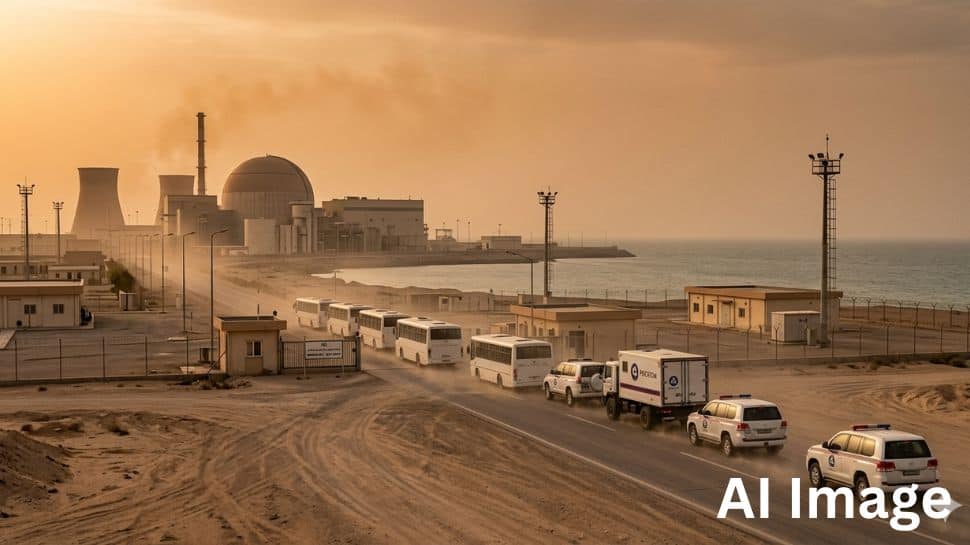
Russia has evacuated 163 staff members from Iran's Bushehr Nuclear Power Plant following recent attacks on the facility, raising serious concerns about the safety of the region's most sensitive nuclear site. The evacuation was confirmed by Rosatom, Russia's state-owned nuclear corporation and a leading global nuclear technology provider. By early Wednesday morning Moscow time, these personnel had already reached the Iranian-Armenian border, while approximately 300 workers remain at the plant to oversee ongoing operations.
This evacuation comes in the wake of a second strike on the Bushehr plant within a single week. The Iranian Atomic Energy Organization attributed the March 24 attack to aerial and missile operations carried out by the United States and Israel. Despite these assaults, Iranian officials reported no structural damage to the reactor, no injuries among staff, and confirmed that the plant's operations continued uninterrupted. This incident followed a similar attack on March 17, which also resulted in no damage, casualties, or radiation leaks.
The Bushehr Nuclear Power Plant, located on Iran's southwestern coast along the Persian Gulf, is a critical facility for the country's energy infrastructure. The presence of Russian nuclear specialists at the plant reflects international cooperation in managing and maintaining the reactor. Rosatom's CEO, Alexey Likhachev, stated that while most personnel had been evacuated for safety, a small team would remain onsite to manage equipment and ensure the plant's stability.
Despite the attacks, there has been no detected release of radiation from Bushehr. Iranian nuclear authorities, alongside international observers and regional governments, have found no evidence of radioactive contamination in the atmosphere, water sources, or surrounding environment. The plant's safety systems are reported to be fully functional, and there has been no call for evacuation of nearby civilian populations related to radiation concerns.
In response to the strike, the Kuwait National Guard issued a precautionary alert to its citizens. Although Kuwait is located roughly 240 kilometers from the nearest nuclear reactor, the National Guard advised residents to stay indoors, avoid unnecessary travel, and keep doors and windows closed. Officials reassured the public that radiation risks from neighboring countries remain minimal and pose no significant threat to Kuwait's borders. This measure reflects heightened regional tensions and concerns about potential nuclear hazards amid ongoing conflict.
The attacks on the Bushehr facility are part of a broader escalation of violence in West Asia, where a war has now entered its fourth week. The conflict has resulted in more than 2,300 deaths in Iran alone, including over 1,300 civilians and nearly 200 children under age 12. The extensive fighting has severely damaged infrastructure, strained global energy markets, and disrupted international shipping through the strategically vital Gulf region.
Israel has also suffered significant impacts from the war. On March 22, Iranian ballistic missiles struck the southern Israeli towns of Arad and Dimona, injuring over 100 people, including children. These missile attacks caused substantial damage to residential areas and overwhelmed local emergency services. The conflict's origin traces back to coordinated strikes by the United States and Israel targeting Iran, which killed several senior Iranian officials. In retaliation, Tehran launched missile and drone assaults on Israel and US military bases across the Gulf and sought to impede maritime traffic through the Strait of Hormuz, a critical chokepoint for global oil shipments.
The ongoing hostilities have intensified geopolitical tensions in the Gulf, a region already fraught with complex rivalries and security concerns. The targeting of the Bushehr Nuclear Power Plant, a facility with significant international involvement, adds a dangerous nuclear dimension to the conflict. While no radiation leaks have occurred so far, the repeated strikes underscore the risks posed to nuclear infrastructure in conflict zones.
Rosatom's evacuation of its personnel underscores the seriousness of the threat environment surrounding the Bushehr plant. Maintaining operational safety at nuclear sites amid military hostilities is a challenge that draws international attention, given the potential for catastrophic consequences in the event of a nuclear accident or deliberate attack.
Meanwhile, regional governments and international observers continue to monitor the situation closely. The absence of detected radiation leaks provides some reassurance, but the potential for escalation remains a concern. Kuwait's precautionary measures illustrate the anxiety felt by neighboring countries that could be affected by any nuclear incident.
As the West Asia war continues, the humanitarian toll and geopolitical instability grow. The conflict's impact on civilians, infrastructure, and global energy supplies has broad implications beyond the immediate region. Efforts to de-escalate tensions and secure vital facilities like the Bushehr Nuclear Power Plant remain urgent priorities for local and international actors.
In summary, the recent evacuation of Russian nuclear staff from Iran's Bushehr Nuclear Power Plant follows two missile and aerial strikes attributed to US and Israeli forces. Despite these attacks, the plant remains secure with no radiation leaks reported, and operations continue under a reduced staff. The incident highlights the heightened risks to nuclear facilities amid ongoing conflict in the Gulf region. Kuwait has issued precautionary alerts amid concerns about potential radiation exposure, though no immediate threat is indicated. The broader war in West Asia has resulted in thousands of deaths, extensive infrastructure damage, and strained international relations, underscoring the urgent need for conflict resolution and safeguarding of critical civilian infrastructure.