
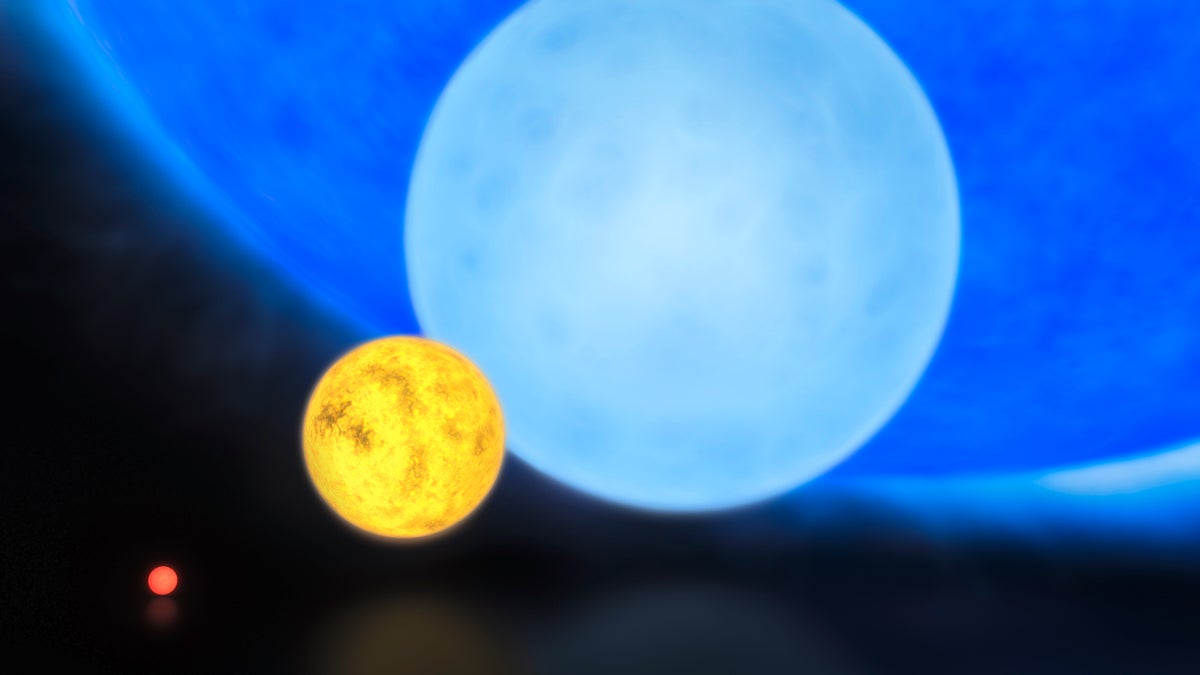
The question of how massive a star can become is one that fascinates astronomers and space enthusiasts alike. While many people consider our sun to be an average star, this common assumption is misleading. In reality, the sun ranks among the more massive stars in the universe, falling within the top 10 percent by mass. This is largely because the majority of stars scattered throughout the cosmos are far smaller and cooler than the sun. These are the red dwarfs—dim, low-mass stars that contain only a fraction of the sun’s mass, sometimes as little as 7 to 8 percent. This lower limit is significant because a star must have enough mass to sustain nuclear fusion in its core, the process that defines a star’s very existence.
At the opposite end of the spectrum lie the colossal stars, some hundreds of times more massive than our sun. But there’s a natural limit to how massive a star can grow, a cosmic boundary shaped by the interplay of gravity and nuclear fusion. Understanding this upper limit requires a dive into the physics of stars and how their mass influences their structure and behavior.
Mass, rather than size or weight, is the critical factor when discussing stars. Unlike planets, stars don’t have solid surfaces, and the largest stars are so bloated and diffuse that their boundaries gradually fade into space. Weight, which depends on gravity, varies depending on where you measure it, but mass is an intrinsic property. The mass of a star governs the delicate balance between inward gravitational pull and the outward pressure generated by energy released from nuclear fusion at its core.
Nuclear fusion in stars is the process of combining lighter atomic nuclei, primarily hydrogen, into heavier ones, such as helium. This reaction releases tremendous amounts of energy in the form of gamma rays, which heats the star’s interior and causes it to radiate light. The rate of fusion depends heavily on the star’s core temperature, which itself is determined by the star’s mass. For stars like the sun, the fusion rate scales approximately with the fourth power of the temperature—meaning that even a slight increase in core temperature dramatically increases the energy output.
For very massive stars, the fusion process is even more temperature sensitive. Their energy generation rates can scale as steeply as the twentieth power of the core temperature. This means that doubling the core temperature in a massive star can increase its energy output by a million times. Such extreme sensitivity creates a powerful feedback loop. As the star gains mass, gravity compresses the core, raising the temperature and accelerating fusion. But if the fusion rate becomes too intense, the star’s outer layers are heated so much that they expand and can be blown away into space, leading the star to lose mass.
This self-regulating mechanism limits how massive a star can become. Stars that grow too large become unstable, undergoing violent outbursts and shedding material to maintain equilibrium. Theoretical models suggest that the upper mass limit for stars today is around 300 times the mass of the sun. Stars near this threshold are extraordinarily rare, with only a handful known to exceed 200 solar masses.
The most massive star confirmed so far is R136a1, located in the Large Magellanic Cloud, a satellite galaxy about 160,000 light-years from Earth. R136a1 is a staggering 290 times the mass of the sun and shines with seven million times the sun’s luminosity. It resides within the R136 star cluster, which was initially mistaken for a single star due to its incredible brightness. Subsequent observations with the Hubble Space Telescope revealed it to be a cluster of stars, with R136a1 as the dominant and most massive member. Despite its immense size and brightness, R136a1 is relatively young, estimated to be around one million years old, with only a few million years left before it ends its life in a spectacular supernova explosion.
While stars like R136a1 represent the upper mass limit of stars in the modern universe, this boundary has not always been fixed. The cosmic environment and the chemical composition of stars have evolved over time, influencing how large stars can become. One key factor is the abundance of heavy elements, called metals in astronomical terms, present in a star’s outer layers. These elements absorb energy from the star’s interior, heating the outer layers and causing the star to lose mass through stellar winds. Even trace amounts of heavy elements can significantly affect the star’s stability and maximum mass.
In the early universe, however, heavy elements