
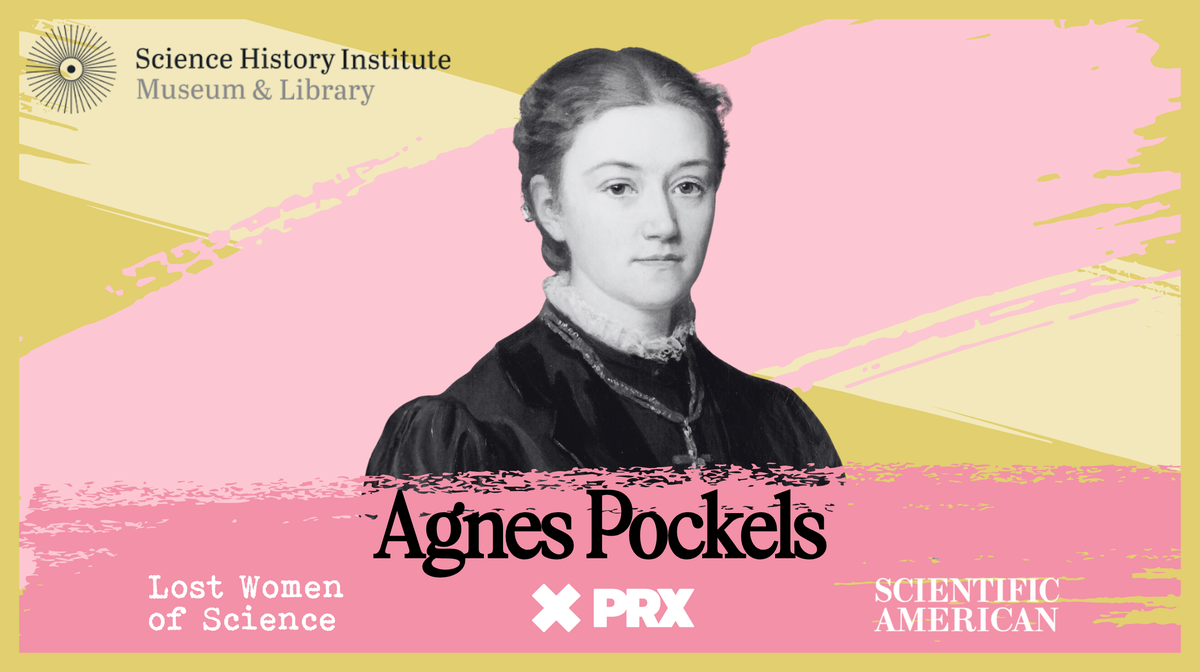
Agnes Pockels was a pioneering figure in the field of surface science whose remarkable contributions have often been overshadowed by reductive and gendered narratives about women’s roles in the home. Her invention of an experimental device known as the Pockels trough laid the groundwork for important advances in material science, including those made by Katharine Burr Blodgett and Irving Langmuir, whose work quietly influences many everyday technologies today. Yet, as historians and scientists reflect on Pockels’s life and legacy, they urge us to reconsider how success in science is defined and to dismantle the assumptions that have long shaped the telling of her story.
Born in 1862 in Venice during the time it was part of the Austrian Empire, Agnes Louise Wilhelmine Pockels grew up in a family with scientific interests. Her father was an army officer who fell ill with malaria, prompting the family to relocate to Braunschweig in the newly unified German Empire. Despite the social constraints of the era, which barred women from attending university, Agnes pursued her passion for natural science through self-education, aided by her younger brother Fritz, who later studied physics at the University of Göttingen. Fritz shared his textbooks with Agnes, facilitating a scientific dialogue between the siblings that was characterized by mutual respect and intellectual exchange, challenging the common trope that women in science were only involved through male relatives.
Agnes’s interest centered on the physical properties of water surfaces and the effects of impurities such as oils and soil. To explore these phenomena, she ingeniously constructed the Pockels trough using household items, including an old pharmacist’s balance and a button as a measuring disk. This apparatus allowed her to measure the surface tension of liquids and to observe how molecules behaved at interfaces — foundational work in the field of surface science. Her meticulous experiments and observations led to the definition of what is now called the Pockels Point, describing the minimal area a single molecule occupies in a monolayer film.
In 1891, Agnes sent a letter detailing her findings and experimental methods to John Strutt, the third Baron Rayleigh, a distinguished physicist and Nobel laureate. Lord Rayleigh recognized the significance of her work and the sophistication of her instrument, requesting details so he could replicate the apparatus. He described her as a “German lady” working with “homely appliances,” a phrase that reflected both the domestic setting of her laboratory and the gendered expectations of the time. Nevertheless, he valued her contribution, forwarding her letter to the scientific journal Nature for publication—an uncommon honor for a woman in the 19th century.
Over the next several years, Agnes continued to refine her experiments and corresponded with Lord Rayleigh, showing a remarkable level of rigor and self-critical analysis. She even highlighted potential sources of experimental error, such as contaminated equipment, demonstrating her commitment to scientific precision. Despite never holding an official scientific appointment, she published fourteen papers on her work and was later recognized with the Laura R. Leonard Prize from the Colloid Society in 1931.
A pervasive and problematic narrative associated with Agnes is the anecdote that she became interested in surface science while doing the dishes, a story that neatly ties her scientific curiosity to traditional domestic roles for women. Historians and scholars now challenge this simplification, pointing out that such a trope diminishes the deliberate, systematic nature of her research and reinforces gender stereotypes. Agnes’s work was not a happenstance discovery born of household chores but the product of a curious and educated mind intentionally engaged in scientific inquiry.
The context of Agnes’s home life further complicates the story. While some might assume she performed all household tasks herself, historical evidence suggests that domestic help was likely available in her upper-middle-class household, making the dishwashing story even less credible. Moreover, Agnes’s decision to conduct research at home was not necessarily a sign of amateurism or lack of seriousness. In fact, the concept of “amateur” science in the 19th century was not derogatory; many respected scientists, including Lord Rayleigh himself, conducted significant research outside formal institutions. The home laboratory was a legitimate site of scientific investigation, and Agnes’s work exemplifies this tradition.
In 1893, Agnes was invited to conduct research in the laboratory at the University of Göttingen, where her brother studied. Yet she chose to remain at home to care for her ailing parents, a decision shaped by familial duty, social expectations, and health considerations. Her parents’ poor health