
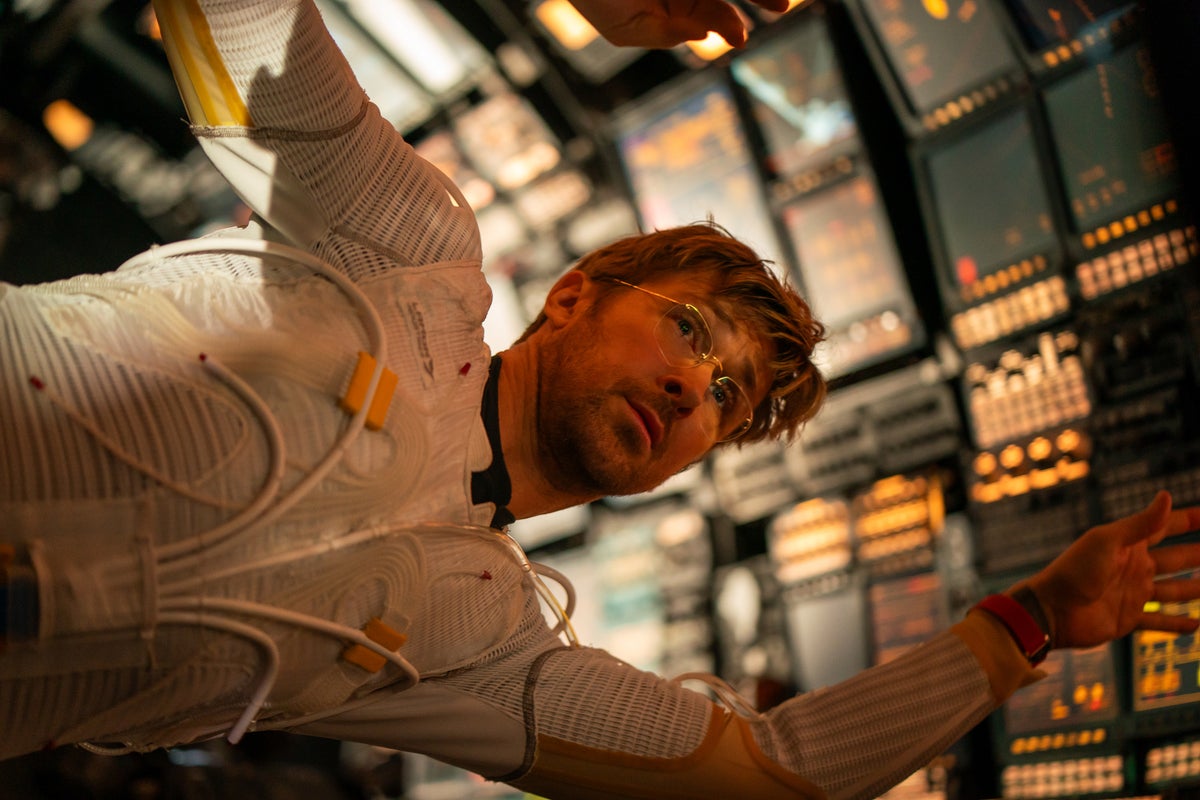
The science-fiction film *Project Hail Mary*, released on March 20, 2026, has quickly captured audiences with its thrilling narrative of an unlikely hero’s mission to save Earth from an existential threat. Starring Ryan Gosling as Dr. Ryland Grace, a middle school teacher turned astronaut, the movie explores complex scientific ideas involving quantum physics, space travel, astrobiology, and mass-to-energy conversion. While the story is undeniably fantastical, it is rooted in genuine scientific concepts that lend the film a surprising level of plausibility.
At the heart of *Project Hail Mary* is an alarming scenario: alien microbes, known as Astrophage, are consuming the sun’s energy, causing the star to dim and threatening life on Earth with extinction. These microbes travel between the sun and Venus to reproduce, progressively draining the sun’s power. To combat this cosmic crisis, Dr. Ryland Grace embarks on a one-way mission to Tau Ceti, a star twelve light-years from Earth, where he encounters Rocky, an alien lifeform that becomes his unexpected companion.
The film’s creator, Andy Weir, who wrote the original book on which the movie is based, went to great lengths to ensure the scientific underpinnings of the story were as accurate as possible. Weir not only conducted thorough research into relevant physics, astronomy, and biology but also served as a consultant during filming. This collaboration helped maintain scientific integrity even as actors improvised dialogue—sometimes requiring minor tweaks to terminology to keep the science plausible. For example, when an actor mistakenly used “milligrams” instead of “nanograms,” Weir intervened to correct the detail, illustrating his commitment to accuracy.
One of the most intriguing scientific ideas in the film revolves around the Astrophage’s extraordinary ability to absorb neutrinos—tiny, nearly massless particles that pass through ordinary matter almost undetected. Neutrinos are produced in enormous quantities by the sun and other stars, streaming endlessly through space and even through our bodies without us noticing. Weir imagined that Astrophage could harness the mass-energy of neutrinos, converting their mass into usable energy in a process that, while speculative, is grounded in real physics principles such as Einstein’s famous equation E=mc².
Physicist Chad Orzel explains that while the concept of microbes traveling between the sun and Venus is not impossible, it would require different energy expenditures depending on the direction of travel. The microbes would have an easier time moving from the sun to Venus, aided by solar particles streaming outward, but the return journey would demand more energy to counteract the solar wind. Weir’s imaginative solution posits that Astrophage use neutrino absorption to power their propulsion, converting matter into energy far more efficiently than humans currently can. This fictional mechanism fuels the spacecraft, the Hail Mary, that carries Gosling’s character across interstellar space.
The film also grounds its setting in real astronomical systems. Tau Ceti is a genuine star known to astronomers, located about 12 light-years from Earth. Another star featured in the story, 40 Eridani, home to Astrophage and Rocky’s species, lies roughly 16 light-years away. The exoplanet Adrian, visited by the characters, corresponds to Tau Ceti e, a real exoplanet cataloged by astronomers, though much about it remains unknown. Weir intentionally selected stars similar to our sun to maintain biological plausibility, reflecting his belief that life sharing a common ancestor would likely emerge around stars with comparable elemental compositions.
The film also touches on deep biological connections between Earth life and the alien microbes. Astrophage are depicted with cell organelles called mitochondria—structures critical to energy production in Earth’s cells. Astrobiologist Mike Wong points out that mitochondria evolved on Earth, and while many Earth organisms lack them, their presence in Astrophage suggests a distant shared ancestry. This idea aligns with Weir’s concept that all life in the solar system’s neighborhood descends from an ancient progenitor from Tau Ceti, creating a cosmic family tree that spans light-years.
Beyond astrobiology, *Project Hail Mary* explores the concept of artificial gravity, a staple of space travel fiction. The film shows parts of the spacecraft rotating to generate centripetal force, simulating gravity for the crew—an idea supported by physics and actively researched by companies like Vast, where astronaut and consultant Drew Feustel works. However, the