
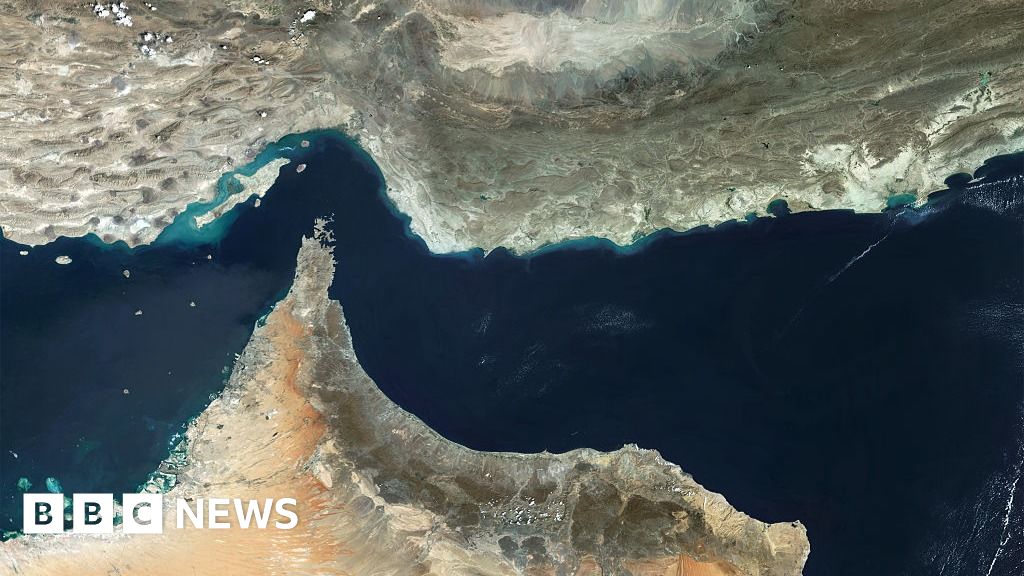
The Strait of Hormuz, a narrow yet crucial maritime passageway, has once again become a focal point of geopolitical tension and global economic concern. Iran has issued a stark warning that it will "set fire" to any ships attempting to navigate this vital corridor, effectively threatening to block one of the world’s busiest oil shipping lanes. This announcement comes amid heightened regional conflicts and retaliatory actions linked to US and Israeli strikes, which have already unsettled international markets and pushed oil prices upward.
The significance of the Strait of Hormuz cannot be overstated. Located between Iran to the north and Oman and the United Arab Emirates (UAE) to the south, this waterway connects the Persian Gulf with the Arabian Sea. Despite its narrow width—only about 50 kilometers (31 miles) wide at its entrance and exit and narrowing down to approximately 33 kilometers at its tightest point—the strait accommodates some of the world’s largest crude oil tankers. Its strategic importance is underscored by the volume of oil that transits through it daily; estimates from the US Energy Information Administration (EIA) suggest that in 2025, around 20 million barrels of oil passed through the strait each day. This translates to nearly $600 billion (£447 billion) worth of energy trade annually.
Oil exports through the Strait of Hormuz do not originate solely from Iran. Other Gulf states such as Iraq, Kuwait, Qatar, Saudi Arabia, and the UAE also depend heavily on this route to transport their crude oil to global markets. On average, about 3,000 ships transit the strait each month, making it a bustling artery of international commerce. The disruption of this route, therefore, has far-reaching global implications, affecting not only the Gulf economies but also major oil-importing countries, particularly in Asia.
Iran’s recent declaration, voiced by General Sardar Jabbari, that it will “not let a single drop of oil leave the region” if provoked, signals a potentially severe escalation. This statement is a direct response to perceived aggression by the US and Israel and reflects Tehran’s willingness to leverage its control over the strait as a strategic tool. The threat of blocking or attacking ships has already created a climate of fear and uncertainty among shipping companies and traders. According to Arne Lohmann Rasmussen, chief analyst at Global Risk Management, the strait is effectively “closed” in practical terms, as insurers are reluctant to cover vessels passing through due to the high risk of attack. This lack of insurance and the potential for hostile actions mean that many tankers are either delaying transit or diverting their routes, further tightening the supply chain.
The impact on oil prices has been immediate and noticeable. Following a weekend during which at least three ships were attacked near the strait, the global benchmark Brent crude briefly surged to $82 (£61) a barrel. This spike reflects the market’s sensitivity to any perceived disruption in supply from this chokepoint. Reuters reported that approximately 150 tankers have been stranded due to these tensions, unable or unwilling to traverse the waters. The cost of shipping oil has also soared; the London Stock Exchange Group data reveals that the price of hiring a supertanker to transport oil from the Middle East to China has nearly doubled within a week, reaching a record high of over $400,000 (£298,300).
The broader economic consequences of a prolonged closure or blockade are profound. Gulf countries, particularly Saudi Arabia, whose economies are heavily reliant on energy exports, would suffer significant losses. Saudi Arabia operates alternative infrastructure such as a 1,200-kilometer pipeline capable of transporting 5 million barrels of crude oil per day, which could partially offset the disruption. The UAE has also developed pipelines connecting inland oilfields to the port of Fujairah on the Gulf of Oman, bypassing the strait, with a capacity of at least 1.5 million barrels per day. However, even with these alternatives, the loss of the strait’s full capacity would reduce supply by an estimated 8 to 10 million barrels per day, a shortage that would ripple through global markets.
Iran’s own oil exports amount to approximately 1.7 million barrels per day, generating about $67 billion (£50 billion) in revenue for the financial year ending March 2025, according to the International Energy Agency and the Central Bank of Iran. Blocking the strait would thus be a double-edged sword, potentially damaging Iran’s own economic interests