
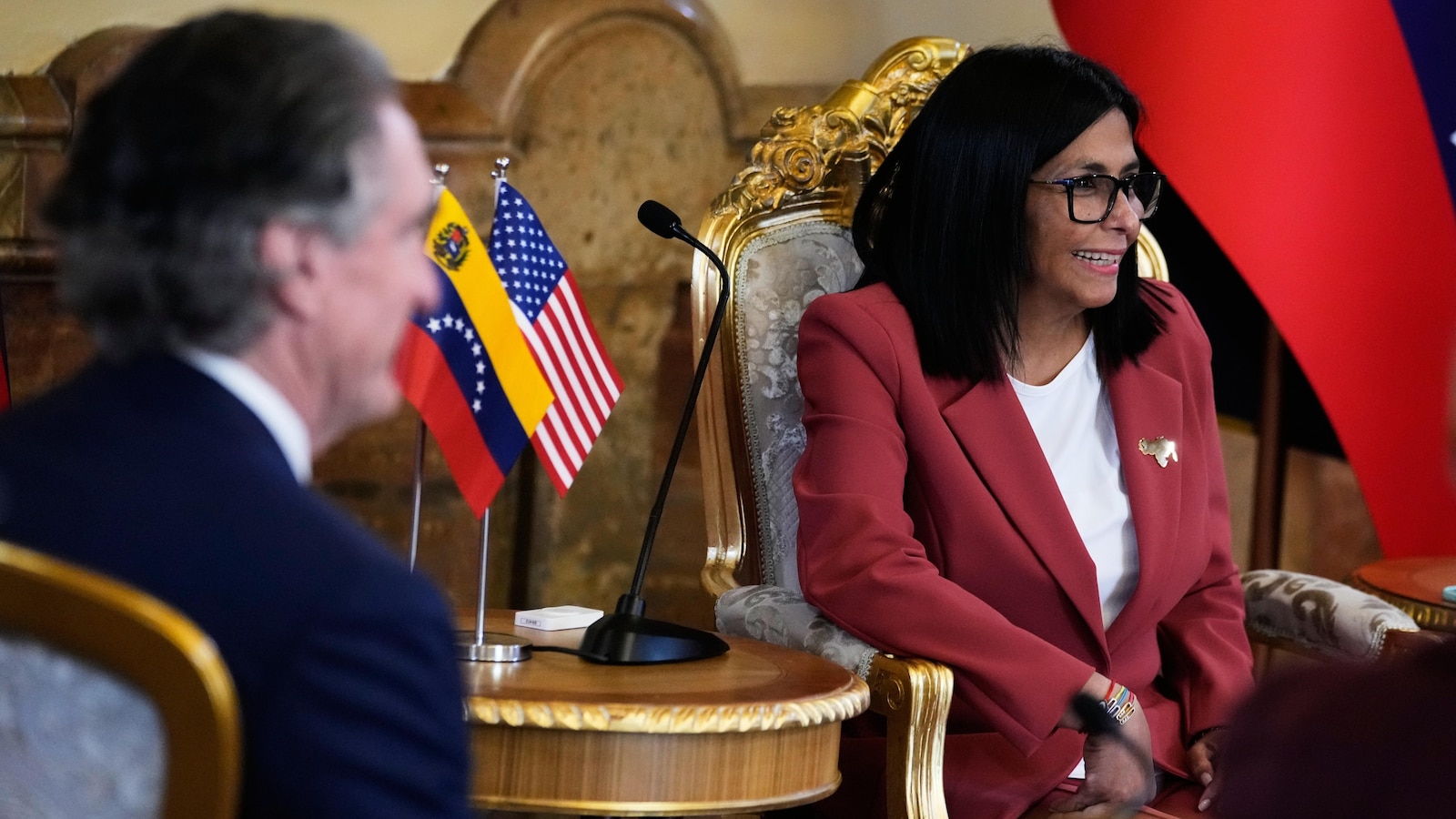
Venezuela's acting President, Delcy Rodríguez, is actively promoting her country's oil industry to international investors, highlighting a newly reformed sector that aims to attract private capital and benefit from eased U.S. sanctions. Speaking remotely at a Saudi-backed investment summit held in Miami on Wednesday, Rodríguez emphasized the long-term economic opportunities available in Venezuela, a nation rich in natural resources but burdened by years of economic challenges and political turmoil.
In her address, delivered entirely in Spanish, Rodríguez outlined a vision of Venezuela's economy stabilizing and growing significantly in the coming years. She projected double-digit economic growth not only for the current year but also for the next two years, underlining the government's commitment to reforms designed to create a more secure and attractive investment climate. "We are in a process of stabilization, implementing the reforms needed for a productive environment and to attract investments that will diversify the engines of the Venezuelan economy," she said. She sought to reassure potential investors that Venezuela's legal framework now guarantees the safe return of their investments despite any political changes or restrictive circumstances, signaling a break from the country's recent past of instability and uncertainty.
Venezuela, which possesses the world's largest proven oil reserves, once boasted the strongest economy in Latin America, powered largely by its oil exports. However, decades of corruption, economic mismanagement, and a series of U.S. economic sanctions severely weakened the country's oil sector. Production, which stood at approximately 3.5 million barrels per day in 1999 when Hugo Chávez took power, plummeted to less than 400,000 barrels per day by 2020. This dramatic decline reflected the cumulative impact of internal problems and international pressures.
A major turning point occurred in 2019 when the U.S. Treasury Department, under the Trump administration, imposed stringent sanctions on Venezuela's state-owned oil company, Petróleos de Venezuela S.A. (PDVSA). These sanctions effectively barred Venezuela from accessing world oil markets, as part of a broader policy aimed at penalizing the government of Nicolás Maduro for corruption and alleged authoritarian practices. The restrictions forced Venezuela to sell its remaining oil output at steep discounts-often about 40% below global market prices-to countries such as China. Additionally, the Venezuelan government resorted to unconventional methods of payment, including accepting Russian rubles, bartered goods, and cryptocurrency, to circumvent financial blockades.
Currently, Venezuela's oil production has somewhat rebounded to about one million barrels per day, but it remains far below its historical peak. Rodríguez highlighted the country's competitive advantages in the oil sector, including low production costs and a willingness to offer generous terms to investors. "When we consider a barrel of oil, its production cost, 64% of that barrel has room for negotiation with the investor regarding royalty reductions, income tax reductions, and most importantly, the dividends the investor receives," she explained. She indicated that larger investments would yield higher returns for investors, signaling an openness to flexible and attractive contractual arrangements.
Rodríguez assumed the role of acting president under extraordinary circumstances. On January 3, Nicolás Maduro and his wife were captured in Caracas and transferred to New York to face drug trafficking charges. Both have pleaded not guilty and were scheduled for a court appearance shortly after Rodríguez's speech. Her rise to the presidency came amid intense pressure from the Trump administration, which had been pushing for regime change and reforms in Venezuela.
Since taking office, Rodríguez has spearheaded a swift overhaul of Venezuela's oil industry regulations. Notably, a new law dismantles the long-standing monopoly held by PDVSA over oil production and sales. Private companies are now permitted to control these activities, including pricing decisions. This reform also introduces independent arbitration for resolving disputes, abandoning the previous requirement that all disagreements be settled exclusively in Venezuelan courts-institutions widely regarded as controlled by the ruling party and lacking impartiality. This change is designed to provide investors with greater confidence in the fairness and predictability of the legal environment.
In response to these reforms, the U.S. Treasury Department has relaxed some of its sanctions on Venezuela's oil sector. Last week, it issued a broad authorization allowing PDVSA to sell Venezuelan oil directly to U.S. companies and on the global market. This marks a significant policy shift, as U.S. dealings with Venezuela's government and oil industry had been largely blocked for several years. The easing of sanctions opens new avenues for Venezuela to reengage with international markets and attract foreign investment critical to revitalizing its oil production capabilities.
Rodríguez's participation in the Saudi-backed investment summit reflects Venezuela's strategic effort to reposition itself as an attractive destination for oil investment amid changing geopolitical dynamics. By emphasizing reforms, regulatory transparency, and the potential for high returns, she aims to counteract years of negative perceptions and economic isolation. Her message to investors was clear: Venezuela is ready to welcome private capital, provide legal protections, and offer flexible terms that can generate substantial profits.
The context of these developments is complex. Venezuela's oil sector has been a cornerstone of its economy for decades, but it has also been a focal point of political struggles and international sanctions. The country's fortunes have been closely tied to the leadership of Hugo Chávez and later Nicolás Maduro, whose administrations faced accusations of corruption, economic mismanagement, and authoritarianism. U.S. sanctions sought to isolate the Maduro government but also contributed to the country's economic hardships by limiting its ability to sell oil and attract investment.
Rodríguez's ascent to the presidency and the subsequent policy shifts signal a potential turning point. By opening the oil market to private and international players, Venezuela hopes to reverse the decline in production and restore its position as a major oil exporter. The reforms to arbitration and legal protections aim to mitigate investor fears related to political risk and judicial bias, which have historically deterred foreign involvement in the country's energy sector.
The U.S. Treasury's recent sanction relief, particularly the authorization for PDVSA to engage directly with U.S. companies, suggests a cautious but notable willingness by Washington to support Venezuela's economic recovery under the new leadership. This could pave the way for increased exports to the U.S. market and improved revenues for Venezuela's struggling economy.
In summary, acting President Delcy Rodríguez is actively promoting a reformed and more investor-friendly Venezuelan oil industry at an international investment summit. She highlights the country's vast oil reserves, low production costs, and the government's legal reforms that now allow private companies greater control and protection in the sector. These changes come in the wake of Nicolás Maduro's arrest and amid a phased plan by the U.S. to stabilize and revitalize Venezuela's economy through eased sanctions and regulatory overhaul. While challenges remain, including political uncertainties and the legacy of economic decline, Venezuela is signaling its readiness to attract investment and return to prominence as a major player in the global oil market.