
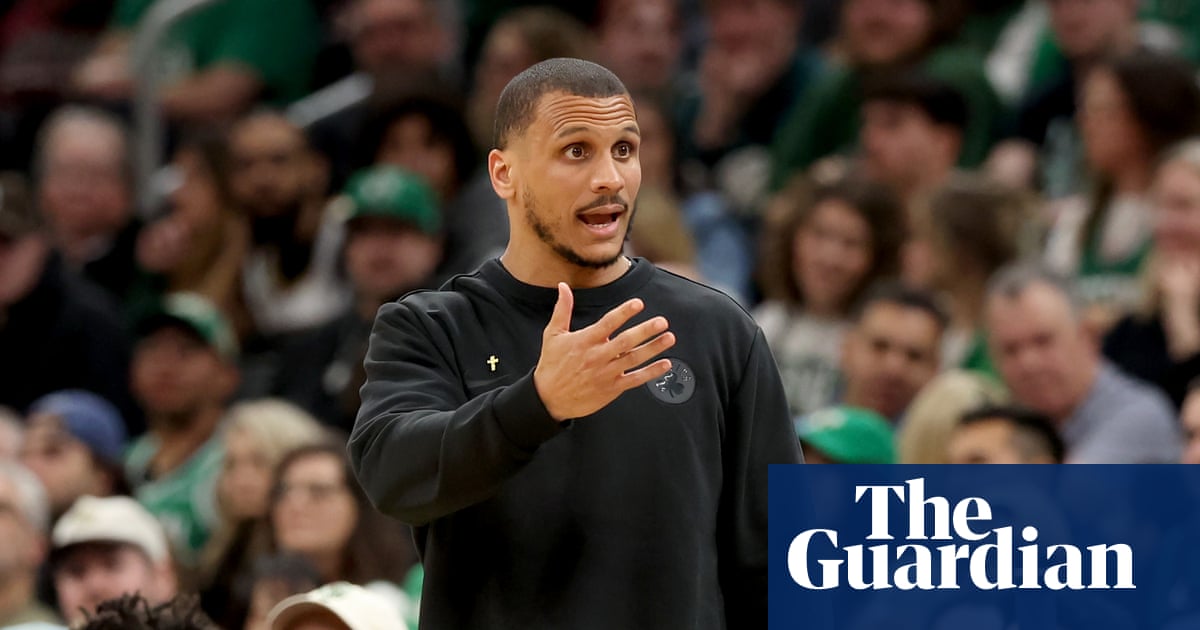
Joe Mazzulla, the 37-year-old head coach of the Boston Celtics, is an unconventional figure in the world of NBA coaching. His methods and demeanor often come across as quirky, even corny or gauche to some observers. Yet, beneath this odd exterior lies a highly effective and innovative coach who has already led the Celtics to an NBA championship and shows every indication of adding more to his resume. Mazzulla’s approach to coaching, his philosophy on basketball and life, and the success he has brought to a team facing adversity make him a fascinating figure and a leading candidate for this season’s Coach of the Year award.
One illustrative anecdote from Celtics guard Derrick White gives a vivid glimpse into Mazzulla’s unique style. During a practice session, rather than starting with the usual coach’s whistle, the first sound players heard was gunfire — the crackling sound of machine guns firing for over ten minutes straight. White described how it felt like being in a war zone. While the scene might sound extreme or even unsettling, the purpose was clear: Mazzulla wanted to push his players’ physical and mental limits, making their lungs burn and forcing them to taste discomfort and even nausea. This intense sensory overload is designed to rewire the brain, forging instincts that bypass conscious deliberation.
Mazzulla’s philosophy draws on psychological principles long studied by experts and militaries alike. Conditioning the brain under stress, immersing it in overwhelming stimuli, accelerates learning and instincts — the body adapts or fails. He applies this concept in a basketball context so that when the real pressure hits during a close fourth quarter in a loud arena, Celtics players respond automatically and decisively, like well-trained operatives capable of delivering the “kill shot” to win games. This controlled chaos, making the practice environment feel like a battlefield, is a hallmark of Mazzulla’s method.
Beyond the war-like practice drills, Mazzulla’s public persona is equally distinctive. He doesn’t fit the mold of typical NBA coaches who often speak in rehearsed clichés and jargon. Instead, his press conferences can sound more like philosophical lectures, filled with cryptic analogies and deadpan humor that leaves listeners unsure if he’s joking or serious. Players have learned to accept this and simply absorb the essence of what he communicates without overanalyzing every word. His oddities include a superstition about never sitting with his back to the door at restaurants, an aversion to revolving doors because they might trap him, and an interest in studying the behavior of animals like orcas and hyenas to glean lessons applicable to basketball strategy.
Despite or perhaps because of these quirks, Mazzulla has proven to be an exceptionally effective coach. He already has a championship to his name and has guided the Celtics through a challenging season to secure the second seed in the Eastern Conference. This achievement is remarkable given the obstacles Boston faced: their star player, Jayson Tatum, suffered an Achilles injury last postseason, sidelining him for what was expected to be a “gap year” for the team. Additionally, key players Jrue Holiday and Kristaps Porziņģis were traded away, and veteran role players Al Horford and Luke Kornet left in free agency due to salary cap constraints under the new collective bargaining agreement. Many teams in similar circumstances would have opted to rebuild or reset, but Mazzulla chose a different path.
Faced with a depleted roster, Mazzulla went to work “in the lab,” fundamentally altering the Celtics’ style of play and basketball DNA. On offense, he maintained organization centered on spacing, timing, and reading defenses, creating a system resilient enough to function effectively even without Tatum. Defensively, he simplified the approach to relentless ball pressure — a stripped-down, intense style that relies on energy and constant activity rather than star rim protectors. This minimalist but high-energy defense forces opponents into mistakes and creates turnovers without fouling excessively. Such a scalable and adaptable system allowed role players like Ron Harper Jr., Baylor Scheierman, Hugo González, and Luka Garza to step up and contribute meaningfully, while stars like Jaylen Brown were tasked with embracing a more physical and energetic role rather than trying to replicate Tatum’s style.
Mazzulla’s evolving philosophy was further shaped through international collaboration. Over the summer, he traveled to France to meet with Guillaume Vizade, head coach of Le Mans and another self-described basketball eccentric. Their meeting was more like a think