
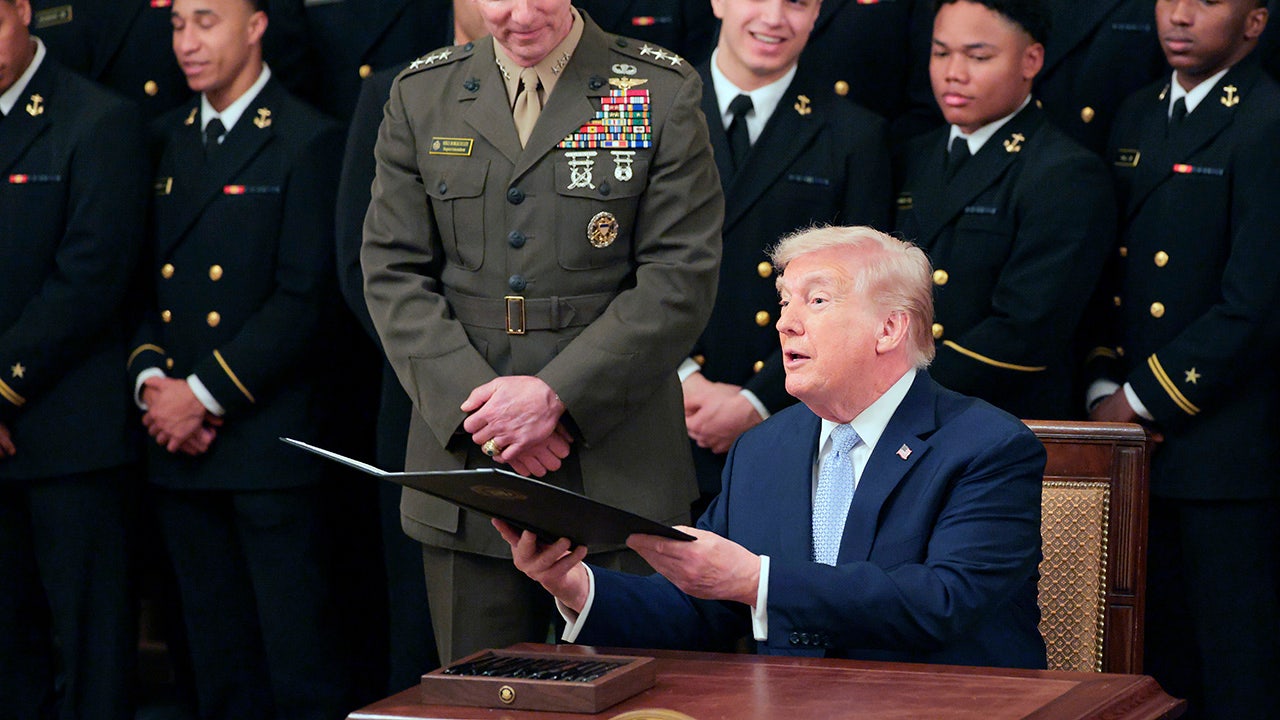
On March 20, 2026, President Donald Trump signed an executive order titled "Preserving America’s Game" aimed at safeguarding the traditional time slot of the annual Army-Navy college football game. The signing ceremony took place at the White House during a visit by the Navy Midshipmen, who were there to celebrate their recent victory of the Commander-in-Chief’s Trophy—a prestigious award given annually to the service academy (Army, Navy, or Air Force) that wins against the others during the season.
The executive order is designed to ensure that the Army-Navy game remains a standalone event on the college football calendar, specifically preserving the second Saturday in December as a dedicated four-hour window exclusively for this game. Trump emphasized the importance of maintaining this slot, stating that no other college football games, including major matchups like Ohio State versus Notre Dame or LSU against Alabama, would be scheduled to compete with the Army-Navy game during that time. He highlighted the game as “one of the most special occasions in all of sports,” and expressed concern that the recent expansion of the College Football Playoff and the increasing influence of television money threatened to overshadow this historic tradition.
The Army-Navy game holds a revered place in American sports culture, symbolizing not only a fierce athletic rivalry but also the honor and spirit of the U.S. military academies. Traditionally, it has been played without competing college football broadcasts, allowing fans and the nation to focus solely on this event. Currently, the game is broadcast exclusively on CBS, a partnership that will continue through 2038. The timing of the game has been carefully set between conference championship weekend and the first round of the College Football Playoff, which presently features 12 teams. However, with possible future expansions of the playoff format, the scheduling landscape could change and potentially threaten the game’s traditional slot. Trump’s executive order seeks to preempt these changes by legally protecting the game’s broadcast time.
Navy’s victory over Army in the recent game was a nail-biter, finishing 17-16, and marked a historic moment for the program. The Navy Midshipmen completed an 11-2 season, achieving back-to-back 10-win seasons for the first time in their history. This success further elevated the significance of the game and the trophy awarded.
Despite the president’s enthusiasm for the executive order, the move has not been without criticism. Prominent sports commentator Stephen A. Smith voiced strong opposition during his SiriusXM show on Mad Dog Sports Radio. Smith expressed frustration, questioning the president’s authority and involvement in dictating sports programming. He argued that while the Army-Navy game is important, it should not be used as a justification for restricting other football broadcasts. Smith said, "Who the hell does this man think he is?" He criticized the president for overstepping his bounds and attempting to control what football games viewers should watch, suggesting that such interference is unnecessary and inappropriate for the office of the presidency.
Trump, aware of potential legal challenges, acknowledged the likelihood of lawsuits against the executive order but expressed confidence in prevailing if such challenges arise. He joked that they would “probably get sued at some point,” but assured that they would win these cases, underscoring his determination to preserve the game’s unique place on the college football calendar.
This executive order follows Trump’s ongoing interest in college sports and their governance. Earlier in March 2026, he had hosted a roundtable discussion focused on the impacts of Name, Image, and Likeness (NIL) regulations in college athletics, signaling his broader engagement with issues surrounding amateur sports and athlete compensation.
The Army-Navy game itself is steeped in tradition and patriotism. Played annually since 1890, it represents more than just a football game; it is a celebration of the values and commitments of the U.S. military academies. The Commander-in-Chief’s Trophy adds an additional layer of competition and honor among the three service academies, making the game a highlight not only for football fans but also for the nation’s armed forces and their supporters.
Trump first indicated his intentions to protect the game’s broadcast slot in a January 2026 post on his social media platform, Truth Social, where he stated, “This incredible Tradition is now at risk of being pushed aside by more College Playoff Games, and Big TV Money. NOT ANYMORE!” His executive order formalizes this commitment, seeking to enshrine the game’s time slot into law