
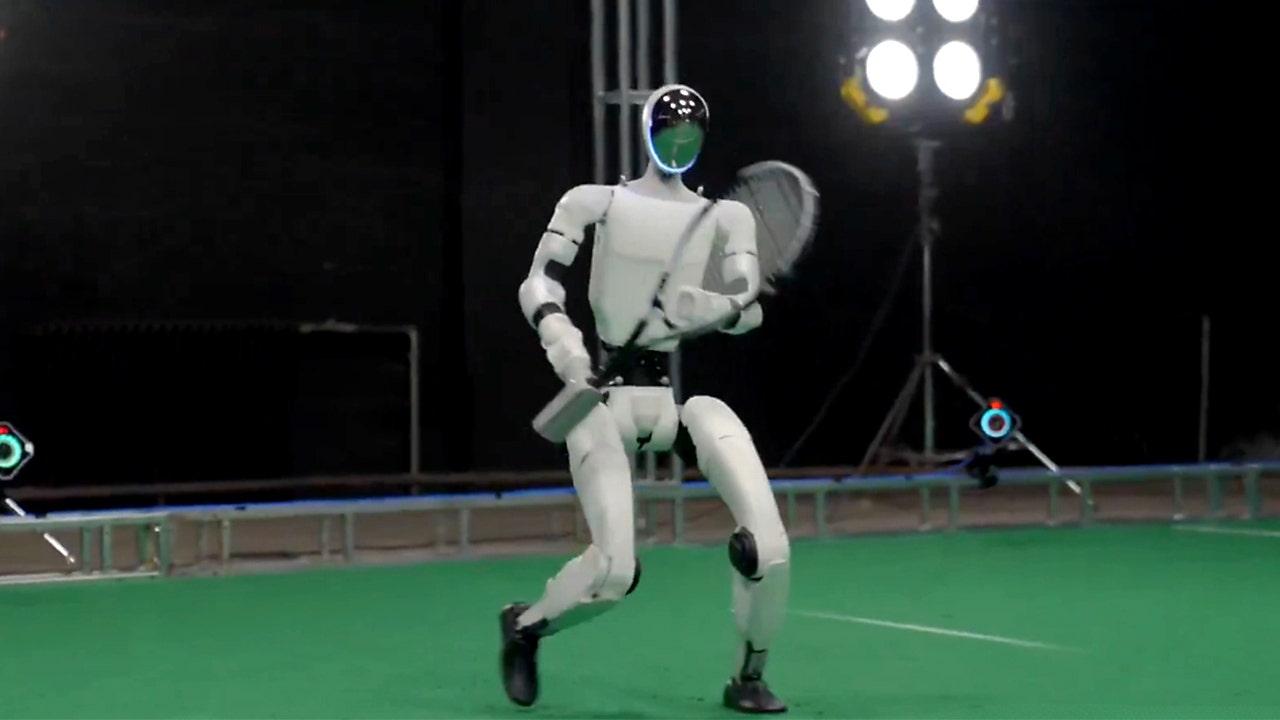
In a remarkable demonstration of technological progress, a humanoid robot developed by Galbot Robotics has been shown rallying tennis shots with a human player in real time, marking a significant leap forward in robotic agility and responsiveness. Unlike most athletic robots that rely on pre-programmed scripts or remote controls, this robot operates autonomously, reacting instantly to the dynamics of a live tennis match. Standing about four feet tall, the robot boasts a compact, human-like frame and is powered by a system known as LATENT, running on the Unitree G1 platform. This breakthrough was highlighted in a recent video released by Galbot Robotics, showcasing the robot’s ability to engage in shot-for-shot rallies with a human opponent, adjusting its movements and strategy on the fly.
The significance of this development lies in the robot’s capacity for real-time interaction and adaptation. Traditional athletic robots typically perform fixed sequences of actions or depend on external commands, limiting their flexibility and responsiveness. In contrast, Galbot’s tennis-playing robot demonstrates the ability to track fast-moving tennis balls, move strategically across the court, and return shots with impressive precision. It adjusts to varying ball trajectories and unpredictable shots during rallies, sustaining long exchanges with millisecond-level reaction times and coordinated full-body movements. This combination of speed, balance, and decision-making represents a major advancement in the field of robotics, pushing beyond simple automation toward genuine competitive play.
Training a robot to master a sport as complex as tennis presents numerous challenges. Tennis involves a wide range of movements, quick reflexes, and strategic decision-making, all of which are difficult to capture and replicate in a machine. Instead of attempting to record entire match play, the researchers at Galbot Robotics adopted a novel approach: they focused on learning small segments of human movement. Over five hours of motion data were collected from five human players on a compact court measuring just 10 by 16 feet—an area more than 17 times smaller than a standard tennis court. By breaking down complex gameplay into manageable fragments, the robot could learn the fundamental building blocks of tennis strokes and movements.
The robot’s learning method involves first mastering individual movements and then combining these into coordinated sequences that mimic human play. This modular approach allows the system to generate flexible responses rather than rigid, scripted actions. To enhance adaptability, the development team trained the robot in simulated environments where physical parameters like mass, friction, and aerodynamics were varied. This simulation training enables the robot to better handle the unpredictable conditions of a real tennis match, ensuring it can respond dynamically to challenges rather than following a fixed routine. As a result, the robot has demonstrated up to 96% success on forehand shots in simulation and has performed well in real-world trials, sustaining rallies and consistently returning the ball across the net.
Watching the robot in action reveals a level of competitiveness that goes beyond simple reaction. The robot occasionally places shots strategically away from the human player, suggesting early forms of decision-making and tactical awareness. While the robot’s movements are not yet as fluid or stable as those of a trained human athlete, and it sometimes struggles with high or unpredictable shots, the progress is undeniable. These imperfections highlight the ongoing challenges in robotic motion control and balance, but they also underscore how far the technology has come.
The implications of this breakthrough extend far beyond the tennis court. The approach used by Galbot Robotics—learning complex human skills through fragmented motion data and adaptable simulation—could be applied to a wide range of tasks where complete motion data is scarce or unavailable. This methodology opens new possibilities for robots to acquire and perform complex skills in dynamic, real-world environments. Whether in sports, manufacturing, healthcare, or service industries, robots with this level of adaptability could transform how machines assist or compete with humans.
Galbot Robotics has already demonstrated other humanoid robots performing sophisticated tasks, such as selecting items from shelves and even performing dance moves, as seen in recent exhibitions at the Shanghai New Expo Center and retail store launches in Beijing. These demonstrations emphasize the company’s commitment to pushing the boundaries of robotic balance, coordination, and interaction.
Looking ahead, the trajectory of this technology suggests a future where robots not only rally but compete alongside or against professional athletes. Exhibition matches featuring humans and robots could become a new form of sport entertainment, blending human skill with robotic precision. Training alongside robotic partners might also revolutionize athletic preparation, offering players consistent, adaptive competition tailored to their level and style.
This evolving landscape raises intriguing questions about the role of robots in sports and everyday life. As machines