
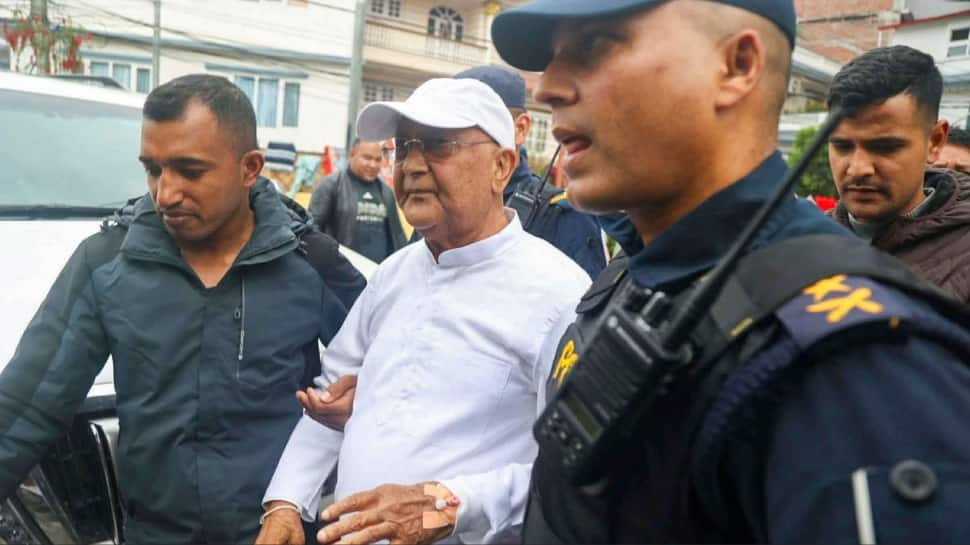
Former Prime Minister of Nepal K P Sharma Oli and former Home Minister Ramesh Lekhak were arrested early Saturday morning in connection with homicide-related cases tied to the suppression of the Gen-Z uprising that occurred in early September last year. Both leaders were taken into custody from their residences in Bhaktapur district. Following his arrest, Oli was admitted to a teaching hospital in Kathmandu after experiencing health complications.
The arrests were prompted by a report from an inquiry commission on the Gen-Z movement, which recommended criminal investigation and prosecution of Oli, Lekhak, and former police chief Chandra Kuber Khapung. This report was decided for implementation during the first Cabinet meeting of the new Prime Minister Balendra Shah, held on the preceding Friday.
The detentions sparked immediate unrest. Cadres of the Communist Party of Nepal (Unified Marxist-Leninist) (CPN-UML), led by Oli, organized protests throughout the Kathmandu Valley in response. Protesters burned tires and copies of the inquiry commission's report, expressing strong opposition to what they perceived as politically motivated actions. Clashes broke out between police forces and protesters, resulting in injuries among some demonstrators.
In line with the party's Central Committee decision, the UML announced plans for its district-level committees to hold demonstrations and submit memorandums to the Chief District Officer (CDO) offices across all districts on Sunday. The party further stated its intention to engage in dialogue and cooperation with other political parties, civil society groups, and the general public who support democracy and the rule of law.
The UML condemned the arrests of Oli and Lekhak, labeling them as retaliatory, biased, and unlawful. In a statement issued after their meeting, the party demanded the establishment of a high-level investigation commission led by a sitting Supreme Court judge to ensure an impartial and judicial inquiry into the events surrounding the Gen-Z movement and the subsequent arrests. The UML expressed serious concern over recent developments and indicated that protests would continue in phases.
Meanwhile, former President of Nepal, Bidya Devi Bhandari, publicly criticized the government's decision to arrest Oli and Lekhak, describing it as immature and potentially destabilizing. In her statement released on Saturday, Bhandari expressed apprehension about the long-term consequences of the arrests, warning that they could increase the risk of political instability in the country.
Bhandari highlighted that studies had shown the inquiry commission's report-known as the Karki Commission report-was incomplete. She noted that the decision to implement the report and arrest prominent political figures on the very first day of the new government's tenure was a sensitive matter with far-reaching implications. According to her, such a hasty decision did not align with Nepal's current Constitution, prevailing laws, or established democratic practices.
She emphasized that implementing any inquiry commission's recommendations requires a thorough legal process, sufficient study, and meaningful institutional consultation. Bhandari cautioned that precipitous actions might undermine public trust in the rule of law and potentially escalate conflict and instability within the country.
The political fallout from the arrests remains significant. The UML's protests and planned demonstrations illustrate deep dissatisfaction within the party and among its supporters. The government, led by Prime Minister Balendra Shah, has taken a firm stance on applying the inquiry commission's report, signaling a commitment to pursuing accountability for the events of the Gen-Z uprising.
This situation underscores the ongoing challenges Nepal faces in balancing demands for justice and political stability. The Gen-Z uprising, which occurred in early September last year, had already been a flashpoint for tensions between the government and youth activists. The inquiry commission's report sought to investigate the suppression of that movement, and its recommendations have now triggered intense political conflict.
As protests continue and calls for impartial investigations grow louder, the Nepalese political landscape remains unsettled. The coming days are likely to see further demonstrations, political negotiations, and public debate over the appropriate course of action in addressing the complex issues raised by the Gen-Z uprising and the subsequent inquiries.
It is essential for all stakeholders, including political parties, civil society, and government institutions, to engage constructively to uphold democratic principles, maintain public trust, and ensure that justice is served in a manner consistent with Nepal's constitutional and legal frameworks.