
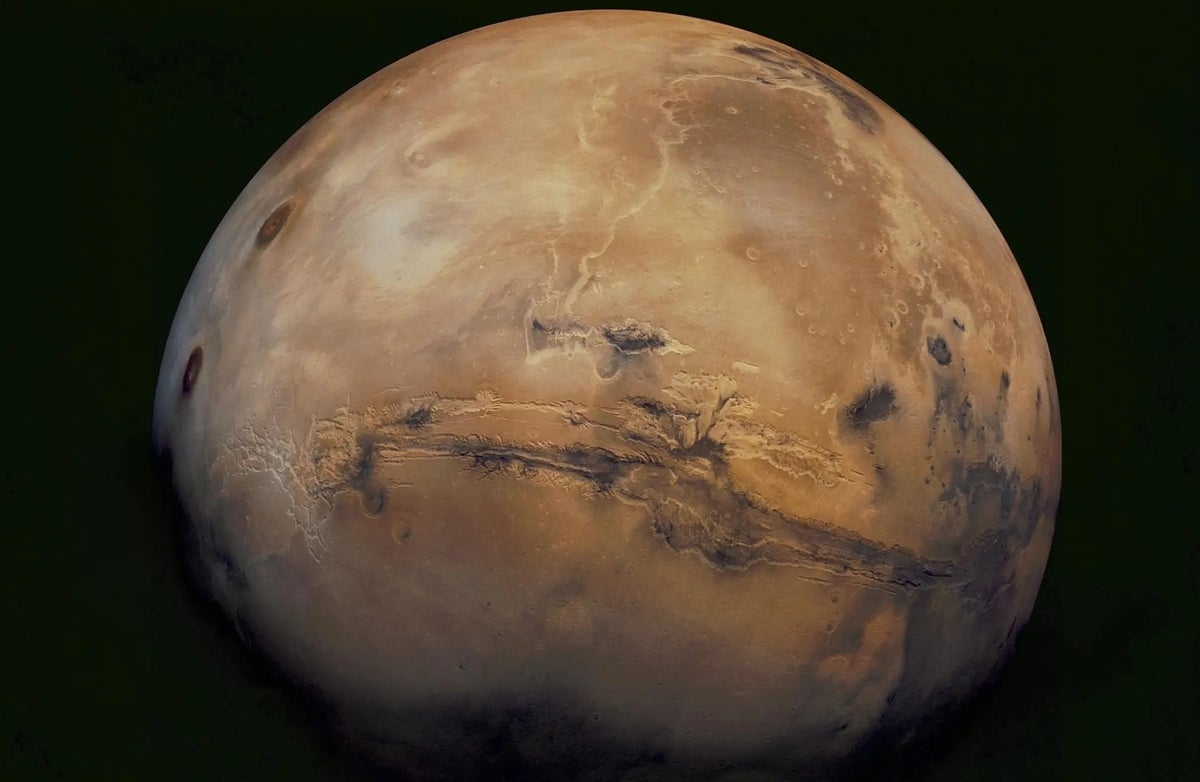
NASA has announced an ambitious new mission to Mars, aiming to launch a nuclear-powered spacecraft to the Red Planet by the end of 2028. This endeavor, if successful, will represent a historic first in space exploration: the use of nuclear propulsion for an interplanetary spacecraft. The agency’s goal is to demonstrate the viability of nuclear-powered propulsion systems, which have long been considered a promising solution for deep space missions but have never before been tested in practice.
The spacecraft, named Space Reactor-1 Freedom, will carry several helicopters modeled after NASA’s Ingenuity drone, which famously accompanied the Perseverance rover during its exploration of Mars. This new fleet of helicopters is expected to expand surface exploration capabilities on Mars, allowing for greater access to diverse terrain and more detailed scientific investigations. Beyond the deployment of these aerial explorers, NASA officials have hinted that the spacecraft’s mission might extend beyond Mars. Steve Sinacore, a NASA representative, noted during a recent press conference that the mission’s final destination remains undecided and that the spacecraft could potentially continue its journey deeper into the solar system following its Mars operations.
The significance of this mission extends far beyond Mars itself. NASA views it as a critical step to prove that nuclear propulsion can be reliably used to power spacecraft, thereby activating an industrial base capable of supporting future fission-powered systems. These systems could revolutionize space exploration by providing propulsion and power for a wide range of missions, including long-duration stays on planetary surfaces and expeditions to the outer solar system. Traditional propulsion methods, which rely heavily on large quantities of chemical liquid fuel, have significant limitations when it comes to long-distance travel. The amount of fuel required to reach distant worlds quickly becomes prohibitive, making such missions costly and complex.
Currently, only small spacecraft powered by batteries or solar panels, such as Voyager and Juno, have been able to venture into the outer reaches of the solar system. However, these power sources are insufficient for larger, more complex missions or those requiring faster travel times and greater payload capacities. Nuclear propulsion promises to overcome these challenges by offering a more efficient and powerful means of propulsion, capable of reducing travel times and enabling missions that are currently beyond our reach.
Despite the promise of nuclear propulsion, NASA has not yet disclosed the specific technology or propulsion design it will employ for the Space Reactor-1 Freedom mission. The agency also has not revealed whether there will be partnerships with private industry or what launch vehicle will be used. They emphasized that any launch system would need to meet stringent safety standards and receive approvals from multiple regulatory bodies before proceeding. This cautious approach reflects the complexity and potential risks associated with launching nuclear-powered systems into space.
NASA’s interest in nuclear propulsion is not new; the agency has been investigating the technology for many years, often in collaboration with the Department of Defense. According to Sinacore, the technology needed for such a mission already exists and is now maturing to the point where it can be integrated into a functional spacecraft. Industry players are also exploring nuclear propulsion concepts, signaling a growing momentum behind this transformative technology.
The broader implications of this mission are profound. Successfully demonstrating nuclear propulsion on an interplanetary scale could open the door to a new era of space exploration. Missions to the outer planets, their moons, and even beyond could become feasible, with spacecraft capable of traveling faster and carrying more substantial scientific payloads. Furthermore, nuclear power systems could support long-term human missions by providing reliable energy sources on planetary surfaces, a crucial factor for sustained exploration and potential colonization.
This announcement comes at a time when the global space community is increasingly focused on extending humanity’s reach into the solar system. With plans for crewed missions to the Moon and Mars, as well as robotic exploration of asteroids and outer planets, efficient propulsion and power systems are essential. NASA’s nuclear-powered Mars mission represents a bold step toward meeting these challenges and advancing the frontiers of space technology.
In summary, NASA’s planned launch of the Space Reactor-1 Freedom spacecraft by 2028 aims to showcase nuclear propulsion as a game-changing technology for deep space exploration. By sending a nuclear-powered spacecraft to Mars equipped with helicopters modeled after Ingenuity, NASA hopes to prove that nuclear propulsion can enable faster, more efficient missions to distant worlds. While many technical details remain under wraps, the mission underscores NASA’s commitment to developing advanced propulsion technologies and expanding humanity’s capabilities in space. If successful, this mission could pave the way for a new generation of space exploration, making the outer