
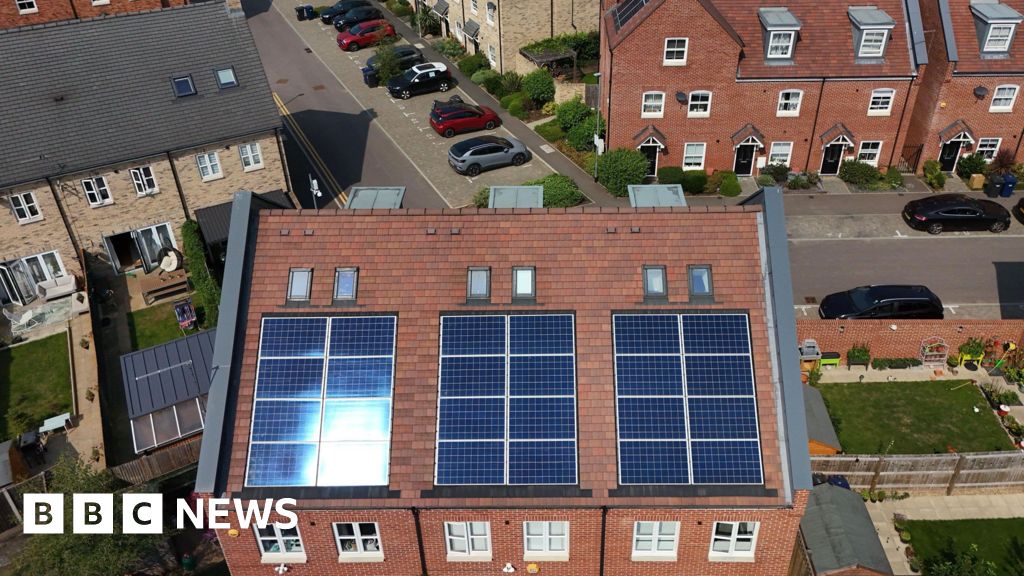
The UK government has announced significant new measures to promote clean energy in the housing sector across England, aiming to reduce reliance on fossil fuels and enhance energy security. Key among these measures is a new requirement that all new homes built from 2028 onwards must be equipped with solar panels and heat pumps. This move forms part of updated planning regulations designed to support the government’s broader climate goals and its commitment to decarbonizing the housing stock.
Under the updated rules, developers will no longer be allowed to connect new homes to the gas network. Instead, homes must be heated either through heat pumps or district heating systems. Additionally, every new home will have to have solar panels installed on its roof, covering an area equivalent to 40% of the property’s ground floor space. This is a significant increase in solar coverage compared to previous standards and reflects a government push to harness renewable energy more aggressively.
Energy Secretary Ed Miliband emphasized the importance of these changes by citing recent geopolitical events, including the war in Iran, as evidence of the necessity to reduce dependence on unstable fossil fuel markets. He stated that clean power is "essential" for the UK’s energy security, allowing the country greater control over its energy future and insulating it from volatile global fossil fuel prices.
The energy industry and green technology advocates have largely welcomed the government’s announcement, praising the clarity it provides regarding the future market for heat pumps and solar panels. Garry Felgate, CEO of the MCS Foundation—which certifies installers of low-carbon heating systems—highlighted how the new regulations will give confidence to installers, builders, and manufacturers by establishing a solid and predictable demand for these technologies.
However, the new requirements are not without controversy or challenges. The Home Builders Federation (HBF), representing developers, expressed concerns about the increased costs and practical challenges posed by the solar panel requirements. Neil Jefferson, CEO of the HBF, pointed out that the mandated solar panel coverage is ambitious, with estimates suggesting that up to 60% of new homes may not have enough suitable roof space to meet the standards. While there are exemptions for homes where space constraints make installation impractical, the need to assess each property individually could slow down the planning and building process, potentially creating bottlenecks.
Financially, the new standards are expected to add roughly £10,000 to the cost of building a new home. While this represents a significant upfront expense for developers, the government and many experts argue that the investment will pay off over time by lowering energy bills for homeowners. The presence of solar panels and heat pumps can reduce reliance on expensive imports of fossil fuels and cut ongoing energy costs. The government also acknowledged that integrating home battery storage systems would further enhance energy savings, but it stopped short of making batteries a mandatory part of the new homes, citing concerns about cost and complexity.
Hannah McCarthy, head of partnerships for new homes at Octopus Energy, welcomed the push to decarbonize new housing but noted that including battery storage in the plans would make the transition even more effective. She suggested that batteries complement solar panels and heat pumps by allowing homeowners to store excess solar energy for use when the sun isn’t shining, thereby maximizing savings and reducing grid dependence.
The government’s target is ambitious: it aims to build 1.5 million new homes by 2029. However, recent data showed a slowdown in housing construction rates, prompting Housing Secretary Steve Reed to call for an acceleration in building activity. The new regulations will add complexity to this goal, but they also signal a clear long-term direction for the housing market.
Political reactions to the new measures have been mixed. The Liberal Democrats and the Green Party both praised the government for mandating solar panels in all new homes. Dr Ellie Chowns of the Green Party, however, criticized the government for waiting until 2028 to implement the changes, calling the delay “utterly ridiculous” given the urgency of the climate crisis.
In contrast, the Conservative Party voiced opposition to the policies, arguing that the focus should be on increasing domestic fossil fuel production to reduce energy costs for consumers. They called for the government to issue new licenses for oil and gas extraction in the North Sea and to scrap green subsidies. Richard Tice, the Reform Party’s shadow business secretary, echoed this sentiment, labeling the government’s net zero policies as costly to taxpayers.
Energy Minister Michael Shanks responded to these criticisms by emphasizing that the North Sea oil and gas fields, while historically important, are in long-term