
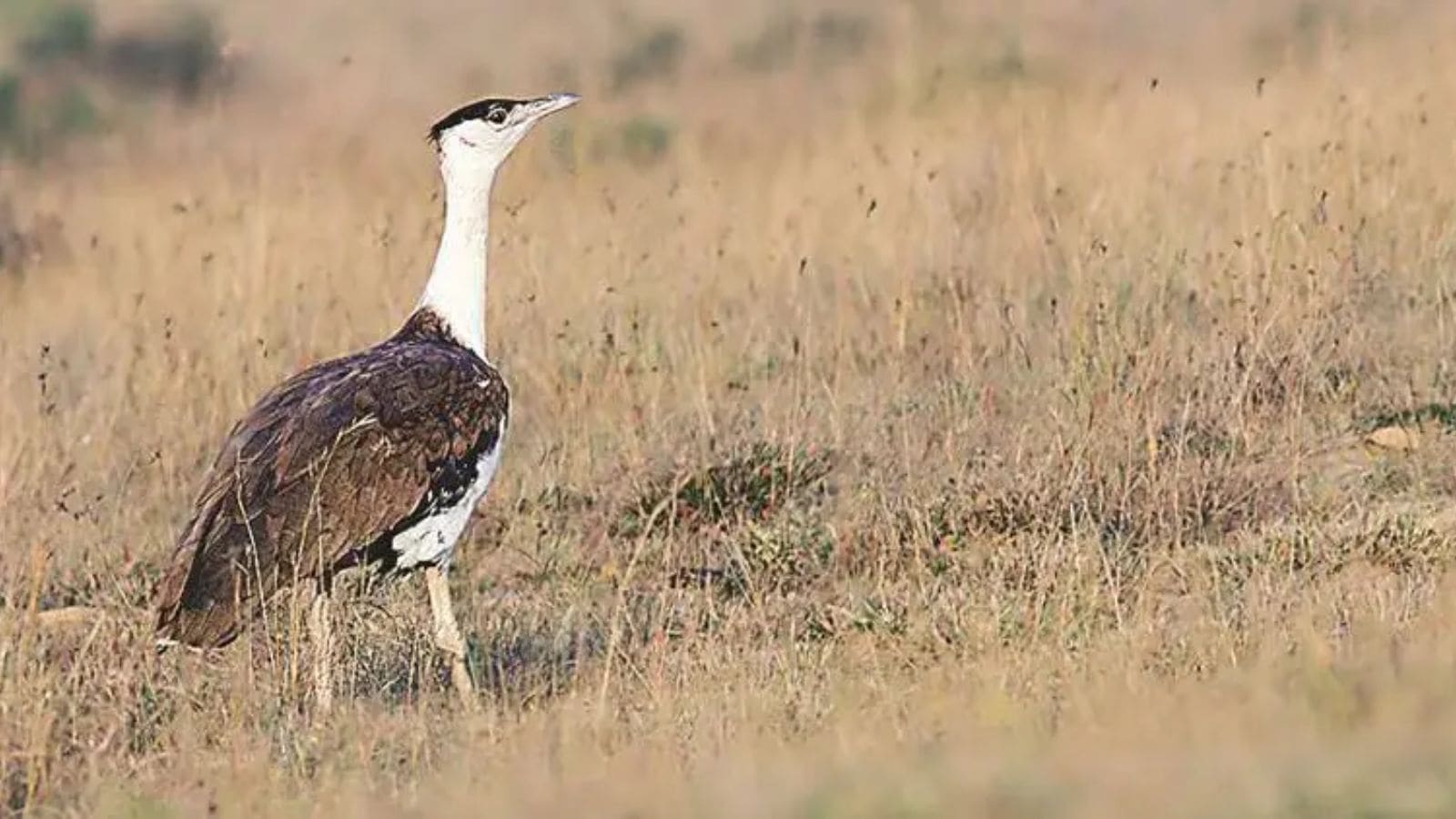
For the first time in a decade, Gujarat has witnessed the birth of a Great Indian Bustard (GIB) chick, marking a significant milestone in the conservation of this critically endangered species. The chick hatched on March 26, following a complex and carefully coordinated trans-state conservation effort that involved transporting a fertile egg over 770 kilometers from Rajasthan's Jaisalmer district to Gujarat's Kutch district. This remarkable achievement was accomplished using a novel "jumpstart" method, which leverages the maternal care of a female GIB in Gujarat to incubate and hatch a fertile egg sourced from a captive breeding center in Rajasthan.
The Great Indian Bustard is among the most threatened birds in India, with an estimated population of only around 150 individuals remaining in the wild. Most of these birds are found in Rajasthan, while Gujarat's wild population has dwindled to just three females. Since all the surviving GIBs in Gujarat are female, their eggs have been infertile, posing a significant challenge to natural reproduction and population recovery in the state.
Union Environment Minister Bhupender Yadav announced the news of the successful birth through a post on X (formerly Twitter), highlighting the collaborative nature of the effort. He explained that the female GIB in Gujarat, tagged in August 2023, had laid an infertile egg. The conservation team then transported a fertile egg from a captive breeding program in Rajasthan to replace the infertile one in the nest. The egg was carefully incubated by the female GIB in Gujarat and hatched successfully after about four days.
The transportation of the egg was a logistical feat that required meticulous planning and execution. The fertile egg, about 15 days old, was carried in a specially designed handheld incubator over a continuous 19-hour journey covering 770 kilometers. To ensure the egg's safety, the team created a halt-free corridor from Sam in Rajasthan to Naliya in Gujarat, allowing for uninterrupted travel. The Wildlife Institute of India (WII) and forest departments from both states worked closely to coordinate this operation, demonstrating a strong example of inter-state cooperation for wildlife conservation.
Sutirtha Dutta, a scientist from the Wildlife Institute of India who accompanied the egg during the journey, emphasized the delicate nature of the task. GIB eggs are highly fragile, especially when less than 10 days old, and can easily be damaged during transport. The team selected an egg that was 15 to 16 days old, as the incubation period for a GIB egg is approximately 22 days. The incubator was specially modified to be shock-proof, and one of the team members held it throughout the trip to minimize any risk of damage.
Prior to this experiment, the female GIB in Gujarat was radio-tagged to monitor her movements and reproductive behavior. This tracking helped confirm that she laid an infertile egg, making her a suitable foster mother for the fertile egg from Rajasthan.
This initiative is the culmination of several years of groundwork. Under Project GIB, the Wildlife Institute of India and the Rajasthan Forest Department have established two captive breeding centers in Jaisalmer district-at Sam and Ramdevra. These centers have been instrumental in incubating eggs collected from the wild, and in some cases, chicks have been born through artificial insemination. The captive populations have grown to 73 birds, with some reaching adulthood and successfully breeding, thereby producing a second generation. This captive breeding program aims to create a robust founder population for the species' long-term recovery.
The "jumpstart" method itself was tested in Rajasthan's Desert National Park over multiple trials. The team placed fertile eggs in nests of wild female GIBs to observe whether the birds would accept and incubate them. Out of six trials, four fertile eggs were incubated and hatched successfully, while two nests contained wooden dummy eggs to test maternal behavior. The success of these trials provided confidence to implement the method in Gujarat.
The birth of the chick in Gujarat is an encouraging sign, but conservationists stress that the initial weeks of the chick's life are critical. The chick remains vulnerable to predators such as desert foxes. Gujarat's Principal Chief Conservator of Forest and Chief Wildlife Warden, Jaipal Singh, noted that forest staff are closely monitoring the chick and may need to take additional measures, including predator control, to ensure its survival.
The "jumpstart" approach has gained official endorsement through a Supreme Court-appointed expert committee's recommendations. Last year, the committee recommended this method as a key conservation strategy to revive the GIB population in Gujarat, where all female birds lay infertile eggs due to the absence of males. The committee's report highlighted the need to swap infertile eggs with fertile ones from Rajasthan's captive breeding centers as a rapid means to boost the population.
This committee was tasked with balancing the conservation of the Great Indian Bustard with the development of renewable energy, which has led to GIB mortality through collisions with power lines in their habitat. Their recommendations, including the jumpstart method, were accepted by the Supreme Court in December 2023, reinforcing the government's commitment to adopting innovative conservation measures.
The Great Indian Bustard is a large bird and an important indicator species for the health of grassland ecosystems in India. Its population decline has been driven by multiple factors, including habitat loss, hunting, and infrastructure development such as power transmission lines. Conservation efforts like captive breeding, habitat protection, and the jumpstart method represent crucial steps in preventing its extinction.
The successful hatching of the chick in Gujarat after a decade is thus a beacon of hope for the species' recovery. It showcases the power of scientific innovation, dedicated teamwork, and inter-state collaboration in wildlife conservation. The coming weeks and months will be critical as conservationists work to protect the vulnerable chick and continue efforts to restore the Great Indian Bustard population across its range.
This breakthrough also underscores the role of institutions like the Wildlife Institute of India and the central and state forest departments in driving conservation science and policy forward. It serves as a reminder of the importance of sustained investment in research, captive breeding, and habitat management to save India's endangered species.
As the Great Indian Bustard chick grows under the watchful care of its foster mother in Gujarat, conservationists remain cautiously optimistic. The journey from a fragile egg transported across state borders to a living symbol of hope captures the spirit of modern conservation-where science, determination, and cooperation come together to rewrite the fate of a species on the brink of extinction.