
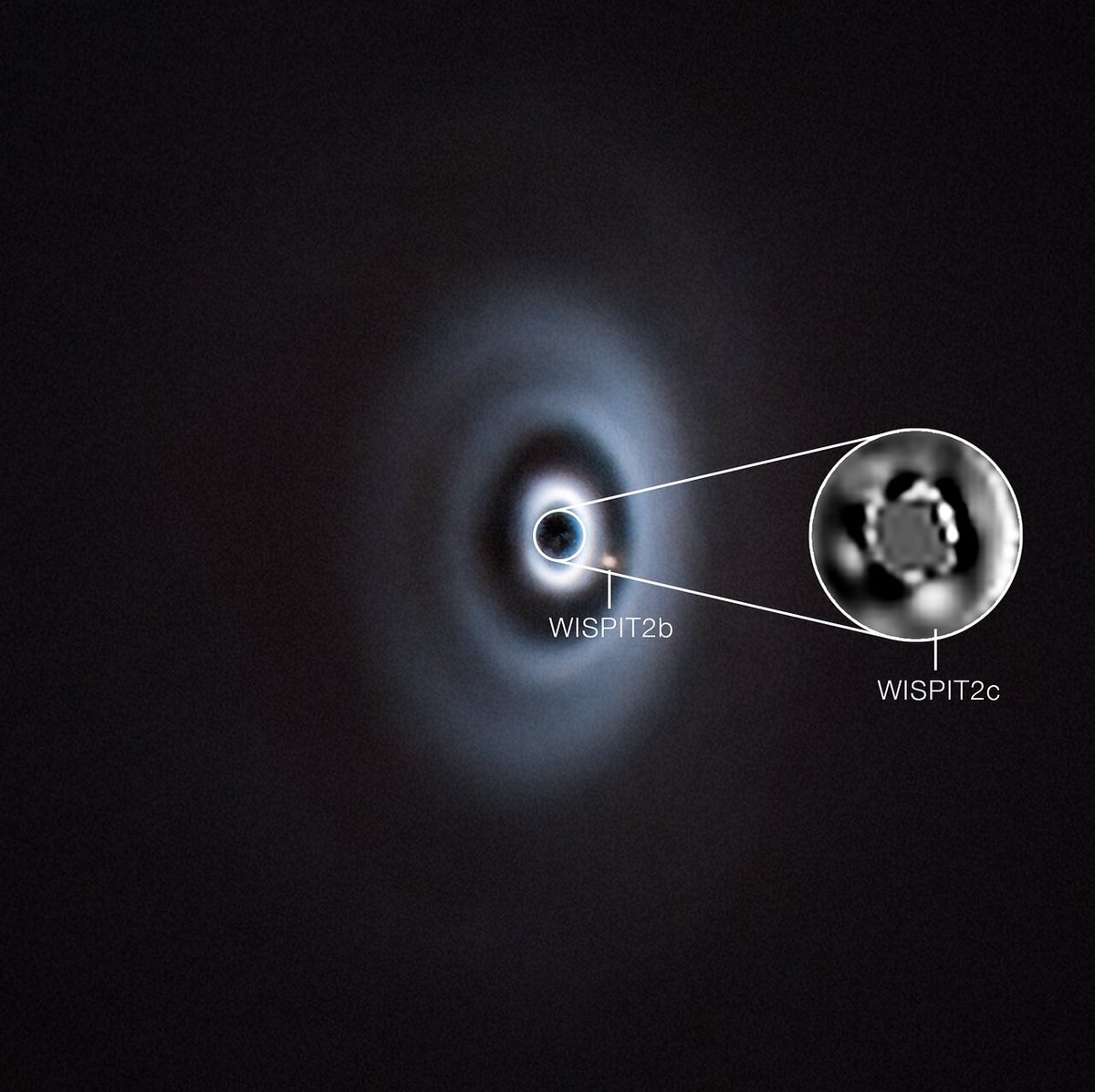
Astronomers have made a remarkable discovery that offers an unprecedented glimpse into the early stages of solar system formation. In a study published recently in the Astrophysical Journal Letters, researchers revealed the presence of a baby solar system forming around a star called WISPIT 2, located approximately 437 light-years from Earth. This finding marks only the second time astronomers have confirmed the existence of a newly forming solar system, the first being PDS 70, discovered in 2018. Such observations are rare and provide crucial insights into one of the most profound questions in astronomy: how did our own solar system come into existence?
The discovery of WISPIT 2’s planetary system is particularly exciting because it allows scientists to study the process by which planets emerge from the spinning disks of gas and dust left over after a star’s birth. These protoplanetary disks are the raw material from which planets coalesce, and understanding their dynamics is key to unraveling the origins of Earth and its neighboring planets. Until now, most exoplanets detected around other stars have been mature, making it challenging to observe the earliest phases of planet formation directly. The identification of a system like WISPIT 2, where planets are still in the process of forming, offers a rare window into these formative years.
The story began last year when astronomers first identified a protoplanet, dubbed WISPIT 2b, orbiting within the star’s protoplanetary disk. This was the first instance where a baby planet was imaged amidst the surrounding material, marking a milestone in observational astronomy. Building on this initial discovery, the research team now reports evidence of a second gas giant planet forming around WISPIT 2. Remarkably, this second planet is estimated to be about ten times the size of Jupiter, making it an extraordinarily massive young world.
But the surprises do not end there. The star’s protoplanetary disk appears more extensive and intricately structured than that of PDS 70, suggesting a complex environment rich with potential for further planet formation. Astronomers have observed multiple gaps or “breaks” in the disk’s material, which are typically interpreted as signs that protoplanets are accumulating mass and carving out paths in the dust and gas. In addition to the two confirmed gas giants, the researchers have spotted a third, smaller break further out in the disk. This feature hints at the presence of another, smaller planet possibly close in size to Saturn, though it remains hypothetical until confirmed by future observations.
The discovery was made using the European Southern Observatory’s (ESO) Very Large Telescope (VLT) located in Chile’s Atacama Desert, one of the world’s premier facilities for astronomical research. The VLT’s advanced imaging capabilities allowed the team to peer through the dense gas and dust surrounding WISPIT 2 and identify the young planets forming within. Looking ahead, the astronomers are eager to employ the next-generation Extremely Large Telescope (ELT), which will boast even greater sensitivity and resolution. The ELT promises to capture clearer images and more definitive evidence of the suspected third planet and potentially uncover additional protoplanets still hidden in the disk.
Chloe Lawlor, a Ph.D. student at the University of Galway in Ireland and the study’s lead author, expressed enthusiasm about the implications of the discovery. She noted that the structured gaps in the disk strongly suggest multiple planets are currently forming and that further detections are likely as observational technology improves. For Lawlor personally, leading such a groundbreaking study early in her career has been both surprising and inspiring. She hopes the achievement encourages other young scientists to recognize that even in the face of uncertainty or self-doubt, they possess the knowledge and capability to contribute significant discoveries to their fields.
The significance of finding and studying infant solar systems like WISPIT 2 cannot be overstated. Each new system observed provides a comparative sample that helps astronomers test and refine models of planet formation. Previously, with only PDS 70 as a reference point, it was difficult to determine whether its characteristics were typical or exceptional. Now, with a second confirmed system, researchers can begin to identify patterns and variations that might explain the diversity of planetary systems observed throughout our galaxy. Such knowledge brings us closer to understanding the origins of our own solar neighborhood and the processes that led to the formation of Earth and its sister planets.
Beyond the scientific community, this discovery resonates with anyone curious about our