
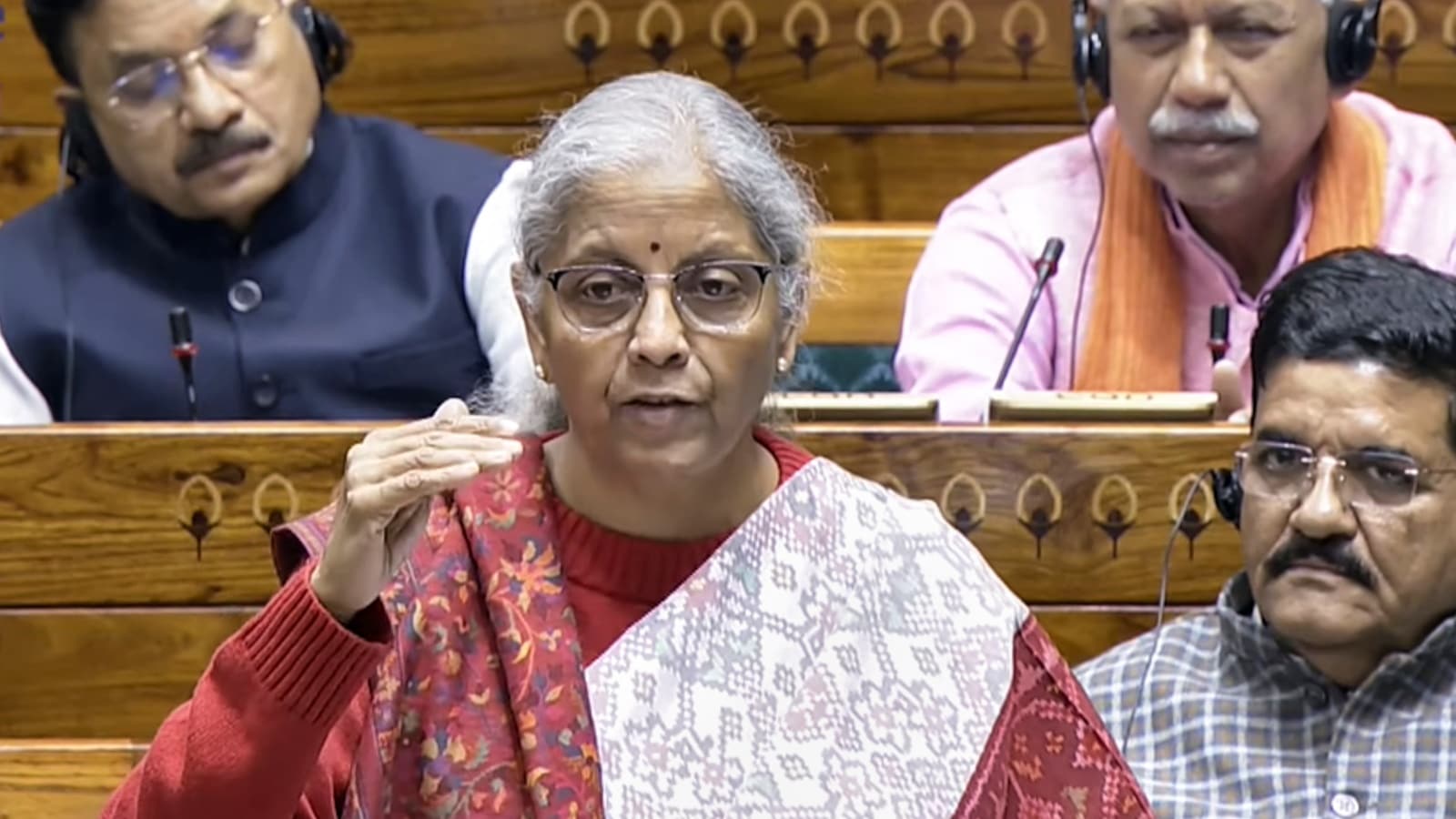
Union Finance Minister Nirmala Sitharaman recently delivered a robust defense of the NDA government’s fiscal management while sharply criticizing the Congress party and other opposition parties, such as the Trinamool Congress (TMC) and the Dravida Munnetra Kazhagam (DMK), during the debate on the Finance Bill, 2026. Her remarks, made in the Lok Sabha, highlighted the government’s efforts in managing the fiscal deficit and repaying past debts, contrasting the current administration’s record with that of the previous UPA government.
Sitharaman’s primary target was the Congress party, which she accused of “giving lectures” on fiscal deficit despite its poor track record during its tenure. She pointed out that the UPA government struggled to manage the fiscal deficit during the global financial crisis of 2008-09, whereas the NDA government successfully navigated the much more severe COVID-19 crisis without destabilizing the economy. She emphasized that the fiscal deficit in the COVID year peaked at 9.3 percent but has since been brought down steadily, a feat she implied was not achieved by the previous government during even milder crises.
A significant part of Sitharaman’s critique focused on the accounting practices of the UPA government concerning fiscal deficit figures. She alleged that the UPA manipulated the fiscal deficit numbers by offloading certain loans onto the balance sheets of oil marketing companies through “oil bonds,” effectively whitewashing the true fiscal deficit. According to her, the actual fiscal deficit in 2008-09 was 7.9 percent, but the government reported it as 6.1 percent by concealing these debts. She accused the UPA of passing on the burden of these loans to future generations, a burden the current government has been repaying with interest since 2014. Sitharaman revealed that the outstanding debt from these oil bonds amounted to Rs 1.3 lakh crore when the NDA government took over and that since then, it has repaid Rs 1.43 lakh crore, including Rs 44,650 crore in principal amounts. This repayment, she argued, has led to shortfalls in developmental spending on critical sectors such as healthcare and education, as funds were diverted to service these inherited debts.
Sitharaman also responded to Congress member Deepender Singh Hooda’s comments and engaged with Manish Tewari’s criticism regarding the rising national debt. She stressed that nominal debt figures should not be viewed in isolation without considering the growth in India’s nominal GDP. Sitharaman illustrated this by noting that while the debt rose from Rs 56.5 lakh crore in 2013-14 to Rs 214.8 lakh crore in 2025-26, the nominal GDP simultaneously surged from Rs 113 lakh crore to Rs 345 lakh crore in the same period. She argued that this growth in GDP makes the rise in debt more manageable and sustainable. Furthermore, she pointed out that the Centre alone cannot be held responsible for the increase in debt and urged Congress leaders to work with their own state governments, such as those in Himachal Pradesh and Karnataka, to address state-level debt issues.
Beyond her criticisms of Congress, Sitharaman also targeted regional parties ruling in states facing upcoming elections. She accused the TMC government in West Bengal of failing to implement key central schemes such as the Pradhan Mantri Cha Shramik Protsahan Yojana and delaying the rollout of the PM-Kisan scheme by two years. She used this to question the TMC’s commitment to “distributive justice,” a point raised by TMC member Sougata Ray during the debate.
Similarly, Sitharaman criticized the DMK in Tamil Nadu, urging the party to take a definitive stance on the Centre’s Production Linked Incentive (PLI) scheme rather than opposing it merely for political reasons. She also took issue with Tamil Nadu Chief Minister M.K. Stalin’s opposition to the Women’s Reservation Bill, highlighting this as an example of the state’s resistance to progressive reforms. However, she acknowledged that the state has benefited from the Centre’s GST reforms 2.0, which have resulted in increased tax collections in Tamil Nadu.
The debate concluded with the Lok Sabha passing the Finance Bill, 2026, by a voice vote, rejecting amendments proposed by opposition members. The official amendments moved by Finance Minister Sitharaman were approved, marking the formal adoption of the bill.
This exchange in Parliament reflects the ongoing political contestation around fiscal