
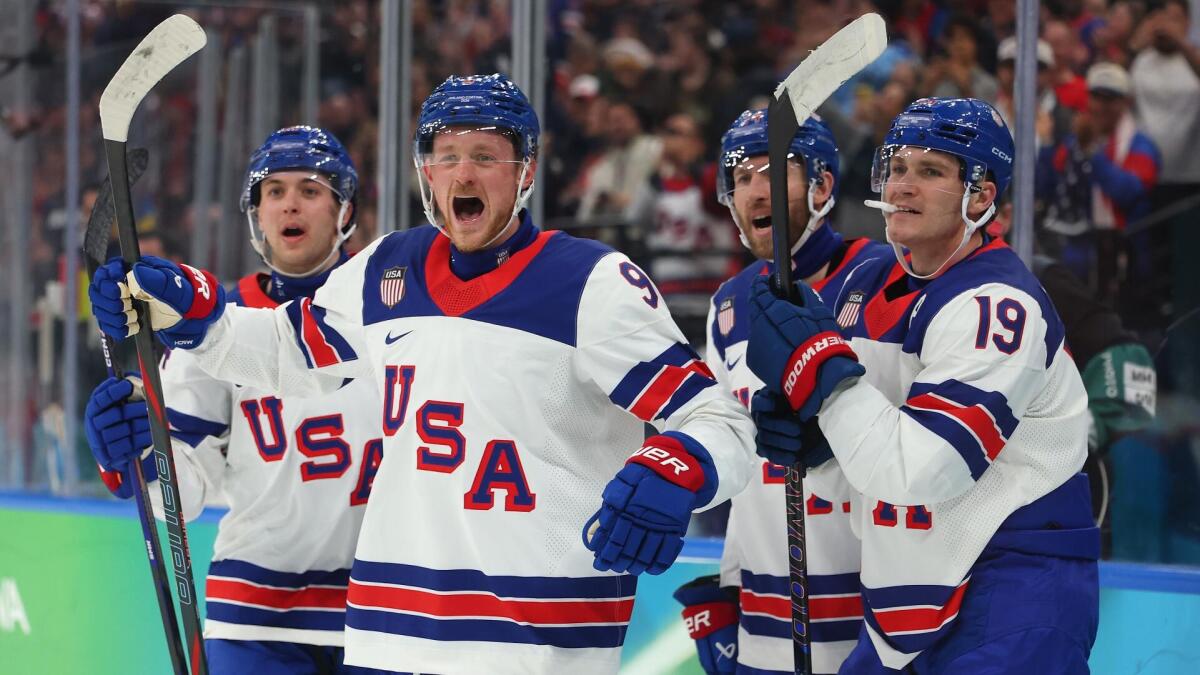
The much-anticipated gold medal showdown in men’s ice hockey at the 2026 Winter Olympics is finally set: Team USA will face off against their archrivals, Team Canada. This matchup fulfills the hopes of hockey fans across North America, promising a thrilling conclusion to a tournament filled with intense competition and dramatic moments.
Both the United States and Canada enter the final as the top two teams in the Olympic field, having battled fiercely to reach this point. The Americans edged past Sweden in a nail-biting overtime quarterfinal, showcasing their resilience under pressure. Meanwhile, Canada demonstrated immense grit with come-from-behind victories in the third period against both Czechia and Finland during the knockout rounds. These hard-fought wins have prepared both squads well, setting the stage for what many expect to be a classic gold medal game.
“There’s hatred there,” said U.S. forward Brady Tkachuk in an interview with ESPN. “They’ve been the top dog. They’ve been the best for the last bunch of years, and for us, we want to be in that position, be the best. So it’s going to be a game where I think a lot of guys could say, this is the biggest game that they’ve ever played in.” Tkachuk’s words capture the intense rivalry and high stakes that define this matchup.
On paper, these two teams are evenly matched, and oddsmakers agree. According to DraftKings, Canada holds a slight edge with odds at -125, while the U.S. is given +105. The game will take place Sunday, February 22, at 8:10 a.m. ET, at the Milano Santagiulia Arena in Milan, Italy, and will be broadcast live on NBC.
### Contrasting Styles and Key Players
The U.S. and Canada bring to the ice very different styles and strengths. Canada’s team is built around a potent offensive core capable of scoring in bunches. Known for their firepower up front, the Canadians rely heavily on stars like Connor McDavid and Macklin Celebrini, who form a lethal first line. Nathan MacKinnon, the current leading scorer in the NHL, anchors Canada’s second line, adding depth and skill. One critical question mark for Canada is the health of Sidney Crosby, who missed the semifinal due to a lower-body injury. If Crosby is able to play, his presence as the third-line center will provide Canada with incredible depth; if not, Nick Suzuki is expected to slot in.
Other notable Canadian forwards include Mitch Marner, Bo Horvat, and Brandon Hagel. Marner was particularly instrumental in Canada’s overtime win against Czechia, delivering a dazzling play that sealed the victory. This blend of creativity and scoring ability makes Canada’s offense formidable.
On the other side, the U.S. team emphasizes defensive strength and two-way play. While they may not boast the same offensive ceiling as McDavid or MacKinnon, their forward group is highly skilled and versatile. Center Jack Eichel and Auston Matthews form a dynamic duo capable of both generating offense and shutting down opponents. Dylan Larkin, serving as the third-line center, has been gaining momentum in the tournament’s later stages.
The American wings provide a balanced mix of skill and physicality. Brady Tkachuk and Matthew Tkachuk epitomize this blend, combining grit and finesse around the net. Meanwhile, Jack Hughes stands out with his flash and playmaking ability, having delivered several brilliant moments throughout the Olympics.
### Defense: The U.S. Advantage
Where the U.S. arguably holds the upper hand is on defense. The American blue line is anchored by puck-moving defensemen Quinn Hughes and Zach Werenski, both capable of contributing effectively in all zones. Jaccob Slavin and Brock Faber add strong shutdown capabilities, while Charlie McAvoy combines physical play with offensive support. Additionally, Jake Sanderson has emerged as an underrated star, providing depth and reliability.
Canada’s defense, by contrast, faces some uncertainties. They feature Cale Makar, widely regarded as the best defenseman in the world, but the loss of Josh Morrissey to injury early in the tournament has limited their options. Veterans like Drew Doughty and Travis Sanheim offer solid defensive play but are less consistent offensively. Colton Parayko provides physical presence, while Shea Theodore and Thomas Harley bring some offensive upside, though Harley has struggled this season. Overall, Canada’s defensive corps is seen