
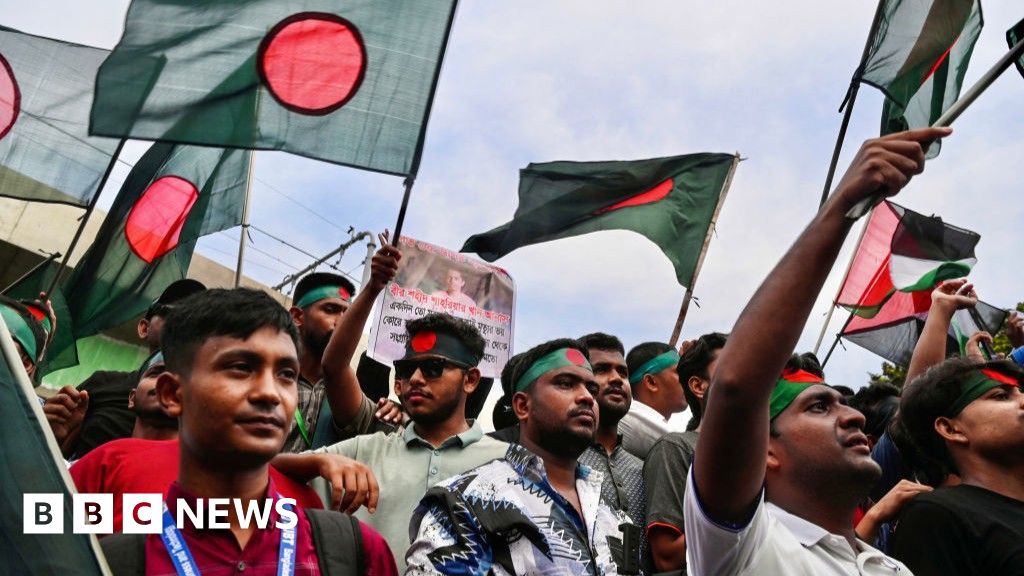
In the aftermath of the dramatic July 2024 uprising that ended Sheikh Hasina’s 15-year rule in Bangladesh, the atmosphere at Dhaka University encapsulates the country’s turbulent political and social landscape. The university’s walls, once silent witnesses, now burst with graffiti—angry, witty, and sometimes poetic—echoing the spirit of a vibrant Gen Z-led movement that brought about a historic political shift. Hasina, once widely regarded as a pro-democracy icon, faced growing criticism for her increasingly autocratic governance. Following her resignation, she fled to India, a move that has further complicated relations between the two neighboring countries.
The university campus is alive with political debate among students, who gather in small groups discussing the future of Bangladesh. Amidst this activism, a modest Chinese New Year celebration takes place, marked by red lanterns swaying over an unkempt lawn—a subtle but meaningful symbol of the ongoing geopolitical tug-of-war between China and India for influence in Bangladesh. For many young Bangladeshis, the upcoming general election scheduled for 12 February 2025 will be their first genuine encounter with the democratic process, raising hopes for a more inclusive and participatory political landscape.
In the power vacuum left by Hasina’s departure, Nobel Peace Prize laureate Muhammad Yunus has stepped in to lead the country’s interim government. Hasina now lives in exile in Delhi, India, which has refused to extradite her to face a death sentence imposed in absentia for her role in the brutal 2024 security crackdown. According to United Nations estimates, around 1,400 people were killed during this crackdown, most at the hands of security forces. Her political party, the Awami League, historically Bangladesh’s oldest and a dominant force commanding about 30% of the popular vote, has been barred from contesting in the upcoming elections. This political exclusion has created a vacuum that the opposition Bangladesh Nationalist Party (BNP) is seeking to fill, positioning itself in the liberal-centrist space left vacant by the Awami League. Furthermore, the Islamist party Jamaat-e-Islami has allied with a new party born from the student uprising, signaling a shifting political terrain.
However, political slogans and sentiments on the campus and across Bangladesh extend beyond domestic concerns. A rising tide of anti-Indian sentiment is palpable, with graffiti proclaiming “Dhaka, not Delhi” emblazoned on walls and even stitched onto traditional saris worn by women. For many young Bangladeshis, the term “hegemony” has entered everyday discourse, symbolizing India’s perceived overbearing influence in their country. This sentiment traces back to the controversial 2014 election, widely criticized as effectively a one-party election, which many believe India tacitly supported.
This sense of betrayal is central to the growing resentment against India. Analysts and locals alike argue that Delhi heavily backed Hasina’s increasingly authoritarian regime, facilitating the erosion of democracy in Bangladesh. “India supported Hasina’s regime without any pressure, without any questions,” says sociology student Mosharraf Hossain. This perception of India as an overbearing neighbor who treats Bangladesh as a subordinate “backyard” rather than a sovereign equal has merged with deeper historical grievances, including border killings, disputes over water sharing, trade restrictions, and inflammatory rhetoric from Indian politicians and media outlets.
These tensions have spilled into the media and public discourse. Reports in Bangladeshi media allege that an Indian conglomerate supplying electricity to Bangladesh has been cheating the country, charges that the company denies. On social media platforms like Facebook, campaigns to ban leading newspapers branded as “Indian agents” have gained traction. Both countries have suspended many visa services, further straining people-to-people connections. India’s recent decision to bar a Bangladeshi cricketer from the Indian Premier League (IPL) and refusal to move Bangladesh’s T20 World Cup matches from India to Sri Lanka have fueled resentment and added to the perception of India’s disregard for Bangladesh’s interests.
Despite these tensions, India has attempted to broaden its diplomatic engagement in Bangladesh. In a notable move, Indian Foreign Minister S. Jaishankar attended the funeral of former prime minister Khaleda Zia, leader of the BNP, and met with the party’s acting chairman Tarique Rahman, who has recently returned from exile and is seen as a frontrunner in the upcoming election. India has also opened channels with Islamist groups, including Jamaat-e-Islami, whose