
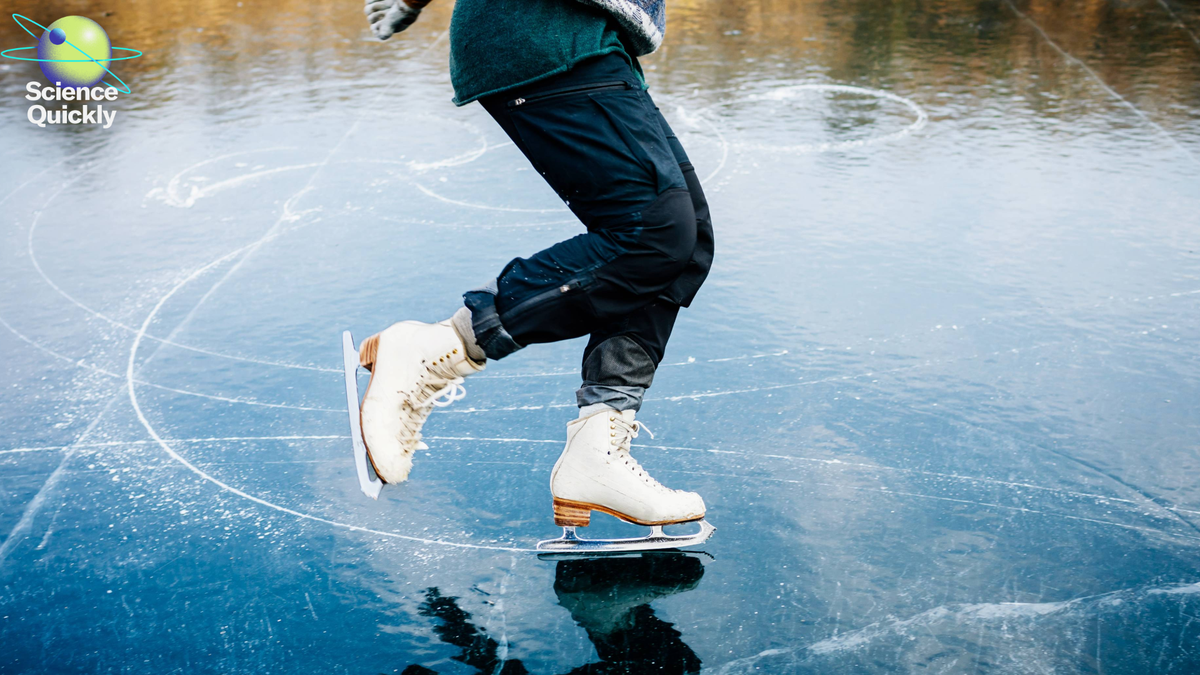
Ice is famously slippery—a fact central to winter sports like figure skating, curling, bobsledding, and luge, which all rely on controlled slipping over ice surfaces. Despite its commonality, the precise physics behind why ice is slippery has baffled scientists for centuries. Recent research and experiments have revisited this question, revealing that the answer is far more complex than previously thought. Multiple competing theories exist, each shedding some light but none fully explaining the phenomenon alone. Understanding why ice is slippery is not just a matter of curiosity; it has practical implications for sports, safety, and energy efficiency worldwide.
The mystery of ice’s slipperiness dates back to the 19th century, with various hypotheses proposed over time. One of the earliest ideas came from James Thomson, a Scottish engineer and brother of the renowned physicist Lord Kelvin. Thomson observed glaciers and theorized that the immense pressure exerted by heavy loads on ice could lower its melting point, creating a thin layer of water on the surface. This liquid layer, he suggested, made ice slippery. The principle behind this is that pressure affects the freezing point of water, meaning that under high pressure ice could melt even below 0°C (32°F).
However, this pressure-induced melting theory has a significant flaw. As physicist Daniel Bonn from the University of Amsterdam explains, the pressure required to melt ice under normal conditions is extraordinarily high—roughly equivalent to the weight of ten elephants standing on a single skate blade. Since humans weigh far less than that, pressure alone cannot account for the slipperiness we experience when walking or skating on ice. This realization prompted scientists to explore other explanations.
A second prominent theory centers around frictional heating. Proposed by tribologists—scientists who study friction and lubrication—this hypothesis suggests that as we move across ice, the friction generated by our movement produces heat, which in turn melts a thin layer of ice beneath our feet or skates. This melted layer acts as a lubricant, making the surface slippery. Frank Bowden, a pioneer in this field, conducted experiments in the Alps comparing two skis identical in every way except heat conductivity. Remarkably, the ski that retained more heat slid faster, supporting the idea that frictional heating plays a role in ice slipperiness.
Daniel Bonn’s team conducted extensive experiments measuring friction on ice over a wide temperature range—from as low as -100°C (-148°F) up to the freezing point. They found that friction is incredibly high at very low temperatures, making skating nearly impossible. As temperatures rise to around -7°C (20°F), friction decreases sharply, making skating easier. However, if the ice becomes too warm, closer to 0°C, friction increases again because the ice turns mushy, causing “plowing friction” where skates or shoes dig into the soft surface. This finding aligns with the experience of skaters who know there’s an optimal temperature range for ideal ice conditions.
Despite the role of frictional heating in melting ice behind us during movement, this theory does not explain why ice feels slippery even before we start moving. Standing still on ice can be difficult, indicating that slipperiness cannot be fully attributed to frictional heating. This brings us to a third theory, which involves the structure of ice itself.
English chemist Michael Faraday proposed in the 1800s that ice might have a thin, naturally occurring film of water on its surface even below freezing temperatures. This “pre-melted” layer exists because the molecules at the surface of ice are less tightly bound than those deeper inside the solid lattice. While the bulk of ice consists of water molecules arranged in an orderly crystalline lattice, the surface molecules form a less ordered, more fluid-like boundary. This thin liquid-like layer could provide the lubrication necessary to make ice slippery.
Over the past several decades, experimental evidence has supported the existence of this pre-melted water layer, but it is very thin—so thin that even a layer with the low viscosity of water would still produce noticeable friction. This contradicts the experience of how easily one can slip on ice, suggesting that the pre-melted layer alone cannot explain the full effect.
In summary, the three main longstanding hypotheses to explain ice’s slipperiness are: first, pressure-induced melting; second, frictional heating melting the ice; and third, the presence of a thin pre-melted water layer on the ice surface. Each theory has strengths but also critical weaknesses. More recent advances suggest the truth likely
Good Job !!
ReplyDelete