
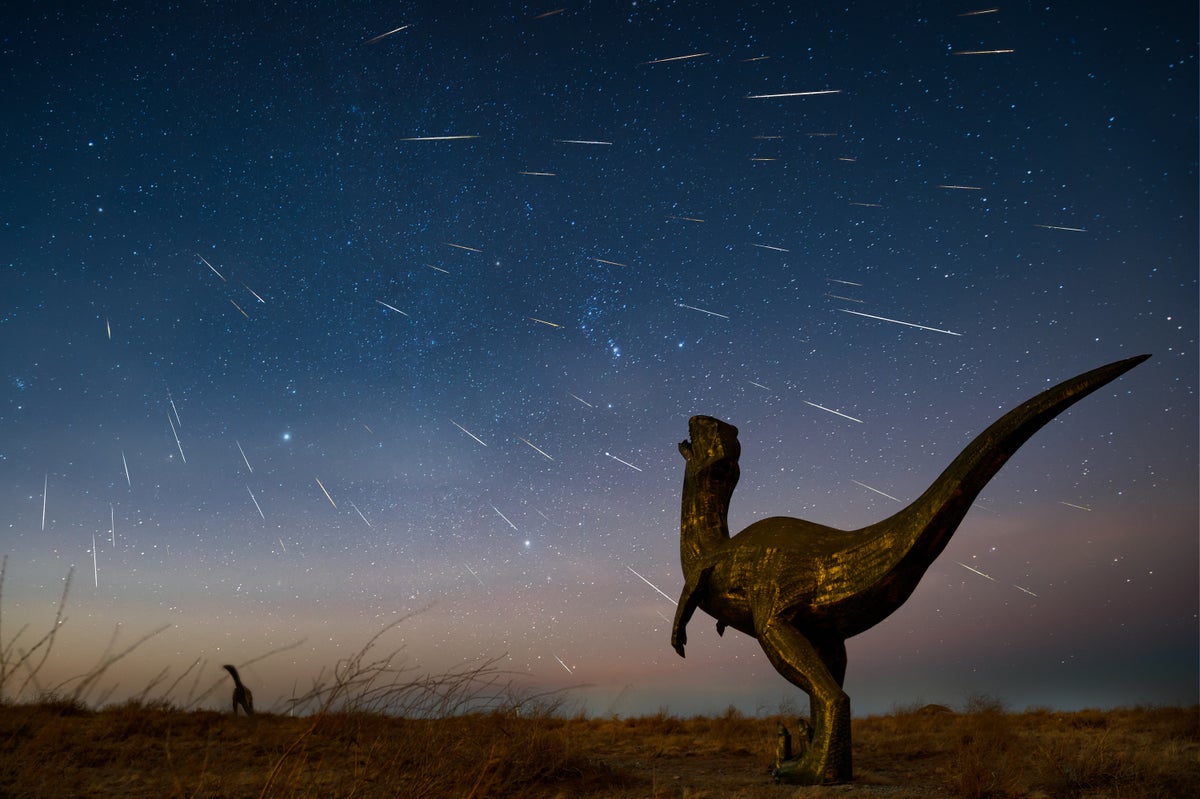
Could aliens in a distant galaxy have observed dinosaurs on Earth? This intriguing question, recently posed by a reader of Phil Plait’s “The Universe” column, invites us to explore the immense challenges involved in peering across cosmic distances to witness events from Earth’s deep past. Specifically, if extraterrestrial observers were located 66 million light-years away—the approximate distance light has traveled since the extinction of nonavian dinosaurs—how large would their telescope need to be to actually see a Tyrannosaurus rex roaming our planet?
At the heart of this thought experiment lies the relationship between distance, size, and observational capability. The number 66 million light-years is significant because the catastrophic asteroid impact that ended the reign of the dinosaurs occurred roughly 66 million years ago. Light from that event, and the last moments of dinosaurs, would just now be arriving at a galaxy situated that far from Earth. So, in theory, an alien civilization with sufficiently advanced telescopes located there could glimpse the late Cretaceous period—if they had the means to build an instrument powerful enough to resolve such tiny details.
To understand what it would take, we need to consider two key factors. First, how large would a dinosaur appear from that distance? And second, what size telescope would be necessary to resolve that apparent size, rather than merely detect it as an unresolved point of light?
Astronomers measure apparent size of objects in the sky using angles, typically in degrees. For context, the full Moon spans about half a degree across the sky. The apparent angular size depends on both the actual physical size of the object and how far away it is. This relationship can be approximated using a simple formula: the angular size in degrees equals the physical size of the object multiplied by 57.3, then divided by the distance to the object.
Let’s apply this to a T. rex, one of the largest and most iconic dinosaurs. Assuming a length of about 10 meters, and placing it at 66 million light-years away—converted to meters as approximately 6.6 × 10^23 meters—the angular size comes out to about 10^-21 degrees. This number is staggeringly small: one sextillionth of a degree, an unimaginably tiny angle that underscores just how minuscule such an object would appear across such a vast gulf of space.
Having established the dwarfing scale of the dinosaur’s apparent size, the next question is whether any telescope could resolve such a small angle. Magnification alone won’t suffice. If an object is too small to be resolved, magnifying it only enlarges a blur or dot—pixels in a digital image—not revealing any real detail. Resolution depends primarily on the diameter of a telescope’s mirror or aperture: the larger the telescope, the finer the detail it can discern.
The theoretical resolution limit of a telescope, known as Dawes’s limit, relates angular resolution in degrees to the mirror diameter (D) in meters by the formula: resolution = 3.2 × 10^-5 divided by D. Using the dinosaur’s angular size for resolution, solving for D gives a required mirror diameter of approximately 3.2 × 10^16 meters—about 3.4 light-years across. To put that in perspective, this mirror would stretch roughly three-quarters of the distance to Alpha Centauri, our nearest star system.
This is not just impractically large; it is effectively impossible with any conceivable technology. Even if such a mirror could be made from extraordinarily thin glass just one millimeter thick, its mass would exceed 10^30 metric tons—a nonillion tons—more than 100 million times the mass of Earth. Building such a telescope would demand dismantling and repurposing large portions of rocky planets from an entire galaxy, a feat beyond even the most speculative advanced engineering.
One potential workaround for such extreme size requirements is to use an interferometer. This technique involves an array of smaller telescopes spread out over a large area, whose combined observations can mimic the resolving power of a single enormous telescope whose diameter equals the greatest separation between the array’s components. While this method saves on materials by using many smaller mirrors instead of one gigantic one, the mass involved remains colossal—still on the order of a billion trillion metric tons, a significant fraction of Earth’s mass, and an engineering challenge of unprecedented scale.
Assuming, for the sake of imagination, that alien engineers managed to construct such an instrument, numerous