
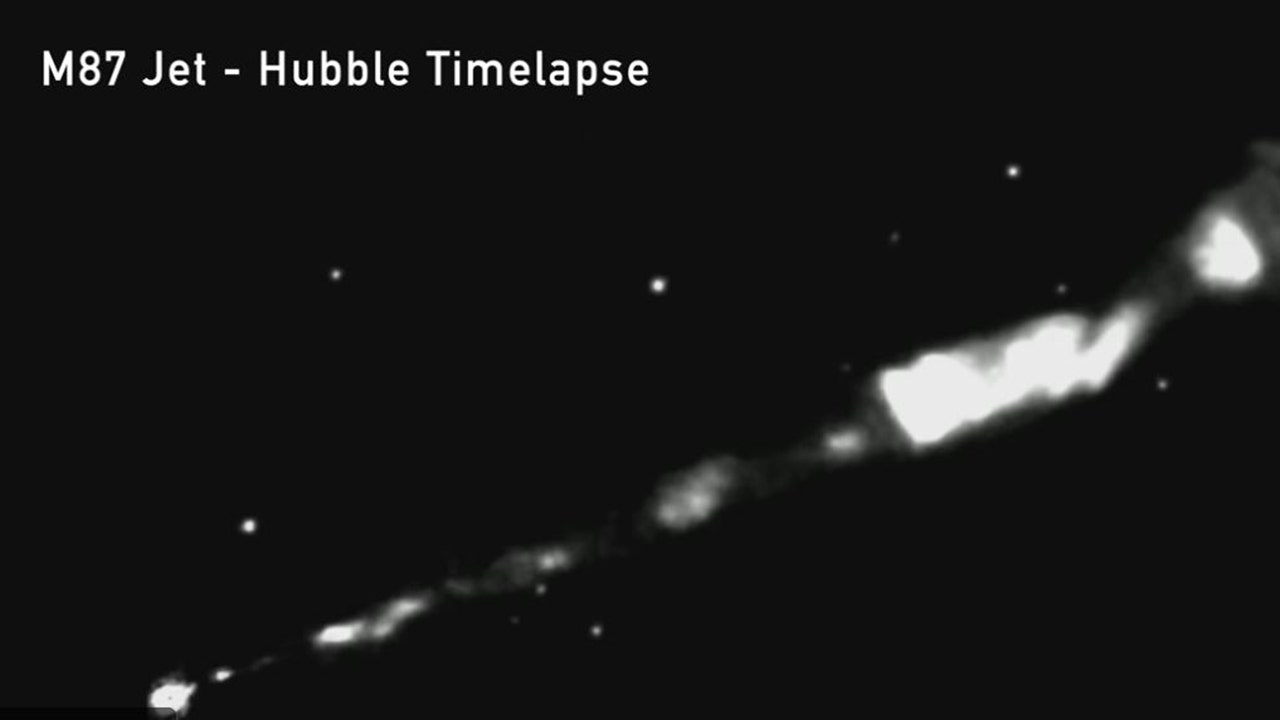
In a groundbreaking new study published this week in the journal *Astronomy & Astrophysics*, scientists have made a remarkable discovery about the origins of cosmic jets emitted by black holes. Using enhanced observations from the global Event Horizon Telescope (EHT) network, researchers have traced a colossal jet of charged particles—stretching an astonishing 3,000 light-years—back to its likely source at the supermassive black hole located at the center of the Messier 87 (M87) galaxy. This finding offers a significant leap forward in understanding how black holes generate and launch these immense jets that travel at nearly the speed of light, shedding light on a long-standing mystery in astrophysics.
M87’s supermassive black hole is no ordinary cosmic object. Situated approximately 55 million light-years away from Earth, this black hole is about 6.5 billion times more massive than our sun. It gained worldwide fame in 2019 when the Event Horizon Telescope collaboration released the first-ever image of a black hole’s event horizon—the boundary beyond which nothing, not even light, can escape. The groundbreaking image was the culmination of data collected in 2017 from a global network of radio observatories working together as one Earth-sized telescope. This milestone not only captivated the public imagination but also provided an unprecedented glimpse into one of the universe’s most enigmatic phenomena.
While M87’s black hole is supermassive, it is also “active,” as NASA scientist Dr. Padi Boyd explained in a video commentary about the discovery. Unlike most black holes, which lie dormant for long periods, active black holes are accreting material and emitting powerful jets of energy. Dr. Boyd noted that only a small percentage of black holes are active at any given time, raising intriguing questions about whether these cosmic giants cycle between active and inactive phases. The presence of extremely strong magnetic fields near the black hole is believed to be crucial in launching these jets, and the new observations provide direct evidence linking the jets to the black hole’s immediate environment.
The jets themselves are streams of charged particles ejected at relativistic speeds from the black hole’s poles, extending vast distances into space. These jets have been observed for decades, but pinpointing their exact origin has been challenging due to the enormous scales involved and the complexities of the black hole’s environment. This study represents an important step toward bridging the gap between theoretical models of jet formation and actual observational data. According to Saurabh, the team leader at the Max Planck Institute for Radio Astronomy, identifying the jet’s origin and understanding its connection to the black hole’s shadow—the dark region framed by the event horizon—provides a crucial piece of the puzzle in decoding how the black hole’s central engine functions.
The Event Horizon Telescope itself is a remarkable feat of scientific collaboration and technology. It connects eight radio observatories located around the world, from the peaks of mountains to remote deserts, synchronizing their observations to create a virtual telescope as large as the Earth. This technique, known as very long baseline interferometry (VLBI), allows astronomers to detect and image radio waves emitted by distant cosmic objects with extraordinary resolution. Through these means, the EHT has opened an unprecedented window into the realms surrounding black holes, enabling discoveries that were once thought impossible.
M87 is an elliptical galaxy notable not only for its supermassive black hole but also for its impressive population of stars—several trillion in total—and roughly 15,000 globular star clusters. The galaxy’s vast scale and complex structure make it an ideal laboratory for studying the interactions between supermassive black holes and their host galaxies. Understanding how these jets influence their surroundings is key to grasping the broader processes that govern galaxy formation and evolution.
The term “event horizon,” central to this research, refers to the black hole’s boundary beyond which no information or matter can escape the gravitational pull. It effectively marks the point of no return. Observing phenomena near this boundary provides critical insights into the extreme physics at play, including how matter behaves under intense gravity and how energy is extracted to power jets.
The current findings were derived from data gathered by the Event Horizon Telescope during its 2021 observing campaign. The study’s authors emphasize that while their results are robust within the parameters and tests conducted, further observations with greater sensitivity and improved intermediate-baseline coverage are necessary to confirm these conclusions definitively. Future enhancements to the EHT—including adding more observatories, expanding the range of frequencies observed, and increasing