
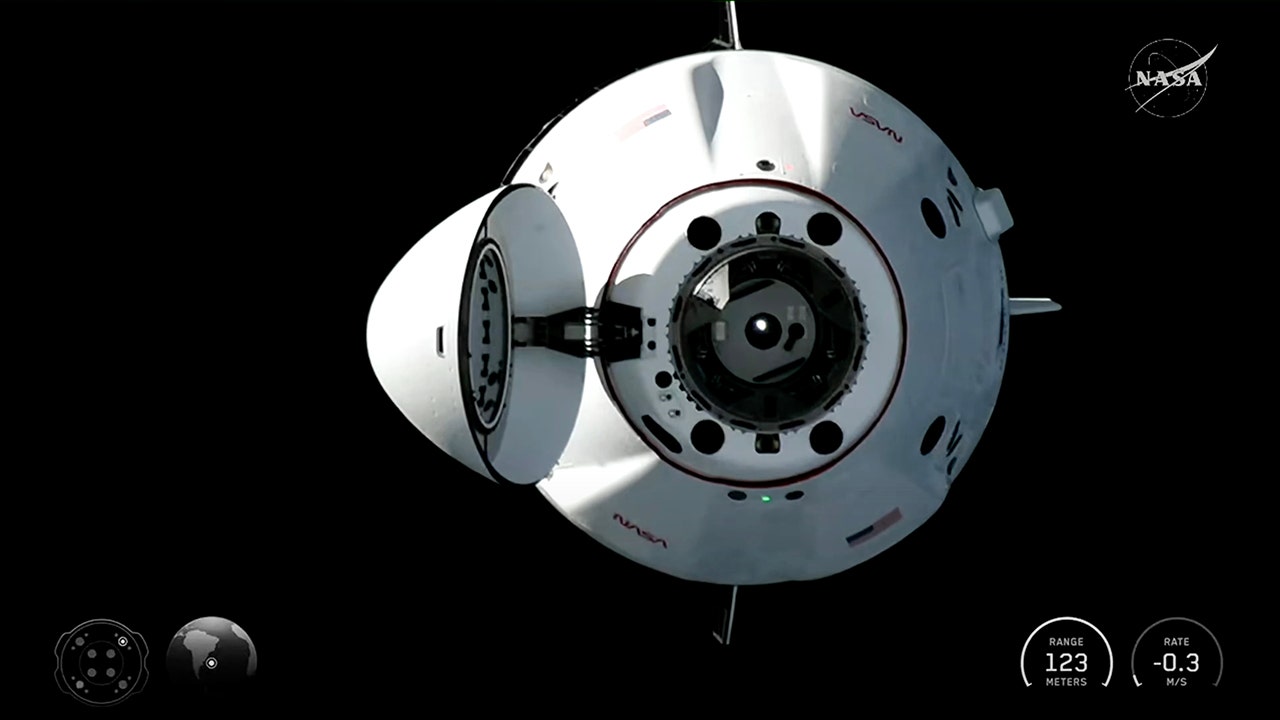
Four new astronauts arrived at the International Space Station (ISS) on Saturday, February 14, restoring the station to full crew capacity after a recent medical emergency forced some astronauts to return to Earth earlier than planned. The arrival marks the beginning of a new mission, Crew-12, which is set to last approximately eight to nine months and will continue important scientific research and technology development in preparation for future space exploration.
The Crew-12 team, consisting of NASA astronauts Jessica Meir and Jack Hathaway, French astronaut Sophie Adenot, and Russian cosmonaut Andrei Fedyaev, launched from Cape Canaveral, Florida, aboard a SpaceX Falcon 9 rocket and Dragon spacecraft on Friday. The roughly 34-hour journey to the ISS was smooth, though the launch itself had been delayed twice due to weather concerns. Upon liftoff, NASA Commander Jessica Meir expressed her excitement, saying, “That was quite the ride. We have left the Earth, but the Earth has not left us,” highlighting the awe-inspiring experience of space travel.
Commander Jessica Meir is a marine biologist and a seasoned space traveler, having visited the ISS before and participated in the first all-female spacewalk in 2019. Joining her is Jack Hathaway, a captain in the U.S. Navy, Sophie Adenot, a military helicopter pilot and only the second French woman ever to go to space, and Andrei Fedyaev, a former military pilot from Russia who has also previously visited the ISS. The diverse backgrounds of the crew members reflect the international collaboration that characterizes the ISS program.
After the Dragon capsule autonomously docked with the Harmony module of the ISS at approximately 3:15 p.m. ET on Saturday, the crew opened the hatch around an hour later. They greeted their fellow astronauts aboard the station and expressed their enthusiasm for the work ahead. Jessica Meir said, “We are so excited to be here and get to work,” while Sophie Adenot reflected on the breathtaking view of Earth from space, noting, “The first time we looked at the Earth was mindblowing. … We saw no lines, no borders.” This perspective underscores the unity and cooperation that space exploration fosters among nations.
The arrival of Crew-12 is particularly significant because it follows a rare medical evacuation from the ISS in January. For the first time in 65 years, a crew member aboard the station experienced a serious health issue that necessitated an early return to Earth. NASA has kept the details of the medical emergency confidential to protect the astronaut’s privacy. Along with the affected astronaut, three other crew members who had launched with them also returned home early. Prior to the arrival of Crew-12, the ISS was staffed by only one American and two Russian crew members who maintained the station’s operations during this unexpected period of reduced staffing.
NASA Administrator Jared Isaacman praised the mission’s successful launch and arrival, calling it “an absolutely wonderful start to the day” and a demonstration of NASA’s mission-focused approach. He highlighted the agency’s ability to manage multiple complex operations simultaneously, noting that while Crew-12 was launched and docked successfully, NASA was also preparing for the upcoming Artemis 2 mission, which aims to send humans back to the Moon and has a launch window opening in early March.
Crew-12 represents the 12th crew rotation flight under NASA’s Commercial Crew Program, which partners with private companies like SpaceX to ferry astronauts to and from the ISS. This program has been crucial in maintaining a continuous human presence in space since the retirement of the Space Shuttle program. The astronauts aboard Crew-12 will conduct a variety of scientific investigations and technology demonstrations during their mission. Their work aims to advance human space exploration capabilities, with a focus on long-duration missions to the Moon and Mars, while also conducting experiments that have direct benefits for people on Earth.
The SpaceX Falcon 9 rocket and Dragon capsule have become reliable vehicles for transporting astronauts and cargo to the ISS. Friday’s launch from Cape Canaveral was carried out smoothly, with the Dragon spacecraft traveling at approximately 17,000 miles per hour as it approached and docked at the orbiting laboratory. The autonomous docking capabilities of the Dragon capsule help streamline operations and reduce the workload for astronauts aboard the station.
The international composition of the Crew-12 team illustrates the collaborative nature of the ISS program. NASA, the Russian space agency Roscosmos, and the European Space Agency (ESA), which Sophie Adenot represents,