
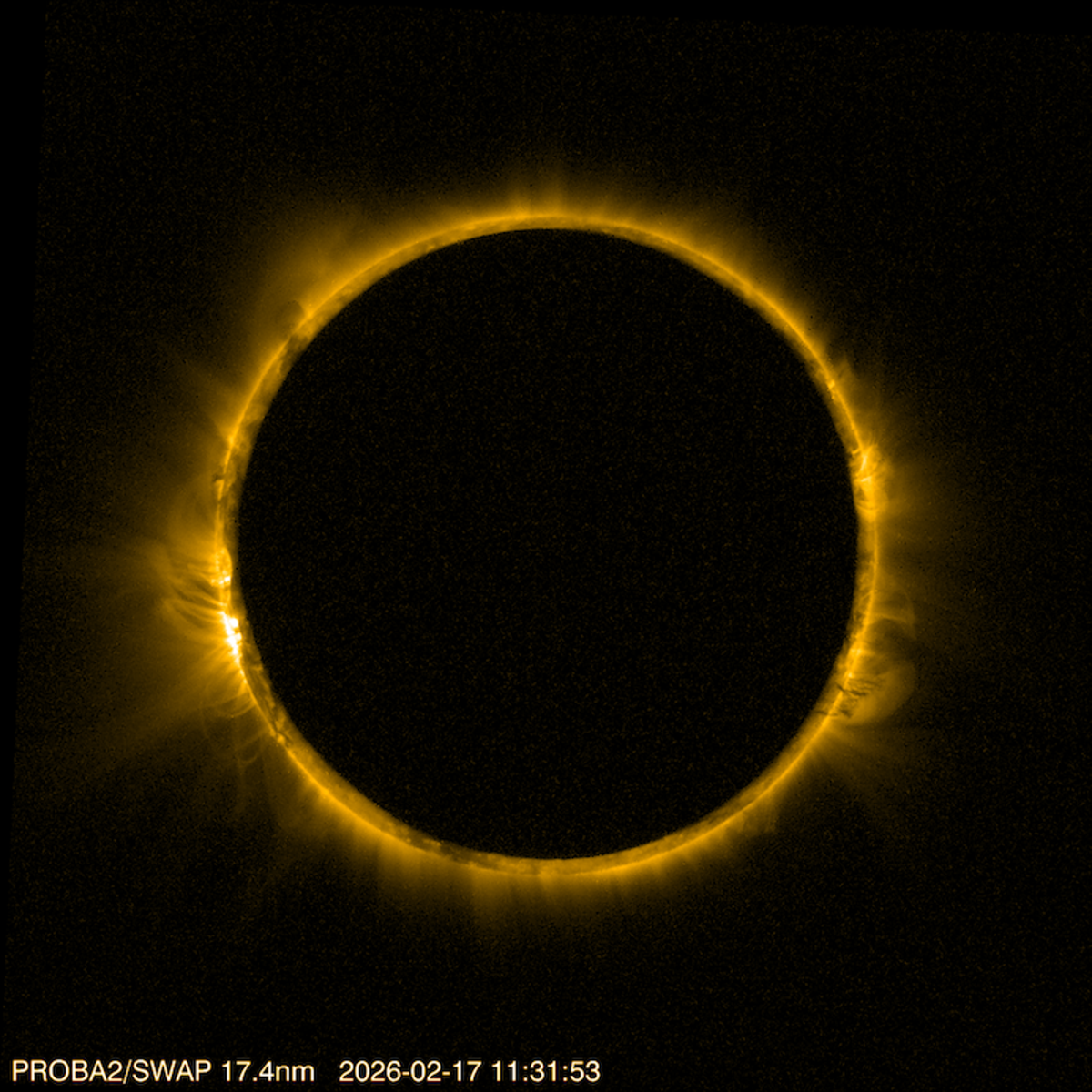
On February 17, 2026, a remarkable astronomical event captivated those in the southernmost reaches of the Earth: the year’s first solar eclipse, producing a spectacular “ring of fire” effect. While this phenomenon was visible only to a limited audience—primarily those in Antarctica and its surrounding waters—it has now been captured in breathtaking detail from space, offering a fresh perspective on this celestial spectacle.
The stunning images were obtained by the European Space Agency’s (ESA) PROBA-2 satellite, a small but sophisticated craft designed to study the sun and monitor space weather. As PROBA-2 orbited Earth during the eclipse, it captured multiple images—at least four—of the event, revealing a “perfect” annular eclipse, or “ring of fire,” as ESA described it. These images showcase the eclipse’s glowing halo, created when the moon aligns directly between Earth and the sun but appears slightly smaller than the sun itself in the sky. Consequently, the moon cannot completely obscure the sun’s light, leaving a luminous ring around its silhouette.
This particular type of eclipse, known as an annular eclipse, differs from a total solar eclipse because the apparent size of the moon is insufficient to cover the entire solar disk. The resulting effect is a fiery ring encircling the darkened moon, a rare and visually striking phenomenon that has fascinated humanity for centuries.
The best vantage point for witnessing the eclipse on February 17 was Concordia Station, a research outpost located deep in Antarctica. From there, observers were able to view the ring of fire for approximately two minutes, a brief but awe-inspiring moment. For the majority of people around the world, the eclipse went unseen due to its remote location and limited visibility path.
Looking ahead, sky-watchers need not wait too long for another remarkable lunar event. The next eclipse of 2026 is a total lunar eclipse scheduled to begin on March 3 (Coordinated Universal Time). During a total lunar eclipse, Earth moves directly between the sun and the moon, casting its shadow over the lunar surface. This shadowing often imparts a reddish tint to the moon, earning it the evocative nickname “blood moon.” This upcoming eclipse will be at least partially, if not fully, visible to viewers across a broad expanse of the globe, including Asia, Australia, the Pacific Islands, and the Americas.
These celestial events are not only spectacular to behold but also provide valuable opportunities for scientific observation and study. Satellites like ESA’s PROBA-2 contribute significantly to our understanding of solar and space phenomena by capturing data that ground-based observers cannot. PROBA-2 carries two primary instruments dedicated to solar observation, supplemented by additional sensors monitoring space weather conditions, which can influence satellite operations and communications on Earth.
The recent images from PROBA-2 enrich our appreciation of the dynamic interactions between the sun, moon, and Earth. They also highlight the importance of continued investment in space-based observation platforms, which enable scientists to capture rare and fleeting events from unique vantage points.
This coverage and the broader efforts to communicate science underscore the vital role of organizations such as Scientific American. Founded 180 years ago, Scientific American remains a steadfast advocate for science and its contributions to society. Reporters like Jackie Flynn Mogensen, who covered this eclipse event, bring scientific discoveries and breakthroughs into public view, making complex phenomena accessible and engaging to a wide audience.
Mogensen, a seasoned science journalist with a background in environmental communication and earth sciences from Stanford University, previously worked at Mother Jones, where she earned recognition for her excellence in science communication. Her reporting continues to inspire curiosity and wonder about our universe, encouraging readers to look up and appreciate the celestial rhythms that quietly shape our world.
In a time when science faces increasing challenges—from funding cuts to public skepticism—support for quality science journalism is more crucial than ever. Subscriptions to trusted outlets like Scientific American help ensure that in-depth, accurate, and meaningful scientific reporting remains available to all. Subscribers gain access to a wealth of resources, including news articles, podcasts, videos, infographics, newsletters, and more, all designed to illuminate the wonders of the natural world and the frontiers of human knowledge.
As the year progresses, more astronomical phenomena await observation, promising to deepen our understanding of the cosmos and our place within it. The February 17 annular solar eclipse, captured so vividly from space, stands as a testament to both the beauty of our universe and the power of human