
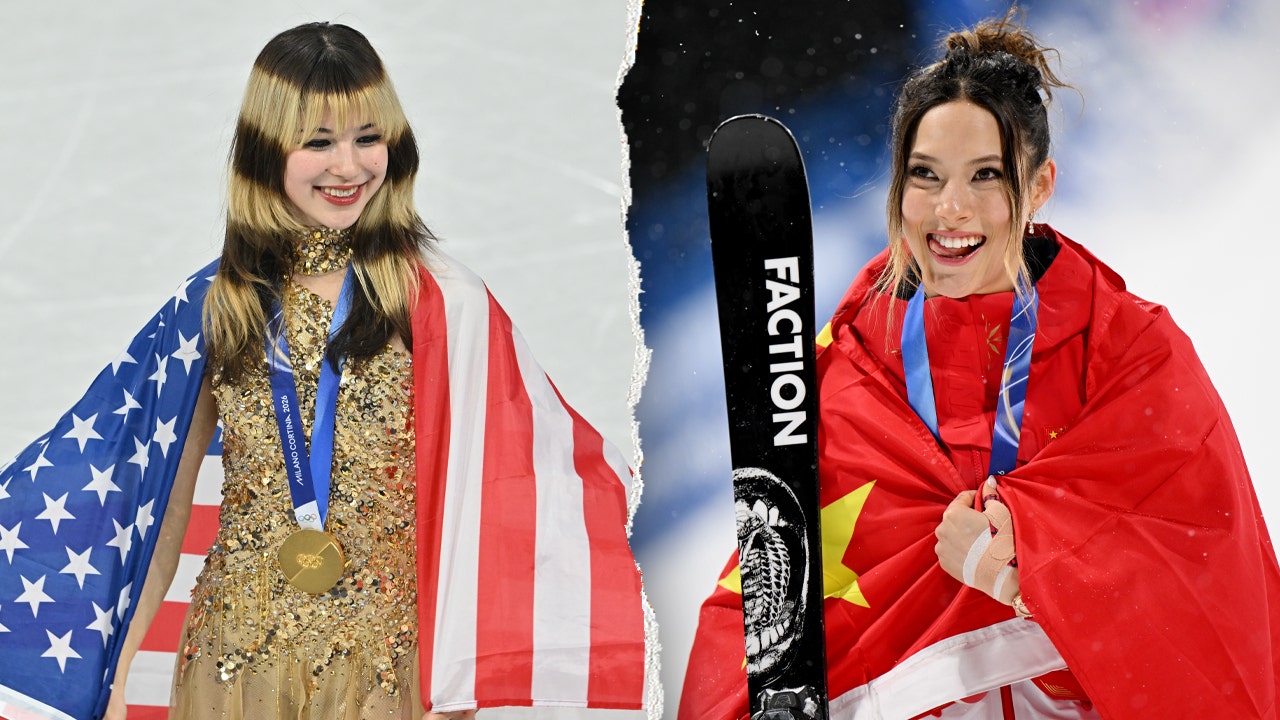
At the 2026 Winter Olympics in Milan-Cortina, a compelling narrative unfolded around two remarkable Chinese American athletes—figure skater Alysa Liu and freestyle skier Eileen Gu—who found themselves symbolizing a broader cultural and political dialogue. Their intertwined stories highlight themes of identity, loyalty, and the complex intersection of sports and geopolitics. OutKick founder Clay Travis recently discussed their journeys and achievements on “Fox News Live,” shedding light on the significance of their performances and the ongoing debate surrounding Gu’s decision to represent China.
Alysa Liu made history at the Olympics by becoming the first American woman in 24 years to claim a gold medal in an individual figure skating event. Her triumphant moment came during the women’s free skate final, where she delivered a polished and confident performance that earned her a season-best free skate score of 150.20 and a total score of 226.79. Liu’s victory was not only a personal milestone but also a moment of national pride, as she helped the U.S. secure the team gold as well. Celebrating her success on Instagram, Liu posted a photo holding both her individual gold medal and the team gold, captioning it, “These are for y’all,” expressing gratitude and solidarity with her supporters.
Eileen Gu, on the other hand, is a figure who has sparked considerable discussion due to her decision to compete for China, despite being born and raised in the United States. Gu, a freestyle skier, has been a prodigious talent since her youth. Her parents, immigrants from China, raised her in the San Francisco Bay Area, just as Liu was raised nearby in Oakland. However, their athletic paths dramatically diverged in 2019 when the Chinese government launched a program aimed at recruiting foreign-born athletes of Chinese descent to boost their competitiveness ahead of the 2022 Beijing Winter Olympics. Gu accepted the invitation to compete for China, switching allegiance after her initial competitions for the U.S.
This decision placed Gu at the center of an ongoing debate about national identity and the politicization of sports. While many viewed Gu’s choice as a strategic career move that brought her international fame—she won two gold medals and one silver at the 2022 Winter Games in Beijing—others questioned her loyalty, especially given her American upbringing. In contrast, Liu and her family remained steadfastly committed to representing the United States. According to reports, her father, Arthur Liu, was “not open to persuasion” when it came to competing for China, underscoring a strong sense of American loyalty.
The 2026 Winter Olympics continued to highlight this contrast. While Liu’s historic gold medal and spirited celebration—complete with exuberant exclamations and heartfelt joy—captured headlines, Gu’s performances have been impressive but less dominant. As of the latest events, Gu has earned two silver medals in Italy, and she is preparing for one last shot at gold in the women’s halfpipe final, widely regarded as her strongest event. Despite a fall during the halfpipe qualifiers, Gu recovered on her second run to secure a spot in the final, demonstrating resilience and determination.
Gu’s journey has not been without controversy. She has faced intense scrutiny and criticism in the United States for her decision to compete for China, often becoming a focal point for broader geopolitical tensions. When asked about this scrutiny during a recent interview, Gu expressed that she feels like a “punching bag” for certain political perspectives, noting that many athletes compete for countries other than their birth nations without similar backlash. She highlighted that much of the criticism stems from a generalized animosity toward China, rather than any substantive issue with her personal choices.
In defending her achievements, Gu emphasized her status as the most decorated female freeskier in history, pushing back against the narrative that frames her silver medals as “golds lost.” She argued that every Olympic medal is a significant accomplishment and that expectations rise with an athlete’s success, making continued podium finishes extraordinarily challenging. Gu’s remarks underscore the pressure elite athletes face, not only in competition but also in managing public perception and political expectations.
The dynamic between Liu and Gu has become a symbolic proxy for the broader cultural and political tensions between the United States and China. Social media and public discourse have often positioned them as rivals beyond the sporting arena, focusing on their heritage and national representation rather than purely their athletic prowess. Yet, in a moment of sportsmanship and mutual respect, Gu commented on Liu’s Instagram post celebrating her gold