
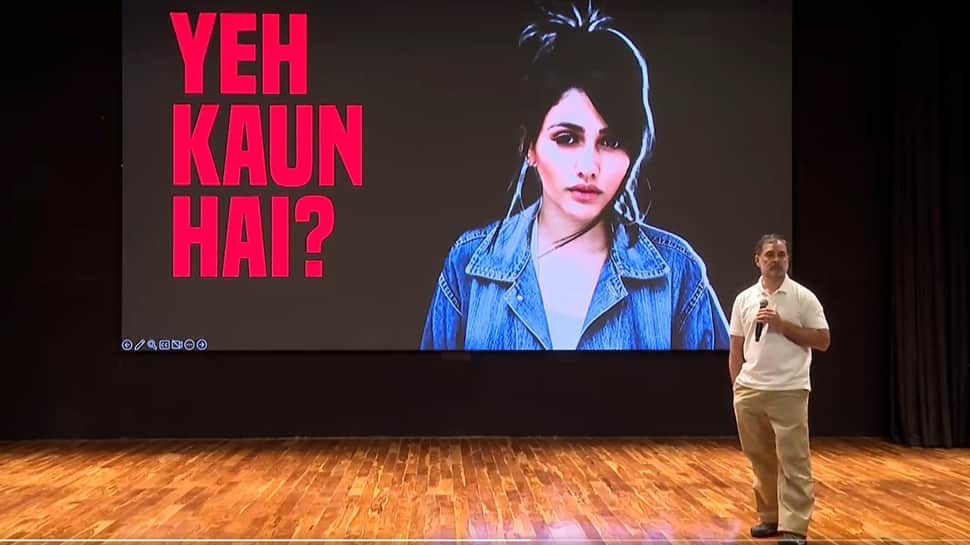
In a recent political controversy that has captured significant public attention, Rahul Gandhi, a senior leader of the Indian National Congress, alleged serious irregularities in the Haryana voter rolls. He claimed that the photograph of a Brazilian model named Larissa Nery appeared multiple times—22 times, to be exact—on the voter list under different fictitious names such as Sweety, Seema, and Saraswati. This accusation implied a massive case of electoral fraud, suggesting that fake voter identities were being used to manipulate election outcomes in Haryana.
The controversy quickly went viral, prompting a wide range of reactions both within India and internationally. Adding an unexpected twist to the story, Larissa Nery herself responded to the allegations and the use of her photograph in the voter roll. Larissa, a professional model from Brazil, took to Instagram to share her amusement and bewilderment at her old photo being co-opted into an Indian electoral dispute. In a video posted on her social media, she explained that the photograph in question was taken when she was much younger—around 18 or 20 years old—and expressed disbelief that it was being used to portray her as an Indian voter involved in fraudulent activities.
She recounted receiving calls from Indian reporters seeking interviews about the issue, some even contacting the salon where she works. Larissa chose not to respond to the interview requests but confirmed that the reporters had found her Instagram profile and were reaching out to her directly through social media. She also shared that a friend from another city sent her images related to the controversy, which she posted to her followers to illustrate the bizarre misuse of her image. Larissa’s reaction underscored how her identity had been misappropriated in a political context far removed from her personal life.
While Rahul Gandhi’s claims initially suggested a glaring case of electoral malpractice, subsequent investigations by media outlets raised questions about the authenticity of the information he presented. One of the supposed voters listed with Larissa’s photograph, a woman named Poonam, was located by journalists. Poonam provided her voter ID card, which contained her real name and photograph, establishing that she was a legitimate voter who had indeed cast her vote in the Haryana elections. This discovery cast doubt on the claim that the voter rolls contained multiple fake entries using Larissa’s image.
The political fallout from these revelations has been significant. The Bharatiya Janata Party (BJP), the ruling party in India, accused Rahul Gandhi and the Congress party of intentionally distributing a fabricated voter list to discredit the Election Commission of India (ECI). The BJP argued that the Congress was attempting to undermine the credibility of the electoral process by spreading misinformation and staging a fake expose. This counter-accusation has intensified the political rivalry and escalated the debate over election integrity in Haryana.
The incident highlights the complex interplay between politics, media, and technology in modern elections. The use of an international model’s image in Indian voter rolls — whether by mistake or design — has opened up questions about the security and verification processes of electoral databases. It also exemplifies how political parties leverage social media and viral content to influence public opinion and challenge institutional credibility.
The Election Commission of India, which oversees the conduct of elections, has not officially commented on the specific allegations involving Larissa’s photograph. However, the controversy has put additional pressure on the commission to reassure the public about the accuracy of voter lists and the fairness of the electoral process. Ensuring that voter rolls are free from duplication, fraud, and errors remains a critical challenge in India’s vast and diverse democracy.
Larissa Nery’s unexpected involvement in this political drama has also attracted international media attention, demonstrating how global connectivity can suddenly thrust individuals into foreign political disputes. Her lighthearted and bemused response has, in some ways, defused the tension, reminding observers of the human element behind the headlines.
To summarize, the key points of this unfolding story are:
- Rahul Gandhi alleged that Larissa Nery’s photograph appeared 22 times on Haryana’s voter rolls under different names, suggesting electoral fraud.
- Larissa Nery, the Brazilian model whose image was used, responded with amusement and clarified that the photo was old and that she had no involvement in the Indian elections.
- Media investigations traced at least one of the supposed voters, Poonam, who produced legitimate voter identification, contradicting the claim of widespread fake entries.
- The BJP accused Congress and Rahul Gandhi of deliberately circulating fake voter data to malign the Election Commission of India.